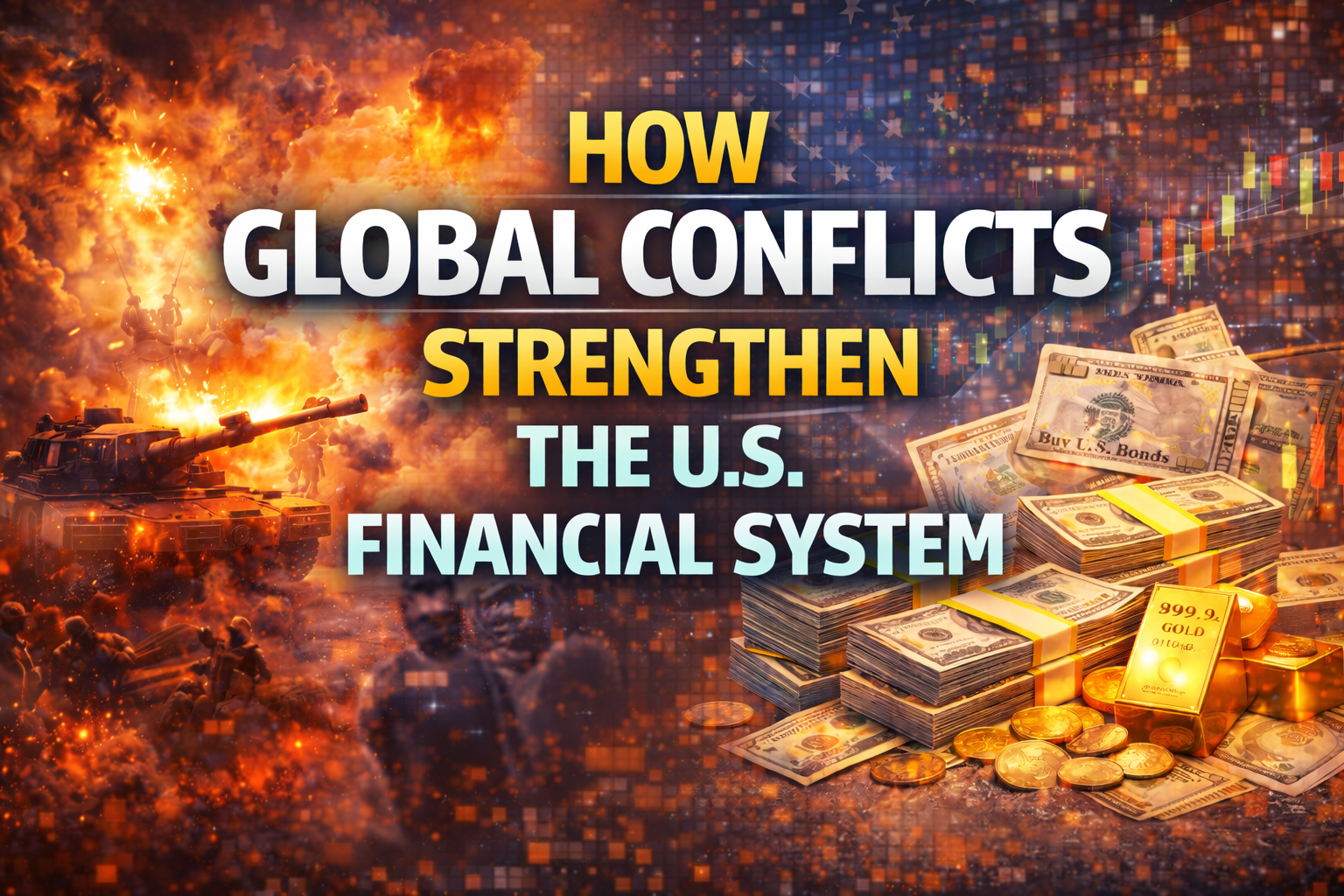
Discover how wars, geopolitical tensions, and global instability often reinforce the U.S. Financial System, driving capital flows, dollar demand, and market dominance.
Table of Contents
Introduction: Conflict and Capital Move Together
When global conflicts erupt, most people focus on human tragedy, political fallout, and economic damage. What often goes unnoticed is how financial power quietly shifts during these periods. History shows a consistent pattern: while much of the world struggles with uncertainty, the U.S. Financial System often emerges stronger.
This is not because conflict is beneficial, but because global instability reshapes investor behavior, capital flows, and currency demand in predictable ways. In 2026, with rising geopolitical tensions across multiple regions, this dynamic is once again shaping global finance.
Why Global Conflicts Trigger Capital Flight
During wars or geopolitical crises, uncertainty becomes the dominant force in markets. Investors hate uncertainty more than bad news, and when confidence erodes, capital seeks safety.
The United States offers:
- Deep and liquid financial markets
- Strong legal protections
- Transparent institutions
- Reliable settlement systems
As a result, money moves toward the U.S. during global shocks. This repeated behavior strengthens the U.S. Financial System almost automatically.
For historical capital-flow patterns:
https://www.investopedia.com/terms/c/capitalflight.asp
The U.S. Dollar as the Ultimate Safe Haven
Global conflicts consistently increase demand for the U.S. dollar. Even when tensions involve the United States politically, the dollar remains the preferred refuge.
Why?
- Most global trade is dollar-denominated
- Debt markets rely heavily on dollars
- Dollar liquidity is unmatched
During crises, investors don’t look for ideological alternatives—they look for liquidity and trust. This dynamic reinforces dollar demand and stabilizes the broader U.S. Financial System.
IMF data on reserve currencies:
https://www.imf.org/en/Topics/international-monetary-system
Treasury Markets Benefit From Global Instability
U.S. Treasury bonds are considered the safest large-scale asset in the world. When conflict escalates:
- Bond demand rises
- Yields often stabilize or fall
- Financing costs remain manageable
This allows the U.S. government to borrow at favorable terms even during turbulent periods. Few countries enjoy this privilege, and it remains a cornerstone advantage of the U.S. Financial System.
For U.S. debt and Treasuries:
https://www.cbo.gov/topics/federal-debt
Sanctions and Financial Infrastructure Power
Global conflicts increasingly involve sanctions, asset freezes, and trade restrictions. While controversial, these tools highlight the central role of U.S.-controlled financial infrastructure.
Key systems include:
- Dollar clearing networks
- SWIFT-linked settlements
- U.S.-based correspondent banking
As long as global finance depends on these rails, the U.S. Financial System maintains leverage even when geopolitical influence is contested.
Stock Markets and Crisis-Driven Reallocation
Contrary to intuition, U.S. equity markets often outperform during global instability relative to international peers.
Reasons include:
- Strong corporate earnings resilience
- Safe-haven capital inflows
- Lower political risk perception
When foreign markets face currency pressure or capital controls, U.S. assets become more attractive, reinforcing market depth and confidence.
Why Alternatives Struggle During Conflicts
Many discussions suggest that global conflicts accelerate de-dollarization. In reality, instability often delays it.
Alternative systems face problems:
- Limited liquidity
- Capital controls
- Political risk
- Weak legal enforcement
In crisis conditions, these weaknesses become more visible, not less. As a result, diversification away from the dollar slows, reinforcing the U.S. Financial System instead of weakening it.
Energy, Commodities, and Dollar Pricing Power
Conflicts frequently disrupt energy and commodity supplies. Yet most global commodity contracts remain priced in dollars.
This means:
- Rising trade volumes increase dollar demand
- Hedging markets stay U.S.-centric
- Settlement systems reinforce dollar usage
Even when producers and buyers dislike dollar exposure, the existing structure leaves few alternatives.
World Bank commodity insights:
https://www.worldbank.org/en/research/commodity-markets
The Psychological Dimension of Financial Trust
Finance is not just math—it’s belief.
During global conflicts:
- Trust in local systems erodes
- Confidence shifts to institutions with long track records
- Familiar systems dominate decision-making
The U.S. Financial System benefits from decades of crisis-tested credibility. This psychological edge cannot be replicated quickly by emerging alternatives.
The Cost of This Strength
While global conflicts often reinforce American financial dominance, this strength is not free of consequences.
Potential downsides include:
- Moral hazard from excessive capital inflows
- Asset bubbles in U.S. markets
- Political backlash from other nations
These risks highlight that dominance creates responsibility as well as advantage.
Could This Pattern Ever Break?
For the U.S. Financial System to weaken during global conflicts, multiple changes would need to occur simultaneously:
- A trusted alternative reserve currency
- Open and liquid foreign capital markets
- Global legal harmonization
- Sustained political stability elsewhere
At present, no system meets all these conditions at scale.
Final Verdict: Stability Wins in Unstable Times
Global conflicts do not strengthen the United States because of aggression or strategy alone. They strengthen it because financial systems reward stability, depth, and trust.
As long as global uncertainty persists, capital will continue flowing toward the strongest financial infrastructure available—and that remains the United States.
Final Thoughts
The uncomfortable truth of global finance is that instability redistributes power. While conflicts devastate economies and societies, they also reveal which systems the world trusts most when fear dominates.
For now, the U.S. Financial System remains the default anchor in a fractured global landscape.
👉 In a world of rising conflict, financial gravity still pulls toward stability.
The AI Boom vs Job Security debate is reshaping America’s workforce. Explore how artificial intelligence affects jobs, wages, skills, and long-term security for U.S. workers.