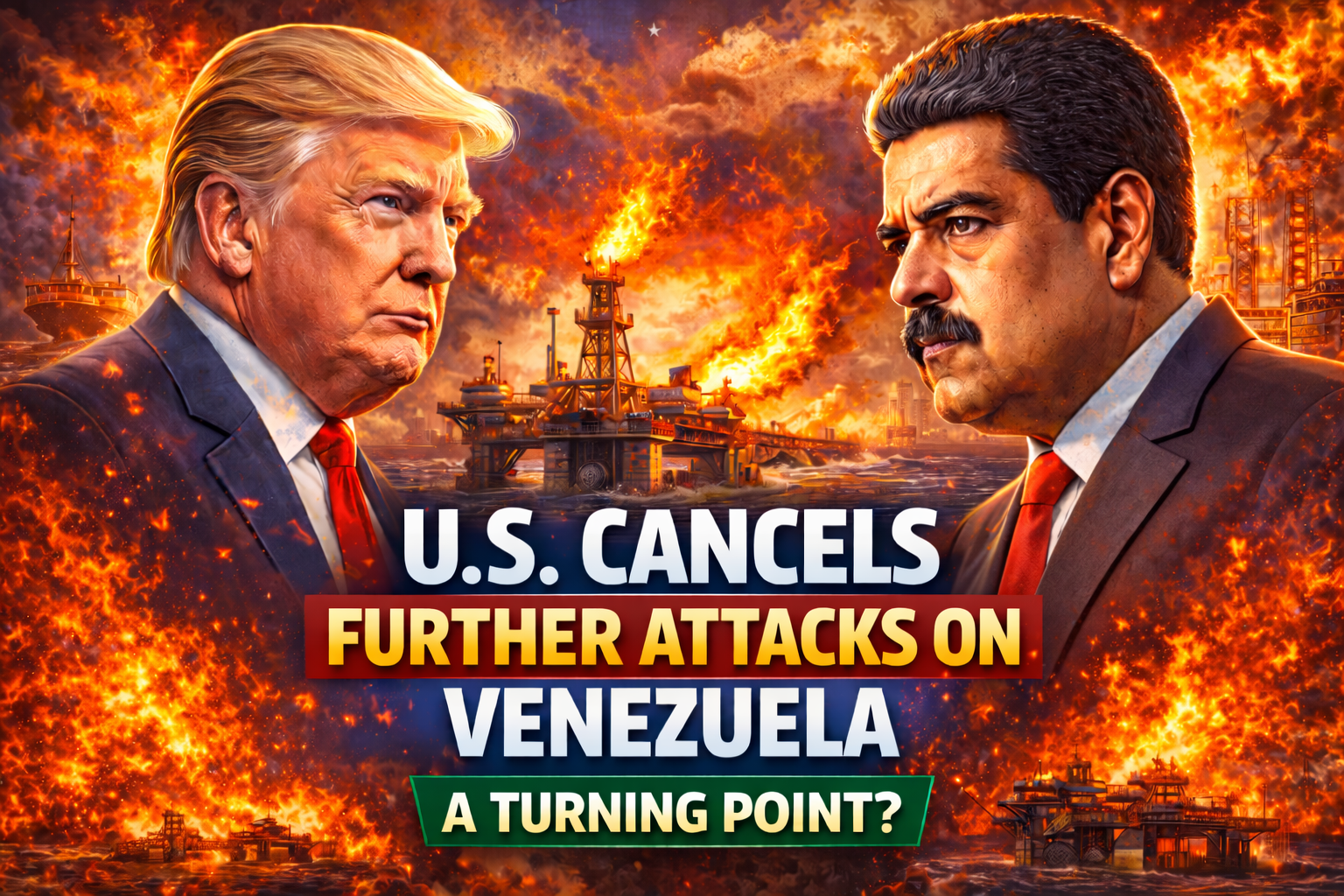
Explore how U.S. Cancels Further Attacks on Venezuela reshapes international politics, economic interests, and regional diplomacy after cooperation between the U.S. and Venezuela emerged as tensions eased.
Table of Contents
U.S. Cancels Further Attacks on Venezuela — What It Means for the World
On January 9, 2026, a remarkable shift occurred in international politics when the U.S. Cancels Further Attacks on Venezuela following improved cooperation with Caracas. The announcement by U.S. President Donald Trump marked a significant pivot away from military confrontation toward collaboration, especially in areas like political reform and energy investment. (Reuters)
This development is not just a headline — it has deep implications for global diplomacy, economic partnerships, and regional stability. In this blog, we unpack why this decision matters, how it came about, and what it could mean for the future.
The Background — What Happened Before the Decision
The United States and Venezuela had been in a state of heightened tension due to a series of dramatic events, beginning with a U.S. military operation that led to the capture of Venezuelan President Nicolás Maduro. While the legality and ethics of that raid sparked international debate, it set the stage for a complex negotiation between the two nations. (CBS News)
Tensions escalated to such an extent that the U.S. had prepared a second wave of attacks — a subsequent round of military action that many feared could trigger broader conflict in the Western Hemisphere. However, as Venezuela began releasing political prisoners and signaling cooperation, the Trump administration made a strategic decision to cancel further attacks. (Moneycontrol)
By choosing diplomacy over conflict at this moment, the U.S. took a path that surprised many observers and reshaped expectations about how conflicts can be de-escalated.
Why the U.S. Cancels Further Attacks on Venezuela Now
At its core, the decision hinged on Venezuela’s willingness to cooperate on several fronts, including political gestures such as releasing political prisoners — a sign interpreted by Washington as a move toward peace. (Moneycontrol)
President Trump publicly stated that this cooperation was a major factor in the decision, noting that meaningful dialogue had replaced the need for an imminent second military action. Beyond the peace gesture, the U.S. also highlighted the potential for economic cooperation, especially in Venezuela’s oil industry.
Under the terms of the renewed relationship:
- Major oil companies are expected to invest significant capital in Venezuelan energy infrastructure. (Reuters)
- Joint efforts on political transition and governance reform may be tabled in future negotiations.
This marked shift from confrontation to cooperation demonstrates that military options are no longer the default response when diplomatic openings arise.
Regional Diplomatic Repercussions
The decision to cancel further attacks on Venezuela resonated strongly across Latin America and beyond.
Many neighboring countries had voiced concern about potential destabilization caused by U.S. military actions. Nations such as Colombia and Mexico emphasized the need for a diplomatic solution, wary of escalating violence on borders and the humanitarian implications that could arise. Although some world leaders criticized earlier military operations, the pivot toward cooperation has been welcomed as a possible step toward stability. (Axios)
However, not all reactions were positive. Some governments, particularly those critical of U.S. foreign policy, expressed skepticism about America’s motives and the long-term implications of its involvement in Venezuelan affairs.
Economic Stakes — Oil and Investment
One of the most consequential aspects of this announcement lies in economics. Venezuela’s oil reserves are among the largest globally, and how they are managed has wide-ranging implications for global energy markets.
Following the announcement, the United States signaled that it would work closely with U.S. and international energy firms to invest and modernize Venezuela’s oil infrastructure. The expected capital influx — tentatively estimated to be in the tens of billions — has the potential to reshape not just Venezuela’s energy sector but global oil supply dynamics. (The Times of India)
For global markets, stability in Venezuelan oil production could ease supply concerns and contribute to price stability. In contrast, continued conflict and uncertainty might have heightened volatility in oil prices — something that has real economic consequences for energy-dependent economies around the world.
For more details on how oil markets respond to geopolitical shifts, see this Investopedia explainer on oil pricing: https://www.investopedia.com/terms/o/oil.asp
Legal and Congressional Response in the U.S.
Domestically within the United States, the decision to cancel further military strikes did not occur in a vacuum. Congress took steps to assert its role in foreign military engagements, with bipartisan efforts pushing back against unchecked executive action. For example, a Senate resolution aimed to limit the president’s war powers in relation to Venezuela required congressional approval for future military operations. (The Guardian)
This pushback reflects broader concerns about constitutional oversight and the balance of power in foreign policy decisions — an important dimension often overlooked in immediate headlines.
For additional context on how such mechanisms work, explore resources on the U.S. War Powers Resolution via the Library of Congress: https://www.congress.gov/
Humanitarian and Social Dimensions
Beyond political and economic angles, the situation has deep human implications.
The release of political prisoners in Venezuela, which triggered the cooperation that led the U.S. to cancel further attacks, has been interpreted by some as a positive step toward reconciliation and internal reform. While rights groups remain cautious about the broader human rights environment in the country, this gesture reflects the potential for humanitarian progress when military escalation is averted. (Moneycontrol)
Civil society organizations continue to monitor conditions on the ground, particularly the treatment of civilians caught up in political and military crosscurrents.
Global Geopolitical Impact
Globally, the shift has significant implications for international relations.
For decades, U.S.–Latin America relations have often been shaped by interventionist policies, both economically and militarily. By pulling back from additional attacks, the United States signaled that alternatives — including negotiation and economic engagement — can be viable even in high-stakes situations.
This recalibration could influence how other major powers approach conflict resolution in the future, pushing international norms toward cooperation rather than unilateral military escalation.
To understand the broader context of international law and military intervention, see the United Nations’ overview on sovereignty and conflict: https://www.un.org/en/sections/issues-depth/peace-and-security/
What Comes Next?
So what does the future hold after the U.S. Cancels Further Attacks on Venezuela?
The situation remains fluid. Clear opportunities now include:
- Expanded economic partnerships, especially in energy and reconstruction sectors
- Continued diplomatic talks on governance and transition
- Regional cooperation to prevent instability spillover
- Revisions in U.S. foreign policy doctrines toward measured engagement
Critically, both countries will have to demonstrate sustained commitment to dialogue and practical steps toward mutual goals. Only then can this moment be remembered as a true turning point rather than a temporary pause.
Conclusion
The decision by the United States to cancel further attacks on Venezuela marks an unexpected but potentially transformative moment in international relations. It underscores how diplomacy, cooperation, and strategic economic engagement can — in certain circumstances — take precedence over military action.
Whether this approach leads to lasting peace and stability will depend on future political commitments, economic investments, and the willingness of both nations to maintain open channels of communication.
What is already clear is that when diplomatic windows open, even long-standing conflicts can shift in dramatic and consequential ways — and the world watches closely when such shifts involve powerful nations and global interests.
Discover how Stability in Oil-Rich Nations influences global forex markets, oil prices, currency strength, investor confidence, and international capital flows.