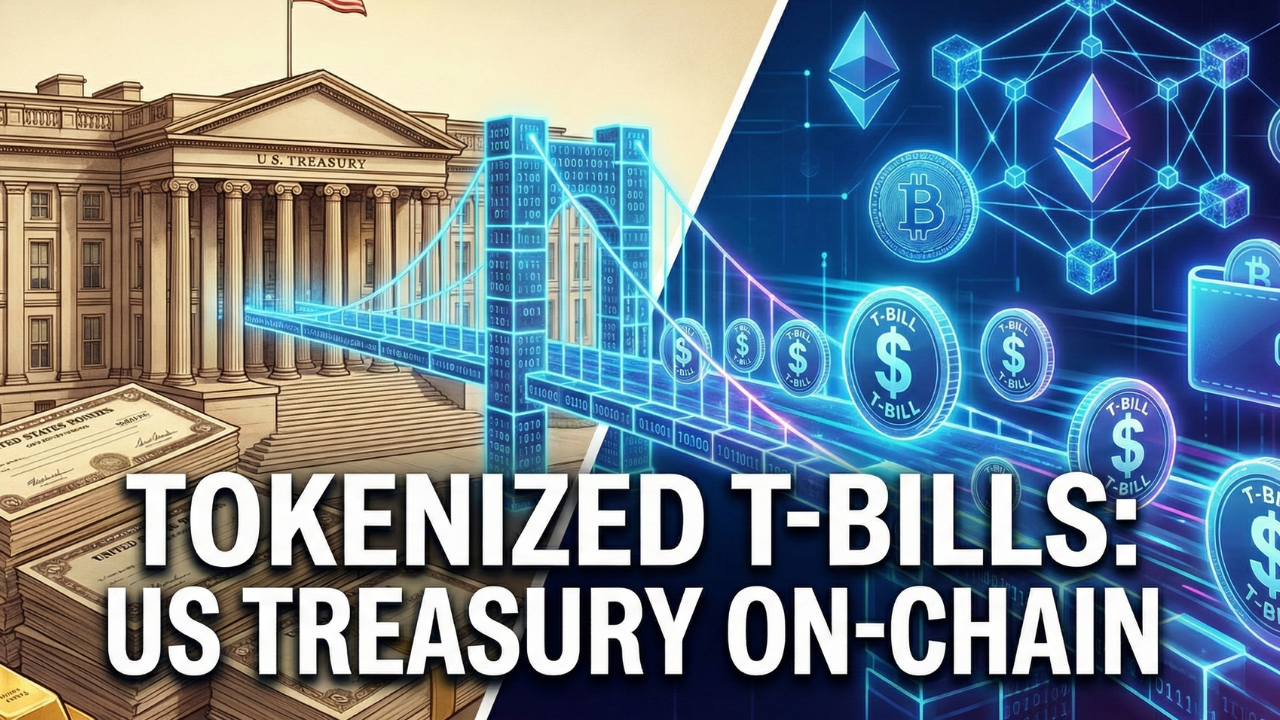
Tokenized T-Bills Discover the trillion-dollar shift in global finance with our deep dive into Tokenized T-Bills: How the US Treasury is Moving On-Chain. Learn how BlackRock, Franklin Templeton, and the US government are digitizing debt, offering 24/7 liquidity, and transforming your high-yield savings strategy in 2026.
Table of Contents
If you told a Wall Street banker in 2020 that the most exciting asset class of 2026 would be the humble US Treasury Bill, they would have laughed you out of the room. T-Bills were “boring.” They were the safe, sleepy bedrock of the old financial world—paper promises that paid a little interest and did nothing else.
But welcome to 2026. The “boring” bond market has undergone a radical technological upgrade. We are witnessing a financial revolution that is arguably bigger than the launch of Bitcoin ETFs. Tokenized T-Bills We are talking about Tokenized T-Bills: How the US Treasury is Moving On-Chain.
This isn’t just about banks saving money on backend paperwork. This is about a fundamental change in how money moves, how savings are stored, and how the entire US economy is beginning to run on blockchain rails. Whether you are a retail investor looking for better yield or a DeFi native, understanding Tokenized T-Bills: How the US Treasury is Moving On-Chain is the single most important lesson for your portfolio this year.
Tokenized T-Bills : The Problem with “Old” Money
Tokenized T-Bills: How the US Treasury is Moving On-Chain To understand why Tokenized T-Bills: How the US Treasury is Moving On-Chain is such a massive narrative, we have to look at how broken the old system was.
In the traditional world (let’s call it the “T+2” era), buying a Treasury Bill was a headache. You had to go through a broker. You had to wait for market hours (9:30 AM to 4:00 PM EST). If you sold your bills on a Friday afternoon, you wouldn’t see that cash settle in your account until Tuesday or Wednesday. In a digital world where information moves at the speed of light, money was still moving at the speed of a fax machine.
Tokenized T-Bills: How the US Treasury is Moving On-Chain solves this by turning a government bond into a digital token—similar to a stablecoin like USDC, but one that pays you interest directly.
The Major Players: Who is Building the Rails?
US Treasury In 2026, the market for tokenized Treasuries has exploded past the $10 billion mark, driven by titans of industry who have fully embraced the blockchain.
1. US Treasury : Franklin Templeton (The Pioneer)
Franklin Templeton was the first major asset manager to plant a flag in this territory with their Franklin OnChain U.S. Government Money Fund (FOBXX). They didn’t just dip a toe in; they built their entire record-keeping system on public blockchains like Stellar and Polygon. By doing this, they allowed investors to hold shares of a US Government fund directly in a digital wallet.
You can view their official fund details and on-chain mechanics here: Franklin Templeton OnChain Fund (FOBXX).
2. BlackRock & Securitize (The Titan)
If Franklin Templeton was the pioneer, BlackRock was the accelerant. Their BUIDL fund (BlackRock USD Institutional Digital Liquidity Fund) became the fastest-growing tokenized product in history. By partnering with Securitize, BlackRock enabled institutions to hold millions of dollars in Treasuries that could be transferred instantly, 24/7/365. This product essentially proved that Tokenized T-Bills: How the US Treasury is Moving On-Chain was not a fad, but the new standard for institutional collateral.
Why Your “Savings Account” is Obsolete
The most disruptive aspect of Tokenized T-Bills: How the US Treasury is Moving On-Chain is what it does to the traditional bank account.
For decades, Americans have left their money in checking accounts earning 0.01% interest because they needed “liquidity” (the ability to spend cash instantly). If they wanted 4% or 5% yields, they had to lock their money up in Certificates of Deposit (CDs) or buy bonds that were hard to sell quickly.
Tokenization breaks this tradeoff.
Because these T-Bill tokens trade on-chain, they are liquid 24/7. In 2026, we are seeing the rise of “Neobanks” and crypto-wallets that allow you to hold your entire life savings in Tokenized T-Bills. You earn the full government risk-free rate (currently hovering around 4-5%), but the moment you swipe your debit card for a coffee, the system automatically sells $5 worth of tokens in the background.
You get the yield of a bond with the liquidity of cash. This is the consumer-facing power of Tokenized T-Bills: How the US Treasury is Moving On-Chain.
The Tech Stack: How It Actually Works
It’s easy to say “it’s on the blockchain,” but the mechanics are fascinating.
- The Asset: The issuer (like BlackRock) buys real, physical US Treasury Bills and holds them in a master custody account at a bank (like BNY Mellon).
- The Mint: They mint a corresponding number of digital tokens on Ethereum, Solana, or Stellar.
- The Audit: Oracles and third-party auditors provide real-time “Proof of Reserve” to ensure that for every $1 digital token, there is $1 worth of T-Bills in the vault.
This transparency is a key selling point. In 2023, during the banking crisis, people worried if their regional bank actually had the money. With Tokenized T-Bills: How the US Treasury is Moving On-Chain, you can verify the collateral on the public ledger.
Integration with DeFi: The New “Money Legos”
The story doesn’t end with just holding the tokens. In 2026, Tokenized T-Bills: How the US Treasury is Moving On-Chain has become the pristine collateral of the Decentralized Finance (DeFi) world.
Traders are now using these tokens as collateral to trade derivatives, or borrowing against them to get leverage. Instead of keeping stablecoins (which pay zero interest) in a margin account, traders keep Tokenized T-Bills. This makes their capital efficient—it is earning yield even while it is sitting there acting as collateral.
This integration is reshaping the “yield curve” of the internet. It is forcing stablecoin issuers like Circle (USDC) and Tether (USDT) to adapt, as users no longer want “lazy” dollars; they want “working” dollars.
The Regulatory Moat
One cannot discuss Tokenized T-Bills: How the US Treasury is Moving On-Chain without mentioning the SEC. Unlike the chaotic “ICO boom” of 2017, this movement is heavily regulated. These products are registered securities. They require KYC (Know Your Customer) and AML (Anti-Money Laundering) checks.
This friction is actually a feature, not a bug. It has allowed massive pension funds and insurance companies—who are legally forbidden from touching “wild” crypto—to enter the space. For more on how the government views these assets, you can check recent filings and discourse on the Securities and Exchange Commission (SEC) website, which has increasingly had to clarify the rules for digital asset securities.
Risks: It’s Not All “Up Only”
While the narrative of Tokenized T-Bills: How the US Treasury is Moving On-Chain is bullish, you must remain aware of the risks:
- Smart Contract Risk: If the code governing the token has a bug, the link between the token and the real-world asset could be severed.
- De-pegging: While rare, if liquidity dries up on the blockchain side, the token might temporarily trade below its $1 NAV (Net Asset Value).
- Regulatory Chill: If the US government decides that public blockchains are not suitable for sovereign debt, they could force issuers to move to private, closed-loop ledgers, killing the DeFi utility.
How to Get Involved
If you are an accredited investor in the US, or a retail investor in certain eligible jurisdictions, you can buy these tokens directly through platforms like Securitize or Franklin Templeton’s Benji app.
For the average retail user in 2026, the easiest path is often through “wrapper” products—DeFi protocols that buy the institutional tokens and fractionalize them for smaller investors. (Always do your own due diligence and ensure the protocol is audited).
Conclusion: The Inevitable Merge
The distinction between “Crypto” and “Traditional Finance” is evaporating. Tokenized T-Bills: How the US Treasury is Moving On-Chain is the bridge that connects these two worlds.
We are moving toward a future where every asset—from your house deed to your government bonds—lives on a shared, global ledger. The US Treasury moving on-chain isn’t just an experiment; it is the first step in a complete re-architecture of the global economy.
The days of T+2 are over. The era of T+0 is here. And for the savvy investor, the opportunities in this transition are just getting started.
understanding the DA : click here