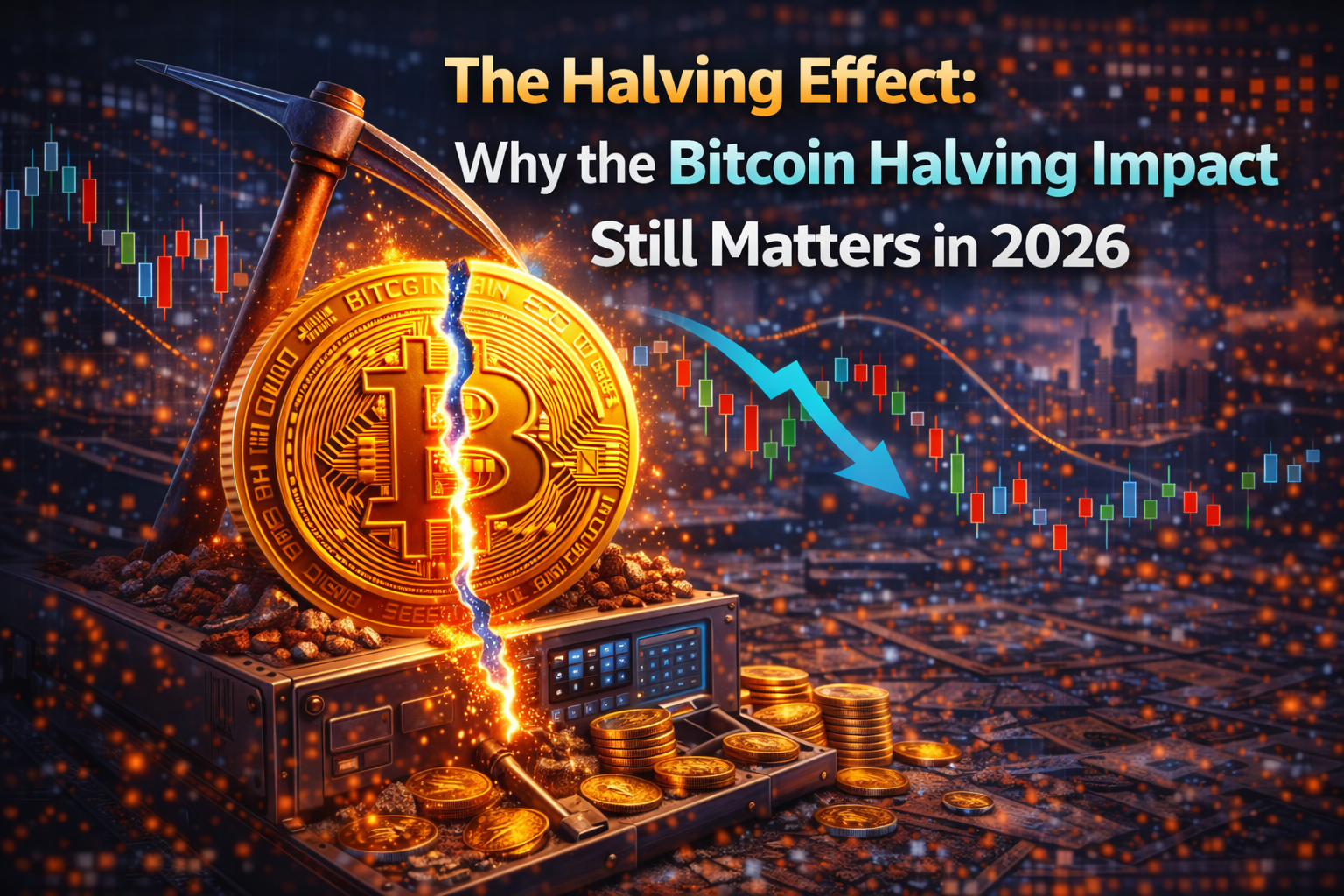
Is the four-year cycle dead? Explore the Bitcoin halving impact on price, miner profitability, and the 2026 market landscape as institutional demand takes over.
Table of Contents
If you’ve been around the crypto block for a while, you know the drill. Every four years, the “Halvening” arrives, the block reward drops, and the internet fills with predictions of a parabolic move to the moon. But as we sit here in early 2026, the conversation has shifted. We aren’t just looking at a simple supply-and-demand chart anymore. We are looking at a market that has matured, institutionalized, and—dare I say—gotten a little more complicated.
The Bitcoin halving impact has historically been the heartbeat of the crypto market. It’s the pre-programmed mechanism that ensures digital scarcity, making Bitcoin more like “digital gold” and less like the fiat currency sitting in your checking account. However, after the April 2024 halving slashed miner rewards to 3.125 BTC, the ripple effects didn’t follow the exact script many expected.
Instead of an immediate, explosive rally, we’ve seen a grinding, institutional-led expansion. For the average investor, this can feel frustrating. You were promised a rocket ship, and instead, you got a very efficient, very expensive train. In this post, we’re going to peel back the layers of how the 2024 halving is still influencing the market today and what it means for the road to 2028.
1. The Supply Shock: Mechanical Scarcity in Action
At its core, the Bitcoin halving impact is a supply-side event. Before the 2024 halving, miners were producing roughly 900 new BTC every single day. Today, that number is down to 450. On paper, cutting the daily “inflation” of an asset in half should lead to a price spike—provided demand stays the same.
But here’s the kicker: demand didn’t stay the same. It exploded. With the approval of spot ETFs in early 2024, the amount of Bitcoin being sucked out of the market by Wall Street giants often exceeds the 450 BTC being produced daily.
- Exchange Reserves: We are currently seeing exchange balances at multi-year lows.
- Institutional Absorption: Funds like BlackRock and Fidelity have created a “vacuum” effect where the circulating supply is shrinking much faster than the halving alone would suggest.
- The “HODL” Mentality: Despite the price fluctuations of late 2025, long-term holders haven’t budged. The percentage of supply that hasn’t moved in over a year is at record highs.
2. Miner Capitulation and the “Survival of the Fittest”
If the halving is a celebration for investors, it’s a stress test for miners. When your revenue is cut in half overnight, your electricity bill doesn’t follow suit. This is where the Bitcoin halving impact gets “messy” for the network.
Bitcoin Halving Impact In the months following the 2024 event, we saw a massive wave of consolidation. Smaller, inefficient mining farms that were running older hardware simply couldn’t keep the lights on. They were forced to shut down or sell their operations to the “big fish” like MARA or Riot Platforms.
What this means for the network:
- Increased Centralization: The top mining pools now control a larger share of the total hash rate than ever before.
- Efficiency Gains: The miners who survived are the ones using renewable energy and the latest ASIC chips.
- Hash Rate Resilience: Surprisingly, even with the reward cut, the total hash rate hit new all-time highs in 2025. This proves that the network is more secure than ever, even if it’s more expensive to maintain.
3. Is the Four-Year Cycle Dead?
Bitcoin Halving Impact For a decade, you could almost set your watch by the Bitcoin cycle: a year of accumulation, a halving year, a “parabolic” year, and a bear market year. But 2026 is challenging this “law” of crypto.
Many analysts, including those at Bitwise, have suggested that the four-year cycle might be breaking. Instead of a sharp peak and a 80% crash, we are seeing a “lengthening” of the cycle.
Why? Because the market is now driven by macroeconomic factors—like Federal Reserve interest rate cuts and global liquidity—more than the halving itself. When the “big money” enters the room, they don’t care about a 50% reward cut as much as they care about the DXY index or the strength of the dollar.
4. The 2026 Outlook: Looking Toward the 2028 Halving
As we navigate through 2026, the Bitcoin halving impact is shifting from a “price driver” to a “narrative foundation.” We are already starting to look ahead to the next halving in early 2028, which will drop the reward to 1.5625 BTC.
Bitcoin Halving Impact By then, nearly 97% of all Bitcoin will have been mined. The “new” supply will be so small that it will barely be a blip on the daily trading volume. This suggests that the future of Bitcoin’s price will be determined almost entirely by its status as a global reserve asset.
Key 2026 Metrics to Watch:
- ETF Inflow Persistence: If the daily buy-side from ETFs remains above the daily issuance of 450 BTC, the “supply squeeze” will eventually break the current resistance levels.
- Transaction Fee Revenue: As block rewards continue to drop, miners will rely more on transaction fees. If network activity (like Ordinals or Layer 2s) stays high, the network remains sustainable.
- Corporate Treasuries: Keep an eye on companies following the MicroStrategy model. Every corporate balance sheet that adds BTC is a permanent removal of supply from the market.
Frequently Asked Questions (FAQ)
What exactly happens during a Bitcoin halving?
Bitcoin Halving Impact : The Bitcoin halving is a pre-programmed event that happens every 210,000 blocks (roughly every four years). It cuts the reward that miners receive for verifying transactions in half. This reduces the rate at which new Bitcoins are created, ensuring the total supply never exceeds 21 million.
Does the halving always make the price go up?
Bitcoin Halving Impact Historically, yes. But it’s not an instant switch. Usually, the “supply shock” takes 6 to 18 months to fully reflect in the price. In 2024, the impact was slightly different because the price hit a new all-time high before the halving occurred, largely due to ETF demand.
Why are miners important if the reward keeps dropping?
Bitcoin Halving Impact Miners are the backbone of the network; they secure it by processing transactions. As the block reward (the “subsidy”) drops toward zero by the year 2140, miners will be paid entirely through transaction fees paid by users.
How many Bitcoins are left to mine?
As of early 2026, over 19.8 million Bitcoins have already been mined. Only about 1.2 million remain to be produced over the next 114 years. This extreme scarcity is the primary reason many call it “digital gold.”
Will the 2028 halving be as significant as the previous ones?
Bitcoin Halving Impact Economically, each halving becomes less significant in terms of new supply (because the absolute number of coins being cut is smaller). However, psychologically and narratively, it reinforces the scarcity of the asset, which can drive significant market interest.
Conclusion: The Long Game of Scarcity
The Bitcoin halving impact isn’t just a gimmick to pump the price; it’s the bedrock of the most predictable monetary system ever created. While the wild “boom and bust” cycles of the early 2010s might be smoothing out into a more mature, institutional grind, the underlying math hasn’t changed.
As an investor in 2026, the goal isn’t to time the “halving pump.” The goal is to understand that you are holding an asset that is becoming mathematically scarcer every single day while the world’s fiat currencies are doing the exact opposite.