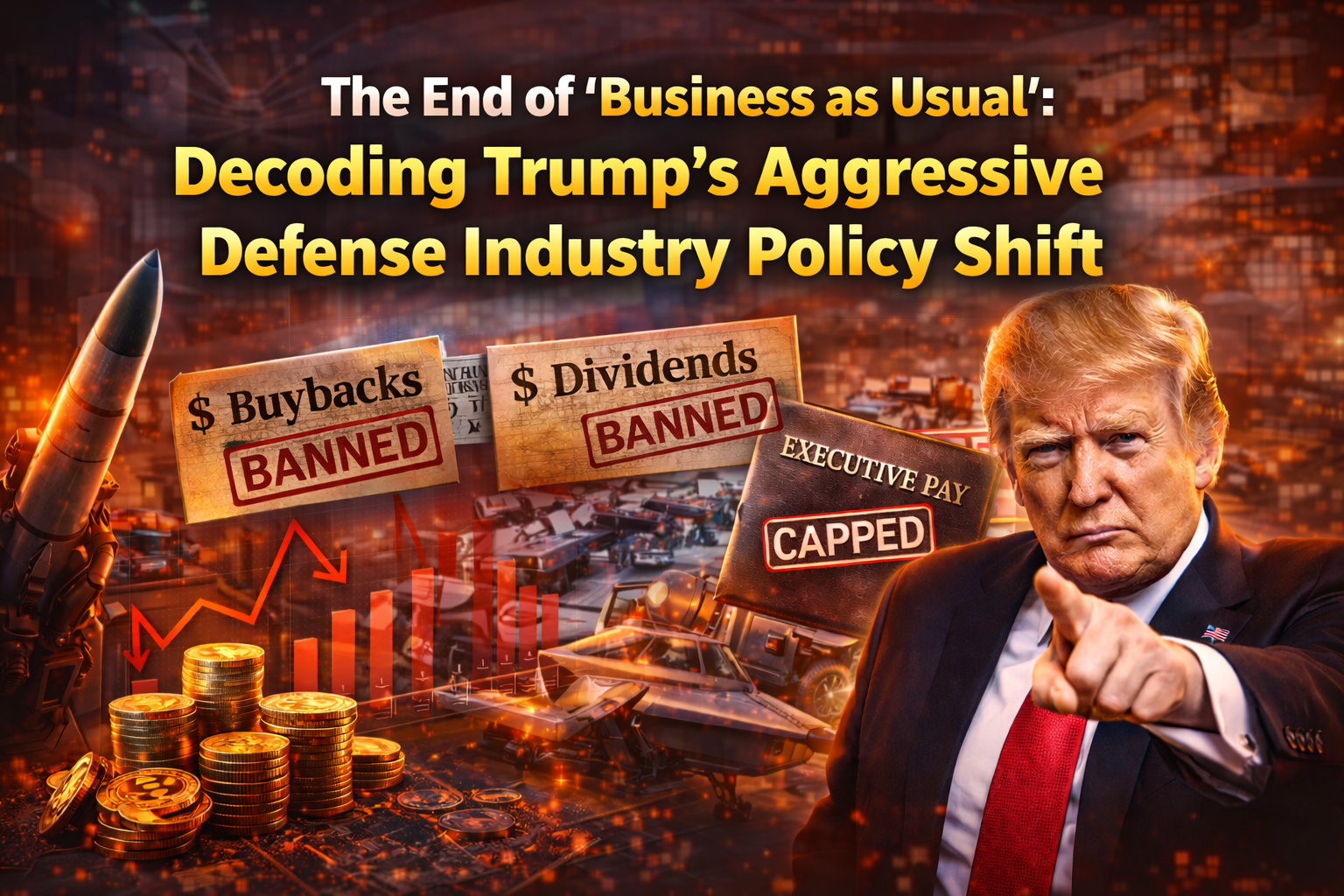
Trump’s new executive order targets defense contractor buybacks and dividends. Learn how this defense industry policy shift impacts stocks, CEOs, and your portfolio.
Table of Contents
If you’ve been following the defense sector for a while, you know it’s usually one of the most predictable corners of the stock market. You get steady government contracts, a reliable dividend, and the occasional stock buyback to keep shareholders happy. But this week, the game changed. President Donald Trump didn’t just rattle the cage; he essentially locked the kitchen door and told the defense giants they can’t have dessert until they finish their homework.
I’m talking about the “Prioritizing the Warfighter in Defense Contracting” executive order. It’s a massive defense industry policy shift that is sending shockwaves from the Pentagon to Wall Street. As a finance writer, I’ve seen administration changes before, but the bluntness here is something else. The message is clear: if you aren’t delivering “superior products” on time and on budget, your days of pampering shareholders with excess cash are over.
For the average investor, this is a “pull over to the side of the road” moment. We’ve moved beyond political rhetoric into a new era where corporate financial engineering is being directly tied to military production speed.
The Hammer Drops: Buybacks and Dividends Under Fire
defense industry policy shift : The core of this new policy is a direct strike on capital allocation. For years, the big “Primes”—companies like Lockheed Martin, Northrop Grumman, and RTX (formerly Raytheon)—have used their massive cash flows to reward investors. It was a winning formula. But the administration is now arguing that this money should have been spent on the factory floor instead of the trading floor.
In a series of pointed Truth Social posts and a subsequent Executive Order (EO), Trump warned that “effective immediately,” companies found to be underperforming would be barred from issuing dividends or repurchasing shares.
- The “Underperformer” Tag: This isn’t just about general vibes. The Secretary of Defense, Pete Hegseth, now has the power to identify specific firms that are falling behind on delivery schedules or failing to invest in production capacity.
- The Freeze: Once a company is tagged, their ability to return capital to shareholders is frozen until they prove they’ve “rectified” the production delays.
- The Raytheon Example: Trump specifically called out RTX, suggesting they’ve been the “least responsive” and most aggressive with shareholder payouts while falling behind on volume.
Why Now? The Push for the “Dream Military”
You might wonder why a Republican administration—traditionally the champions of the free market—is suddenly micro-managing how private companies spend their money. The answer lies in the administration’s ambitious goal: a $1.5 trillion defense budget by 2027.
The President is pitching this as a “Dream Military” initiative. But there’s a catch. He doesn’t want to fund this growth solely through government borrowing or taxpayer money. He wants the defense industrial base to use its own profits to build “NEW and MODERN Production Plants.” defense industry policy shift.
Essentially, the government is saying: “We are giving you record-breaking contracts, but you must use that money to expand your capacity first. Shareholders come second.” It’s a forced reinvestment strategy that we haven’t seen at this scale since the World War II era.
The $5 Million Ceiling: A New Reality for CEOs
It wasn’t just the shareholders who got a wake-up call; it was the corner office. The executive order includes provisions that link executive compensation directly to operational metrics.
In 2024, the CEOs of the top five defense firms were pulling in packages ranging from $18 million to over $24 million. Trump’s new stance suggests a cap of $5 million for executives at underperforming firms.
How Pay Will Be Measured Now:
- Operational over Financial: Instead of being rewarded for a rising stock price (often driven by buybacks), bonuses will now be tied to on-time delivery and increased production volume.
- Base Salary Freezes: The Secretary of Defense can now cap base salaries at current levels (adjusted only for inflation) until performance metrics are met.
This is a fundamental change in corporate governance for the sector. It turns defense CEOs into something more akin to project managers for the state, where their personal wealth is tied to how many missiles roll off the assembly line each month.
Market Reaction: Short-Term Pain vs. Long-Term Stability
When the news broke, defense stocks like Lockheed and Northrop took a dive. Investors hate uncertainty, and the idea of a dividend being cancelled is enough to trigger a sell-off in any sector.
However, we need to look at the financial metrics from a different angle. If these companies are forced to stop buybacks and instead build massive, modern production facilities, they are essentially “moating” their business. They are becoming more efficient and more capable of handling the massive $1.5 trillion in spending that is being proposed.
As noted by analysts at Breaking Defense, this policy creates more questions than answers in the short term, particularly regarding how “underperformance” is defined. But for a long-term investor, a company that is forced to modernize its infrastructure might actually be a safer bet than one that is slowly hollowing itself out to keep a dividend streak alive.
Navigating the Supply Chain Ripple Effect
This defense industry policy shift isn’t just for the big guys. The EO specifically mentions that these production pressures will flow down to subcontractors and vendors.
If you are a smaller firm supplying components to Boeing or General Dynamics, expect your contracts to start including much stricter “on-time” clauses. The “Primes” are going to be under immense pressure to perform, and they aren’t going to take the fall alone. They will be looking to their supply chain to tighten up or face their own penalties.
Frequently Asked Questions (FAQ)
What exactly is the “defense industry policy shift”?
It refers to a new executive order that ties a defense company’s ability to pay dividends, conduct stock buybacks, and pay high executive salaries directly to their production performance and investment in manufacturing capacity.
Can the President actually stop a private company from paying dividends?
While legal experts are debating the enforceability, the government can write these restrictions into new contracts or use the Defense Production Act and other regulatory levers to penalize companies that don’t comply, effectively making it “voluntarily mandatory.”
Which companies are most affected by this order?
Major publicly traded contractors like Lockheed Martin (LMT), RTX (RTX), Northrop Grumman (NOC), and General Dynamics (GD) are the primary targets, as they have historically high levels of shareholder returns and executive pay.
How does this affect defense stock dividends?
If a company is identified as “underperforming” by the Secretary of Defense, their dividend could be frozen or prohibited until they meet specific delivery and investment benchmarks. This makes the dividend “contingent” rather than guaranteed.
What is the goal of the $1.5 trillion defense budget?
The administration aims to build what they call a “Dream Military,” significantly expanding production for naval ships, modern aircraft, and missile systems to ensure national security in what they describe as “very troubled times.”
Conclusion: A New Era of Accountability
We are witnessing a profound shift in how the U.S. government views its relationship with the private sector. The defense industry policy shift under the Trump administration is a bold, controversial attempt to trade short-term shareholder gains for long-term industrial might.
Whether you agree with the tactics or not, the “buyback era” for defense is, at the very least, on a forced hiatus. As an investor, the strategy is no longer just about tracking earnings per share; it’s about tracking delivery schedules. If these companies can successfully pivot from financial engineering back to “heavy metal” manufacturing, they may emerge stronger—but the road there is going to be incredibly bumpy.
understanding the DA : click here