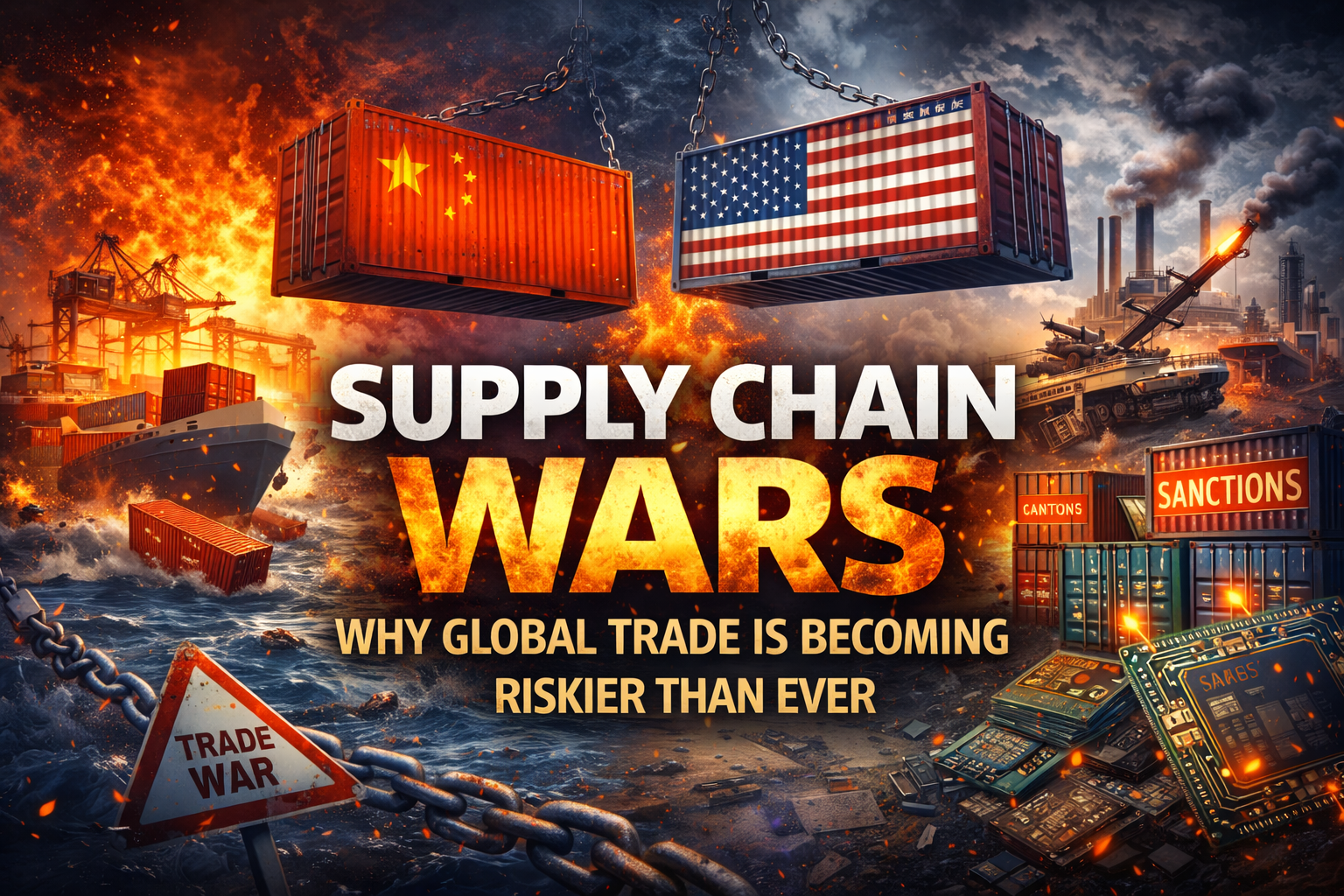
Explore how Supply Chain Wars are reshaping global trade, increasing costs, disrupting businesses, and making international commerce riskier in a divided world economy.
Table of Contents
Introduction: Global Trade Is No Longer Neutral
For decades, global trade was built on a simple assumption: countries would cooperate because it benefited everyone. Companies optimized supply chains for efficiency, low costs, and speed, assuming borders would remain open and trade routes reliable.
That assumption is now breaking down.
Today, Supply Chain Wars are turning global trade into a strategic battleground. Governments are interfering in trade flows, companies are rethinking where they source goods, and geopolitical tensions are reshaping how products move across the world.
What was once a purely economic system is now deeply political — and far more fragile.
What Are Supply Chain Wars?
Supply Chain Wars refer to the growing competition among nations to control critical supply chains such as semiconductors, energy, food, rare earth minerals, pharmaceuticals, and technology components.
Instead of focusing on efficiency, countries are prioritizing:
- National security
- Strategic independence
- Economic resilience
- Political leverage
This shift has transformed supply chains from cost-saving tools into instruments of power.
How the World Entered the Era of Supply Chain Conflict
The roots of today’s supply chain tensions go back several years.
Key Triggers
- Pandemic-era shutdowns that exposed supply vulnerabilities
- Trade wars and tariff battles
- Geopolitical conflicts and sanctions
- Rising nationalism and protectionism
- Overdependence on a few manufacturing hubs
When countries realized that essential goods could be cut off during crises, trust in the global trade system began to erode.
Why Supply Chain Wars Make Global Trade Riskier
Global trade thrives on predictability. Supply Chain Wars destroy that predictability.
Here’s how risk increases:
1. Political Decisions Override Market Logic
Trade routes can be disrupted overnight by sanctions, export bans, or diplomatic breakdowns — regardless of business contracts.
2. Concentration Risk Becomes a Threat
Heavy reliance on single regions for key components makes companies vulnerable to geopolitical shocks.
3. Costs Replace Efficiency
Redundant suppliers, reshoring, and diversification raise costs and reduce profit margins.
This is why businesses now treat geopolitical risk as seriously as financial risk.
The Weaponization of Trade and Supply Chains
One of the most dangerous aspects of Supply Chain Wars is the weaponization of trade.
Countries now use:
- Export controls
- Technology restrictions
- Sanctions on logistics and shipping
- Access denial to critical raw materials
These tools can cripple industries without firing a single shot.
For example, restricting access to advanced technology or energy resources can weaken entire economies over time.
Learn more about export controls:
https://www.investopedia.com/terms/e/export-controls.asp
Impact on Businesses and Corporations
Multinational companies are among the biggest casualties.
Rising Challenges
- Unstable supplier relationships
- Higher inventory costs
- Longer delivery times
- Increased compliance and regulatory burden
Many companies are forced to redesign supply chains built over decades — a costly and complex process.
Some firms are shifting production closer to home, while others diversify across multiple countries, even if it reduces efficiency.

Consumers Ultimately Pay the Price
While supply chain conflicts often sound abstract, their impact reaches ordinary people quickly.

Consumers feel it through:
- Higher product prices
- Fewer choices
- Delayed product launches
- Reduced quality in cost-cutting efforts
Inflationary pressures rise when supply chains become fragmented and inefficient — one of the hidden costs of Supply Chain Wars.
Developing Economies Face Greater Risks
Not all countries are equally prepared for this new trade environment.
Challenges for Developing Nations
- Heavy dependence on exports
- Limited bargaining power
- Vulnerability to sanctions and trade shifts
- Less diversified economies
When supply chains realign, smaller economies can be sidelined or exposed to sudden economic shocks.
For insight into global trade risks:
https://www.worldbank.org/en/topic/trade
Technology and Supply Chain Wars
Technology has become the frontline of supply chain competition.
Semiconductors, AI hardware, batteries, and advanced manufacturing equipment are now considered strategic assets. Governments want control not just over production, but over design, data, and intellectual property.
This has led to:
- Investment restrictions
- Forced localization
- Tech decoupling between major economies
The result is a fragmented global technology ecosystem — slower innovation and higher costs for everyone.
Energy and Food Supply Chains Under Pressure
Supply Chain Wars are not limited to factories and chips.
Energy
- Oil and gas routes are increasingly politicized
- Sanctions disrupt global energy flows
- Energy security now shapes foreign policy
Food
- Export bans during shortages
- Fertilizer supply disruptions
- Climate shocks worsen fragility
When essential resources become political tools, global stability weakens.
Learn how energy politics affects trade:
https://www.iea.org/topics/energy-security
Why Global Trade Is Losing Its Safety Net
Previously, international institutions helped manage disputes and stabilize trade.
Today:
- Multilateral cooperation is weakening
- Trade rules are selectively enforced
- Trust between major economies is declining
This erosion removes the safety net that once protected global commerce from political shocks, making Supply Chain Wars even more dangerous.
Can Businesses Adapt to This New Reality?
Companies are learning that the old “cheapest supplier wins” model no longer works.
New Strategies Include:
- Multi-country sourcing
- Regional supply chains
- Strategic stockpiling
- Political risk assessment
Adaptation is possible, but it requires higher investment and constant monitoring of global events.
The Long-Term Economic Consequences
In the long run, supply chain conflicts may lead to:
- Slower global growth
- Persistent inflation
- Reduced efficiency
- Increased inequality between nations
While some countries may gain short-term advantages, the global economy as a whole becomes less productive.
This is the paradox of Supply Chain Wars — they aim to increase security but often reduce overall resilience.
What This Means for the Future of Global Trade
Global trade is not ending, but it is changing fundamentally.
The future will likely involve:
- More regional trade blocs
- Fewer globally integrated supply chains
- Higher emphasis on strategic autonomy
- Permanent geopolitical risk premiums
Businesses, investors, and governments must accept that trade will remain unstable in a fragmented world.
Final Verdict: A Riskier, More Political Trade System
Supply Chain Wars mark the end of an era where economics alone drove global trade decisions.
Trade is now shaped by power, security, and politics as much as by cost and efficiency.
For companies, this means higher risks and constant adaptation.
For consumers, it means higher prices and fewer choices.
For governments, it means balancing security with economic growth.
Final Thoughts
The global economy is entering a period where reliability can no longer be taken for granted.
Understanding Supply Chain Wars is essential for anyone trying to make sense of rising prices, business disruptions, and shifting global alliances.
In a world where supply chains are weapons and trade is strategy, caution — not efficiency — has become the new rule of global commerce.
👉 Global trade is still moving, but it is moving through a minefield.
Why Central Banks Are Trapped Between Inflation and Recession as rising prices, slowing growth, and fragile economies force policymakers into impossible decisions worldwide.