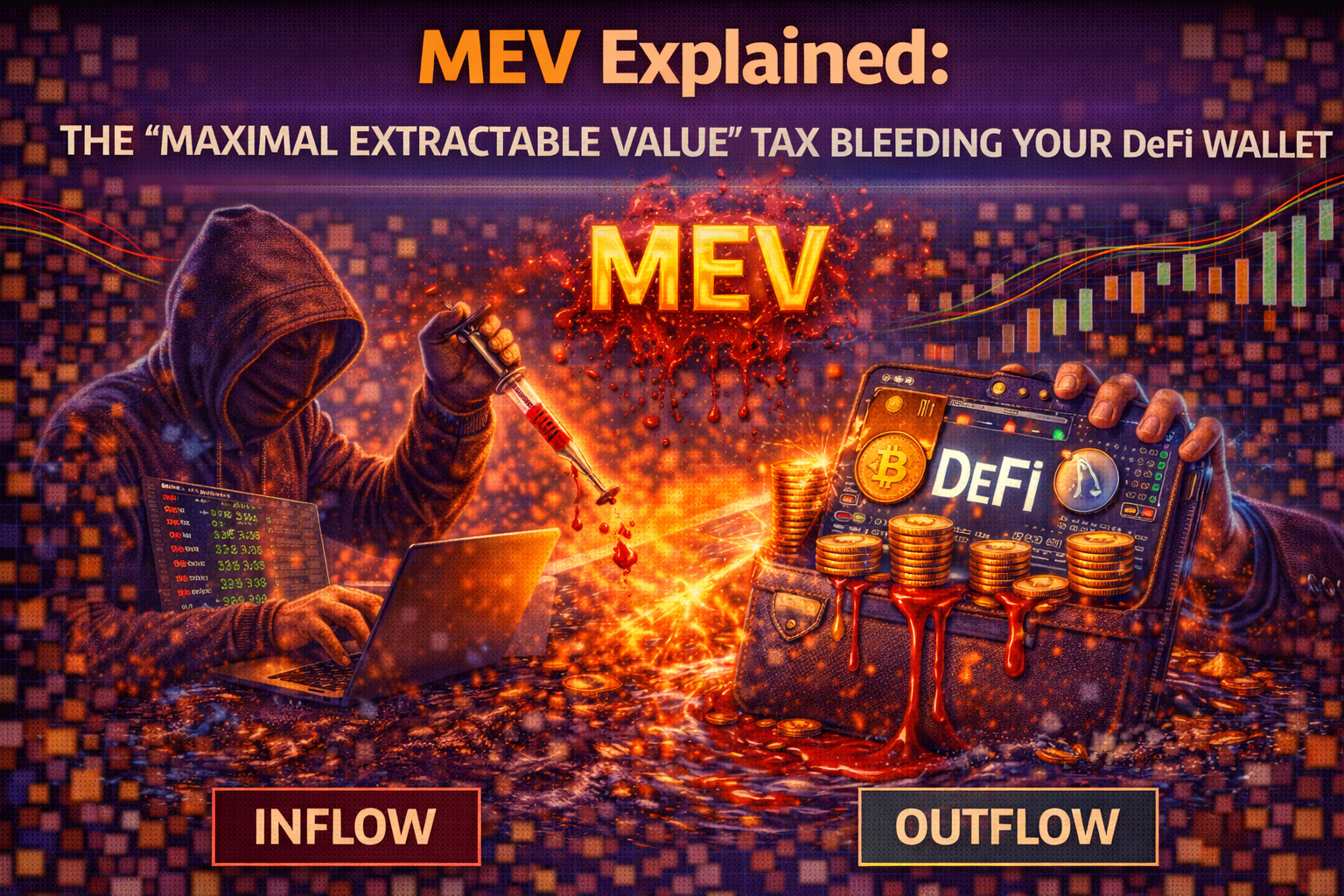
Tired of losing money on swaps? Learn what Maximal Extractable Value (MEV) is, how sandwich attacks work, and how to stop these invisible bots from draining your crypto profits.
Table of Contents
I still remember the first time I got “sandwiched.” I was trying to buy a promising new DeFi token on Uniswap. I set my slippage to 5% because the market was volatile and I just wanted the trade to go through. I clicked swap, the transaction confirmed, and I eagerly checked my wallet.
I had 4% less tokens than I expected.
At first, I thought the price just moved naturally. But when I looked at the block explorer, I saw something suspicious. In the exact same block, someone bought the token right before me (driving the price up) and sold it immediately after me (locking in a profit).
I had just been robbed by a robot.
This wasn’t a hack. It wasn’t a glitch. It was a feature of the blockchain called Maximal Extractable Value, or MEV for short.
If you trade on Decentralized Exchanges (DEXs) in 2026, Maximal Extractable Value is the invisible tax you pay for the privilege of using the blockchain. It is a billion-dollar industry of “searchers,” “builders,” and bots that prey on regular users like you and me. Most people don’t even know it exists, yet it syphons millions of dollars from retail investors every single week.
In this deep dive, we are going to shine a light on the dark forest of Ethereum. We will explain exactly what Maximal Extractable Value is, break down the mechanics of the dreaded “sandwich attack,” and most importantly, show you how to protect your portfolio from being eaten alive.
What is Maximal Extractable Value (MEV)?
To understand Maximal Extractable Value, you first have to understand how a blockchain actually works.
When you submit a transaction (like swapping ETH for USDC), it doesn’t happen instantly. It goes into a waiting room called the Mempool (Memory Pool). It sits there, public and visible to everyone, waiting for a Validator (formerly Miners) to pick it up and add it to the next block.
Here is the kicker: The Validator has god-like power over that block. They can decide:
- Which transactions get included.
- Which transactions get excluded.
- The specific order of the transactions.
Maximal Extractable Value is the profit a validator (or a bot paying the validator) can make by manipulating this order.
Originally, this was called “Miner Extractable Value.” But since Ethereum switched to Proof-of-Stake, the term evolved to Maximal Extractable Value to reflect that it’s not just miners doing it. It is an inherent property of any blockchain where transaction ordering is not fixed.
Think of it like a ticket scalper who can see you standing in line for a concert. Because they control the line, they can cut in front of you, buy the ticket for $100, and force you to buy it from them for $110. That $10 profit is the Maximal Extractable Value.
The Dark Forest: How Searchers Hunt You
You might be thinking, “Do validators really sit there watching my $500 trade?”
No. They outsource the dirty work to “Searchers.” Searchers are sophisticated developers who run high-frequency bots. These bots scan the Mempool 24/7. They simulate every pending transaction to see if there is any Maximal Extractable Value to be found.
If your transaction creates a price movement (which almost all trades do), it creates an opportunity. The Searcher’s bot constructs a bundle of transactions—their trade + your trade—and bribes the Validator to include them in a specific order.
This automation means that Maximal Extractable Value isn’t a rare occurrence. It is a systematic, industrial-scale extraction of value from the DeFi ecosystem.
The Sandwich Attack: The Most Common MEV Strategy
The most notorious form of Maximal Extractable Value extraction is the Sandwich Attack. This is likely how you have lost money without realizing it.
Here is the anatomy of a Sandwich:
- The Bait: You submit a transaction to buy 10 ETH worth of PEPE coin. You set a slippage tolerance of 2%. This tells the network, “I am willing to buy this even if the price goes up by 2%.”
- The Front-Run (Bun #1): A bot sees your transaction in the Mempool. It pays a higher gas fee to jump in front of you. It buys PEPE, pushing the price up by exactly 1.9%.
- The Victim (Meat): Your transaction executes. You buy the PEPE at the inflated price (1.9% higher). You get fewer tokens than you wanted, but because your slippage was 2%, the trade succeeds.
- The Back-Run (Bun #2): The bot immediately sells the PEPE it bought. Since your massive buy pushed the price up even further, the bot sells at a profit.
The bot made risk-free money. You paid a higher price. That difference is the Maximal Extractable Value extracted from your wallet.
Arbitrage: The “Good” Side of MEV
To be fair, not all Maximal Extractable Value is malicious. Some of it actually helps the market.
This is primarily seen in Arbitrage. Let’s say the price of Ethereum is $3,000 on Uniswap but $3,005 on SushiSwap.
- A bot notices this discrepancy.
- It buys on Uniswap and sells on SushiSwap.
- This action equalizes the prices across the market.
The profit the bot makes is technically Maximal Extractable Value, but in this case, the bot is providing a service: price efficiency. Without these MEV bots, DeFi markets would be disjointed and inefficient. However, for the average user, the distinction between “good MEV” and “bad MEV” doesn’t matter much. They just want to stop losing money.
The Cost of Business: How Much is Lost?
The scale of Maximal Extractable Value is staggering. Since the DeFi summer of 2020, over $1 billion has been extracted from users on Ethereum alone.
During periods of high volatility (like the meme coin mania of 2024 or the bull run of 2025), Maximal Extractable Value spikes. Why? Because users are frantic. They increase their slippage tolerance to 10% or 20% just to get their trades through. This is like walking into a shark tank covered in barbecue sauce. High slippage is the number one trigger for Maximal Extractable Value bots. The higher your slippage, the more room you give the bot to manipulate the price against you.
Flashbots and the “Ethical” Mafia
The problem of Maximal Extractable Value got so bad that a group of researchers created Flashbots.
Flashbots is a project that attempts to democratize and transparentize MEV. Instead of bots spamming the network with high gas fees (which clogs the blockchain for everyone), Flashbots created a private communication channel between Searchers and Validators.
- How it works: Bots send their transaction bundles directly to validators via Flashbots, bypassing the public Mempool.
- The Result: It stops “gas wars” where bots bid up the price of block space.
While Flashbots has stabilized the network, it has also institutionalized Maximal Extractable Value. It made it a formal part of the Ethereum economy. Now, almost all validators run Flashbots code to maximize their income. It ensures that Maximal Extractable Value is here to stay.
How to Protect Yourself from MEV
So, can you stop it? Yes, but you have to change how you trade. Here are the strategies to lower your exposure to Maximal Extractable Value.
1. Lower Your Slippage
The easiest fix. Never use “Auto” slippage on a volatile pair. Manually set it to 0.1% or 0.5%. If a bot sees you only allow 0.1% price movement, there isn’t enough profit margin ( Maximal Extractable Value) for them to sandwich you. The math doesn’t work for them.
2. Use “MEV-Protected” RPC Endpoints
This is the pro move. Most wallets (like MetaMask) route your trade to the public Mempool by default. You can change your settings to route your trade through a private RPC (Remote Procedure Call) like Flashbots Protect or MEV-Blocker.
- What it does: These services send your transaction directly to miners/validators, skipping the public Mempool entirely.
- The Benefit: If the bots can’t see your transaction in the Mempool, they can’t front-run it. It renders Maximal Extractable Value attacks impossible against that specific trade.
3. CowSwap (Coincidence of Wants)
Use DEX aggregators like CowSwap. CowSwap matches orders off-chain using a “batch auction” mechanism. Buyers are matched directly with sellers, and professional “Solvers” handle the execution. Because the trade is settled peer-to-peer or in a batch, there is no Maximal Extractable Value to be extracted. If a price shift occurs, the Solvers eat the cost, not you.
The Future: Will MEV Destroy DeFi?
There is a growing debate in 2026 about whether Maximal Extractable Value is an existential threat to Ethereum and other blockchains.
If the rewards from Maximal Extractable Value become too large, it encourages centralization. Large validators who are better at extracting MEV will earn more money, buy more stake, and become even larger. This centralization loop undermines the entire premise of crypto.
We are seeing solutions like “Proposer-Builder Separation” (PBS) being built into Ethereum updates to mitigate this. But it is an arms race. As privacy tech improves, Maximal Extractable Value bots get smarter.
Conclusion: Don’t Be Low-Hanging Fruit
In the wild west of finance, Maximal Extractable Value is the bandit hiding in the canyon. You cannot eliminate the bandits, but you can drive an armored car.
Understanding Maximal Extractable Value distinguishes the tourists from the locals in DeFi. The tourists set 5% slippage and complain about bad prices. The locals use private RPCs, set tight slippage, and keep their profits.
Don’t let Maximal Extractable Value become a line item in your losses. Tighten up your settings and stop feeding the bots.
Frequently Asked Questions (FAQ)
1. Is Maximal Extractable Value illegal? Currently, no. Maximal Extractable Value operates in a legal grey area. Since the blockchain is a transparent, permissionless system, reordering transactions based on gas fees is technically “playing by the rules” of the code. However, regulators in the EU and US are beginning to investigate if sandwich attacks constitute market manipulation.
2. Does MEV exist on other chains like Solana? Yes. Wherever there are decentralized trades, there is Maximal Extractable Value. However, the mechanics differ. Solana generates blocks so fast that “mempool sniping” is harder, but bots still spam the network to capture arbitrage opportunities.
3. How do I know if I was a victim of MEV? You can check your transaction on a block explorer like Etherscan. If you see your trade was executed at a much worse price than the market rate, and there are transactions immediately before and after yours in the same block interacting with the same pool, you likely suffered from Maximal Extractable Value extraction.
4. Does using a Ledger protect me from MEV? No. A hardware wallet protects your private keys from hackers, but it does not protect your transaction from Maximal Extractable Value. Once you broadcast a transaction from your Ledger, it goes to the same public Mempool as everyone else. You need to use MEV-protection software/RPCs.
5. Can I profit from MEV? Unless you are a sophisticated coder capable of writing high-frequency trading algorithms, probably not. The Maximal Extractable Value game is highly competitive. However, you can indirectly benefit by staking with validators who share their MEV profits with their stakers (like via Lido or Rocket Pool).