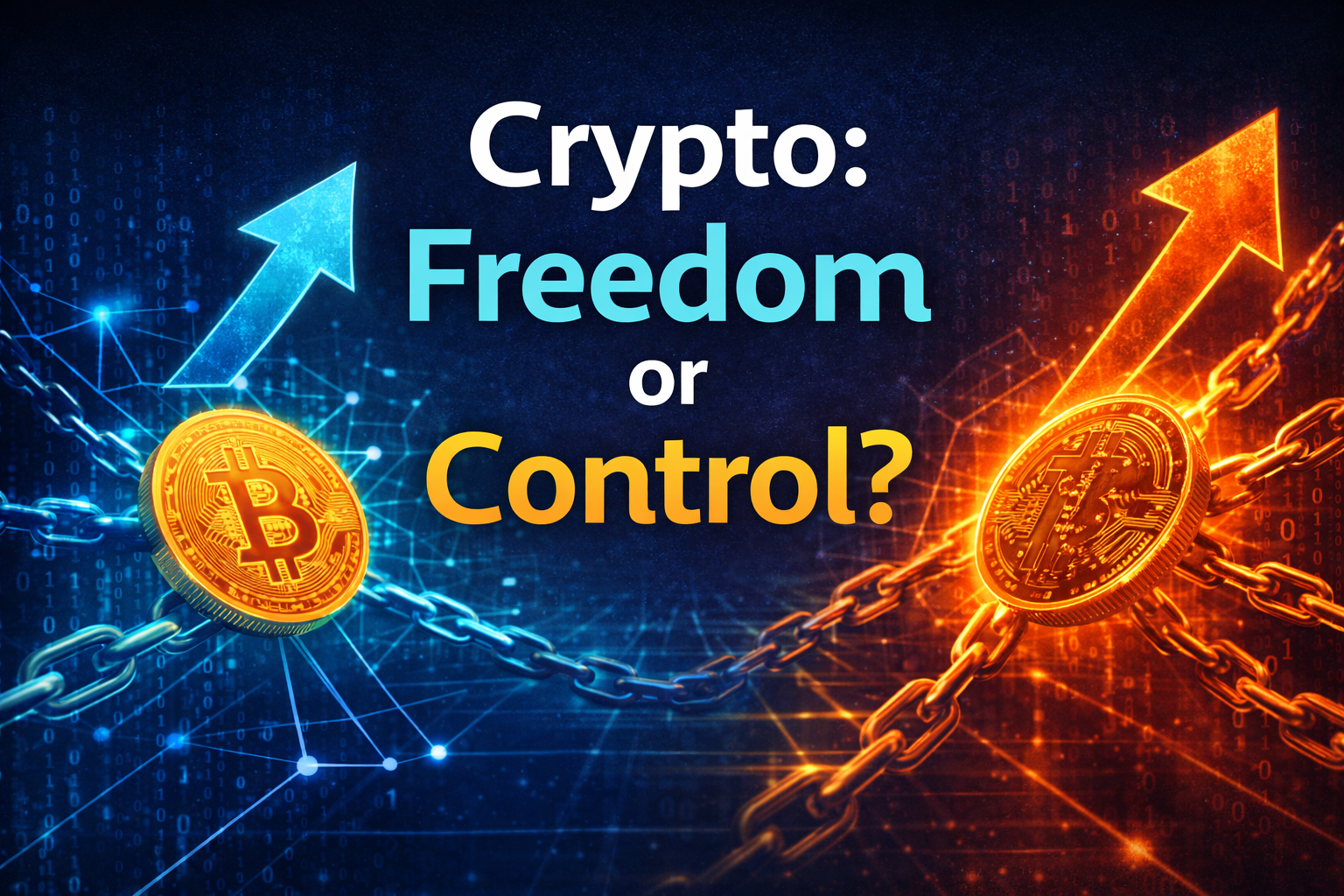
Is Crypto as a Geopolitical Tool empowering nations to bypass financial systems—or creating new forms of global control? An in-depth analysis of power, money, and digital sovereignty.
Table of Contents
Introduction: When Code Meets Power Politics
For years, cryptocurrency was dismissed as a fringe experiment—volatile, speculative, and disconnected from real geopolitics. That perception has changed dramatically. Today, governments, regulators, intelligence agencies, and global financial institutions all monitor crypto movements closely.
The reason is simple: Crypto as a Geopolitical Tool has moved from theory into practice. From sanctions evasion to state-backed digital currencies, crypto now sits at the intersection of technology, finance, and global power.
But does crypto truly weaken traditional systems—or does it quietly build new mechanisms of control under a different name?

Why Crypto Entered the Geopolitical Arena
The global financial system is heavily centralized. Payment rails, reserve currencies, and settlement networks are dominated by a small number of institutions and countries. This structure allows powerful states to impose sanctions, freeze assets, and restrict access to global markets.
Crypto emerged as a technological response to this concentration of power.
By design, decentralized blockchains promised:
- Borderless transactions
- Censorship resistance
- Reduced reliance on intermediaries
It is no coincidence that interest in Crypto as a Geopolitical Tool surged alongside increased sanctions, trade wars, and financial weaponization.
Sanctions, Surveillance, and the Search for Alternatives
Sanctions have become one of the most powerful non-military tools in geopolitics. Countries cut off from the global banking system have explored crypto-based solutions to maintain trade and liquidity.
However, this narrative is often oversimplified.
Blockchain transactions are transparent and traceable. In fact, many enforcement agencies collaborate with blockchain analytics firms, making large-scale covert use difficult. A 2023 report referenced by the International Monetary Fund highlights that crypto does not fully eliminate sanction visibility but instead shifts enforcement methods
(https://www.imf.org).
This creates a paradox: crypto enables alternatives—but also creates new digital trails.
State Adoption: From Decentralization to Digital Sovereignty
Governments rarely embrace systems they cannot influence. This is why many states now prefer central bank digital currencies (CBDCs) over decentralized cryptocurrencies.
CBDCs retain the efficiency of blockchain technology while preserving state control. Unlike open cryptocurrencies, CBDCs allow:
- Programmable money
- Real-time monitoring
- Policy enforcement at transaction level
This raises a critical question: Is Crypto as a Geopolitical Tool still about bypassing control—or is it becoming the ultimate control mechanism?
The Bank for International Settlements has openly discussed CBDCs as tools for monetary sovereignty and policy precision
(https://www.bis.org).
The Myth of Complete Financial Freedom
Crypto enthusiasts often describe digital assets as tools of liberation. In reality, freedom depends on access points.
Most users interact with crypto through exchanges, wallets, and platforms that are subject to national laws. Governments regulate these chokepoints aggressively.
This means crypto rarely exists outside state influence—it simply relocates where influence is applied.
As a geopolitical instrument, crypto does not erase power—it redistributes it.
Energy, Infrastructure, and Strategic Resources
Crypto mining has added an unexpected dimension to geopolitics: energy strategy.
Countries with cheap electricity or excess capacity have gained leverage in mining activity. This has linked crypto policy with energy policy, environmental regulation, and infrastructure planning.
The World Bank has repeatedly highlighted how digital financial infrastructure depends heavily on physical resources, not just code
(https://www.worldbank.org).
Thus, Crypto as a Geopolitical Tool is not purely digital—it is deeply physical and strategic.
Emerging Economies: Opportunity or New Dependency?
For developing nations, crypto offers both promise and risk.
On one hand, it can:
- Improve financial inclusion
- Reduce remittance costs
- Attract digital capital
On the other hand, reliance on volatile crypto markets can destabilize fragile economies. Sudden capital flows, regulatory uncertainty, and cyber risks may amplify rather than reduce vulnerability.
This duality explains why many governments adopt cautious, hybrid approaches rather than full crypto integration.
Big Tech, Big Finance, and the Quiet Centralization of Crypto
Ironically, while crypto was designed to decentralize power, much of its ecosystem has become concentrated.
A small number of:
- Mining pools
- Stablecoin issuers
- Infrastructure providers
now wield outsized influence.
When stablecoins are backed by traditional assets and governed by corporate entities, Crypto as a Geopolitical Tool starts to resemble the system it aimed to disrupt—just with faster rails.
Information Warfare and Narrative Control
Crypto is not just about money—it is also about narratives.
States promote or restrict crypto to signal ideology:
- Innovation-friendly
- Sovereignty-focused
- Security-first
These signals influence foreign investment, diplomatic alignment, and domestic legitimacy. Control over crypto discourse is increasingly part of information warfare.
Regulation: The New Battlefield
Rather than banning crypto outright, most major powers are shaping it through regulation.
This regulatory competition is geopolitical in nature:
- Who sets global standards?
- Whose rules dominate cross-border flows?
- Which jurisdictions attract capital and talent?
The answer will determine whether crypto weakens or reinforces existing power hierarchies.
So, Bypass System or New Control Mechanism?
The honest answer is: both.
Crypto allows partial bypass of traditional systems—but only temporarily and imperfectly. At the same time, it enables unprecedented levels of programmable control when adopted by states.
This dual nature is what makes Crypto as a Geopolitical Tool so powerful—and so dangerous.
Conclusion: Power Never Disappears, It Evolves
Crypto does not eliminate geopolitics. It reshapes it.
The struggle is no longer just about territory or military strength—it is about infrastructure, standards, and digital trust. Those who control the rails, whether old or new, will shape the future of global finance.
Crypto is not the end of power politics. It is the next arena.
Searching for the best inflation hedges in 2026? We break down the ultimate battle of gold vs bitcoin vs real assets to protect your purchasing power.