Why Central Banks Are Trapped Between Inflation and Recession as rising prices, slowing growth, and fragile economies force policymakers into impossible decisions worldwide.
Table of Contents
Introduction: A Crisis with No Easy Exit
Over the past few years, central banks across the world have faced criticism from all sides. Some blame them for allowing inflation to surge, while others argue that aggressive interest-rate hikes are pushing economies toward recession.
The truth lies somewhere in between.
Today, Central Banks Are Trapped Between Inflation and Recession, caught in a policy dilemma where every decision carries serious economic consequences. Raising interest rates helps control inflation but risks slowing growth. Cutting rates may support economies but can reignite price pressures.
This blog explores why this trap exists, how central banks ended up here, and what it means for ordinary people, businesses, and global financial stability.
Understanding the Dual Mandate of Central Banks
Most major central banks operate with two primary goals:
- Price stability (low and predictable inflation)
- Economic growth and employment stability
In theory, balancing these goals is possible. In practice, when inflation and recession risks rise simultaneously, central banks are forced into uncomfortable trade-offs.
This is exactly why Central Banks Are Trapped Between Inflation and Recession in the current global environment.
For background on central banking objectives:
https://www.investopedia.com/terms/c/centralbank.asp
How Inflation Reached Dangerous Levels
Inflation did not appear overnight. It was the result of several overlapping global shocks:
Key Drivers of Inflation
- Massive money printing during pandemic stimulus
- Supply chain disruptions
- Energy and commodity price shocks
- Labor shortages and wage pressures
- Geopolitical conflicts affecting trade
Initially, central banks believed inflation would be “transitory.” When it persisted, they were forced to act aggressively.
Once inflation expectations rise, they become difficult to control — making delayed action extremely costly.
Why Fighting Inflation Risks Recession
To control inflation, central banks primarily use interest rate hikes. Higher rates make borrowing more expensive, slow consumer spending, and reduce investment.
While effective against inflation, this approach has side effects:
- Slower business expansion
- Higher loan EMIs
- Reduced housing demand
- Declining consumer confidence
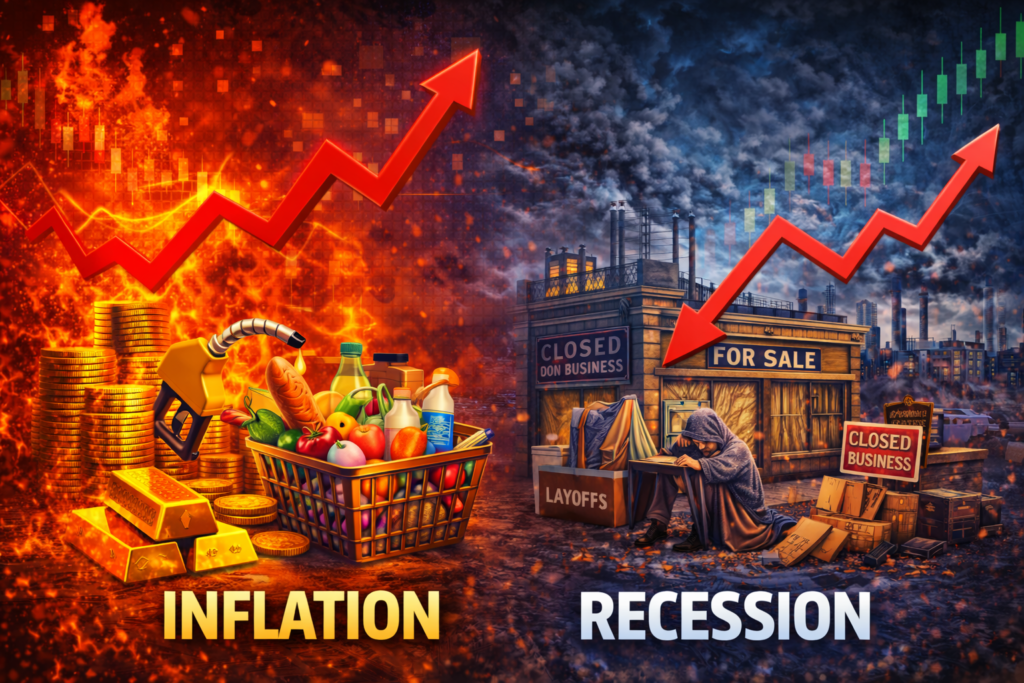
As demand weakens, economic growth slows — increasing the probability of recession. This is the heart of the problem when Central Banks Are Trapped Between Inflation and Recession.
The Recession Threat Is Already Visible
In many economies, warning signs are already flashing:
- Manufacturing slowdowns
- Weak consumer spending
- Declining business confidence
- Stress in banking and credit markets
Raising rates further risks turning a slowdown into a full-scale recession. Yet easing policy too early risks undoing progress on inflation.
This is why central banks are increasingly cautious, data-dependent, and often inconsistent in their messaging.
Why Central Banks Cannot Simply “Pause”
Many people ask a simple question: Why don’t central banks just pause and wait?
The problem is credibility.
If inflation remains high and central banks pause too early:
- Inflation expectations rise
- Currencies weaken
- Long-term borrowing costs increase
Markets may lose trust in central banks’ commitment to price stability. That loss of trust can cause more damage than inflation itself.
This credibility challenge deepens why Central Banks Are Trapped Between Inflation and Recession with limited room to maneuver.
The Global Nature of the Problem
This dilemma is not limited to one country.
Developed Economies
- High debt levels limit policy flexibility
- Aging populations reduce growth potential
- Tight labor markets fuel wage inflation
Emerging Economies
- Currency depreciation increases inflation
- Capital outflows worsen financial stress
- Higher interest rates strain growth and employment
Because global economies are interconnected, policy decisions in one major economy affect others through capital flows, exchange rates, and trade.
For a global policy overview:
https://www.imf.org/en/Topics/Monetary-policy
The Role of Debt in the Central Bank Trap
Global debt levels are historically high — across governments, corporations, and households.
High interest rates mean:
- Governments pay more to service debt
- Businesses face refinancing risks
- Households struggle with loans and mortgages
Central banks are aware that pushing rates too high could trigger debt crises. This financial fragility further explains why Central Banks Are Trapped Between Inflation and Recession rather than acting decisively in one direction.
Financial Markets Add More Pressure
Markets respond instantly to central bank signals.
A hawkish stance can:
- Crash stock markets
- Strengthen currencies
- Tighten financial conditions rapidly
A dovish stance can:
- Fuel asset bubbles
- Weaken currencies
- Reignite inflation fears
Central banks are no longer just managing economies — they are managing market psychology. This makes policy decisions even more complex.
Why There Is No “Perfect” Policy Choice
In the current environment, every option is flawed:
- Raise rates aggressively → Inflation falls, recession risk rises
- Cut rates early → Growth improves, inflation resurges
- Hold rates steady → Risks build quietly in both directions
This is not a failure of central banking — it is the result of extraordinary global conditions.
Understanding this helps explain why Central Banks Are Trapped Between Inflation and Recession, even with decades of experience and advanced economic models.
What This Means for Ordinary People
While central bank decisions sound abstract, their impact is deeply personal.
People feel it through:
- Higher loan EMIs
- Expensive groceries and fuel
- Job insecurity
- Falling savings value
Households are squeezed from both sides — rising prices and slowing income growth. This is why public frustration with monetary policy has grown sharply.
For an explanation of inflation’s impact on daily life:
https://www.investopedia.com/terms/i/inflation.asp
Can Central Banks Escape This Trap?
There is no quick solution.
Possible long-term exits include:
- Structural economic reforms
- Supply-side improvements
- Fiscal discipline from governments
- Productivity-driven growth
Central banks alone cannot solve inflation or recession risks. Without coordinated fiscal and structural policies, they remain stuck managing symptoms rather than causes.
The Bigger Lesson for the Global Economy
The current crisis reveals a deeper truth: monetary policy has limits.
For years, central banks were expected to fix every problem — from slow growth to financial crises. That expectation created dependency and delayed necessary reforms.
Now, as Central Banks Are Trapped Between Inflation and Recession, the world is rediscovering that economic stability requires more than interest rate adjustments.
Final Verdict: An Era of Difficult Choices
Central banks are not powerless — but they are constrained.
They must choose between:
- Short-term pain or long-term instability
- Inflation control or growth support
- Market confidence or economic relief
There is no painless path forward.
Final Thoughts
The phrase Central Banks Are Trapped Between Inflation and Recession perfectly captures the defining economic challenge of our time.
For policymakers, it is a test of credibility and restraint.
For markets, it is a source of volatility.
For ordinary people, it is a daily struggle with rising costs and uncertainty.
As the global economy evolves, one thing is clear: the age of easy monetary solutions is over — and difficult trade-offs are here to stay.
👉 In today’s world, understanding central bank decisions is no longer optional — it is essential for financial survival.
Dividend ETFs invest in a portfolio of stocks, while individual shares represent ownership in a single company. This means that dividend ETFs provide investors with greater diversification, which can help reduce risk.