
Can India Benefit from U.S.–China decoupling? This in-depth analysis explores opportunities, risks, supply chains, geopolitics, and India’s economic future.
Table of Contents
Introduction: A Global Shift India Cannot Ignore
The global economic order is undergoing a slow but decisive transformation. As tensions between the United States and China deepen, the idea of “decoupling” has moved from theory to practice. Supply chains are being restructured, trade routes reconsidered, and strategic alliances redefined.
At the center of this shift stands India—a country large enough to matter, yet flexible enough to adapt. The big question facing policymakers, investors, and citizens alike is simple but critical: Can India Benefit from U.S.–China decoupling, or will it inherit new economic and geopolitical risks?
The answer is not black and white. India sits at a strategic crossroads where opportunity and uncertainty exist side by side.
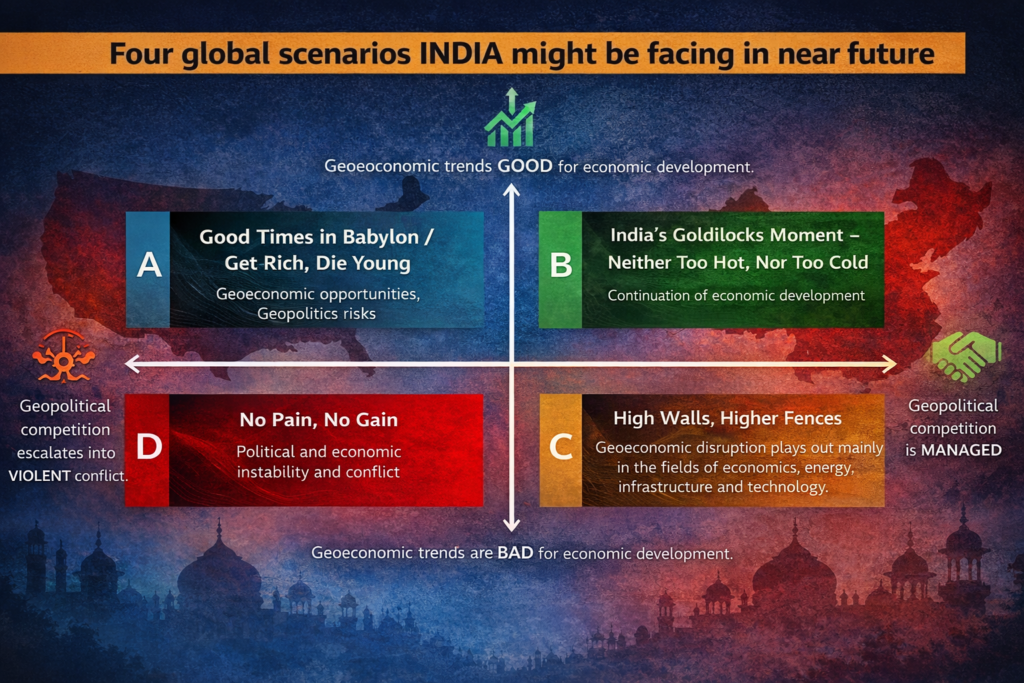
Understanding U.S.–China Decoupling in Simple Terms
Decoupling does not mean the U.S. and China have stopped trading altogether. Instead, it refers to a selective disengagement, especially in sensitive sectors like:
- Semiconductors
- Advanced manufacturing
- Artificial intelligence
- Telecommunications
- Defense-related supply chains
Western companies are diversifying production away from China to reduce dependency and geopolitical risk. This process has created openings for alternative manufacturing hubs—India being one of the most prominent candidates.
Why Many Believe India Benefit Is Inevitable
1. Supply Chain Diversification Is India’s Moment
Global corporations are actively following a “China +1” strategy. India, with its massive workforce and expanding infrastructure, fits naturally into this plan.
Manufacturing incentives, improved logistics, and digital governance reforms have made India more attractive than ever. Electronics, pharmaceuticals, automobiles, and renewable energy components are already seeing increased investment.
This is one of the strongest arguments supporting the idea that India Benefit from decoupling is not just possible—but already underway.
Manufacturing Gains vs Structural Reality
While headlines celebrate new factories and foreign investment, deeper structural issues remain.
India’s manufacturing ecosystem still faces:
- Skill mismatches
- Land acquisition delays
- Complex compliance frameworks
- Power and logistics inconsistencies
If these challenges are not addressed at scale, the long-term India Benefit could remain limited to specific regions rather than becoming a national transformation.
Geopolitical Balancing: Opportunity or Trap?
Strategic Neutrality Has a Cost
India maintains relationships with both Washington and Beijing while also engaging Russia and the Global South. This strategic autonomy offers flexibility—but also risk.
As decoupling intensifies, pressure may grow for India to take clearer positions. Aligning too closely with one side could:
- Invite trade retaliation
- Disrupt energy imports
- Complicate regional security
Thus, while India Benefit economically, it must manage diplomatic expectations carefully to avoid strategic overreach.
Technology and Innovation: A Double-Edged Sword
Decoupling is as much about technology as it is about trade.
India stands to gain access to Western technology partnerships, especially in:
- Semiconductors
- Defense manufacturing
- Clean energy
- Digital infrastructure
However, technology transfer often comes with restrictions. Excessive dependence on one bloc could limit innovation freedom in the long run.
True India Benefit will depend on India’s ability to build domestic capabilities, not just host foreign production.
Labor and Demographics: A Hidden Advantage
India’s young population is frequently cited as a major strength. Unlike aging economies, India has the workforce needed to support long-term industrial expansion.
But demographics alone are not enough.
Without large-scale skill development, India risks becoming a low-value assembly hub rather than a high-value manufacturing center. The real India Benefit lies in moving up the value chain, not just increasing factory count.
Trade Realignment and Export Growth
Decoupling is reshaping global trade flows. India’s exports to the U.S. and Europe have increased in several sectors, partly due to reduced reliance on Chinese suppliers.
Yet India’s trade deficit remains a concern, especially in electronics and energy. Import substitution without competitiveness could raise costs rather than boost growth.
This creates a delicate balance between protectionism and global integration.
Financial Markets and Capital Flows
Foreign investors view India as a relative safe haven amid global uncertainty. Stable institutions, democratic governance, and long-term growth prospects attract capital.
However, sudden geopolitical escalation could reverse flows quickly. Volatile capital movements remain one of the biggest hidden risks in the decoupling era.
Regional Security Risks Cannot Be Ignored
Economic opportunity does not erase security challenges.
Border tensions, regional instability, and maritime competition in the Indo-Pacific could offset economic gains. Defense spending may rise, diverting resources from development priorities.
This is where the India Benefit narrative becomes complicated—economic gains may come with higher strategic costs.
Will Small Businesses and Workers Actually Gain?
Macro-level growth does not automatically translate into broad-based prosperity.
If decoupling benefits only large corporations and urban centers, inequality could widen. For India Benefit to be real and sustainable, small manufacturers, MSMEs, and informal workers must be integrated into global value chains.
Long-Term Outlook: Benefit, But Not Without Risk
So, can India Benefit from U.S.–China decoupling?
Yes—but conditionally.
India gains:
- Manufacturing opportunities
- Strategic relevance
- Investment inflows
India risks:
- Geopolitical pressure
- Trade retaliation
- Overdependence on external blocs
The outcome depends on policy discipline, institutional reform, and strategic patience.
Conclusion: India’s Decoupling Test Has Already Begun
U.S.–China decoupling is not a future event—it is happening now. India is no longer a passive observer but an active participant in the reordering of global power.
Whether India Benefit becomes a historic turning point or a missed opportunity will depend on how wisely the country navigates this moment.
Economic momentum is available. Strategic space exists. The challenge is execution.
World Trade Organization: https://www.wto.org
World Bank – Global Trade Outlook: https://www.worldbank.org
IMF – Geoeconomic Fragmentation: https://www.imf.org

U.S.–India Trade Talks in January 2026 could reshape tariffs, technology cooperation, and global supply chains. Here are the key issues businesses and policymakers are watching.