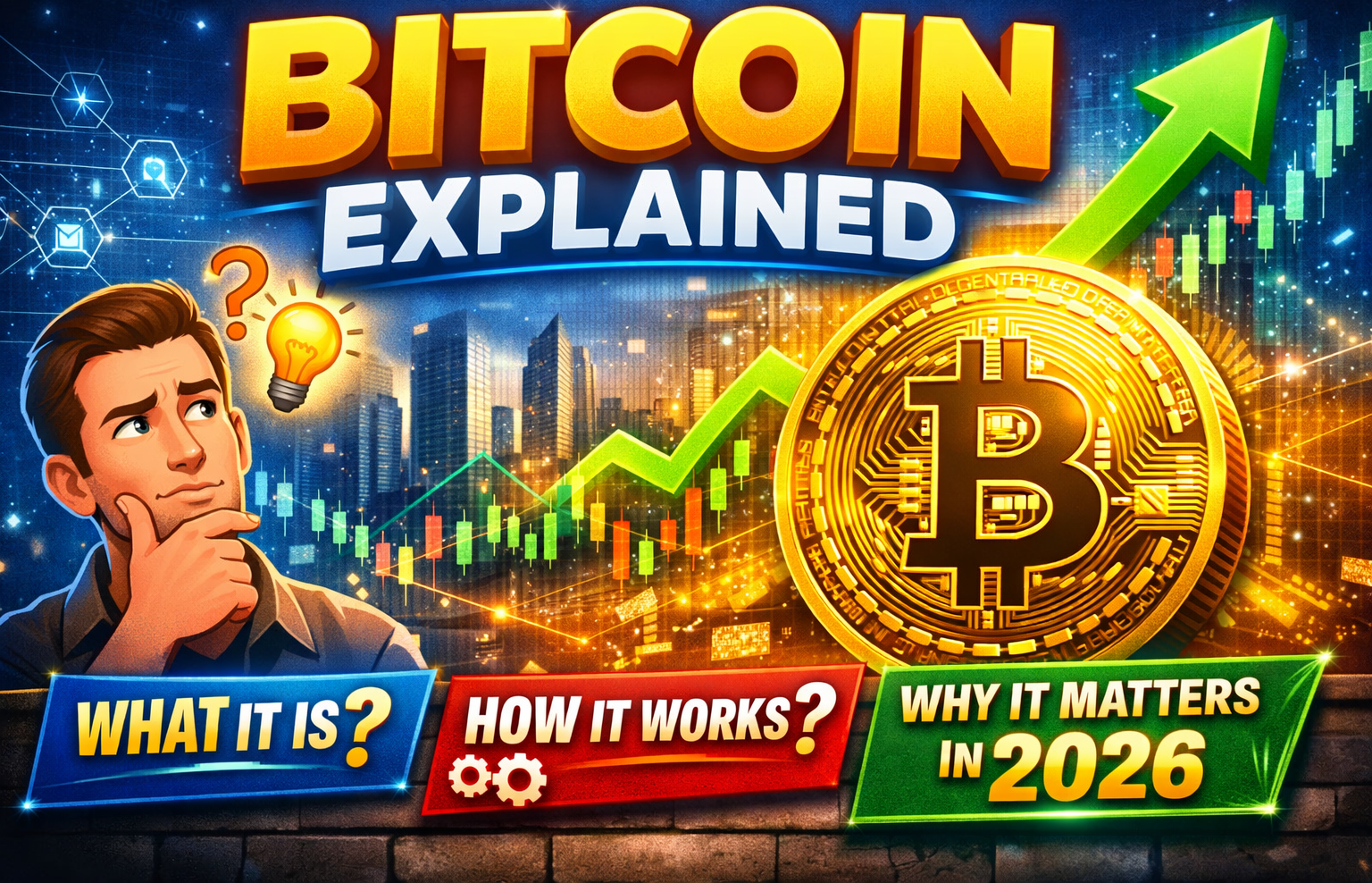
Bitcoin Explained: What It Is, How It Works, and Why It Matters in 2026 this complete beginner-friendly guide.
Table of Contents
Introduction Of Bitcoin Explained: What It Is, How It Works, and Why It Matters in 2026
Bitcoin is the world’s first and most popular cryptocurrency. Since its launch in 2009, Bitcoin has transformed the way people think about money, payments, and financial freedom. From being worth almost nothing to becoming a global digital asset, Bitcoin continues to attract investors, developers, institutions, and governments worldwide.
In this article, you will learn what Bitcoin is, how it works, its benefits, risks, and future potential—explained in simple and clear language.
What Is Bitcoin?
Bitcoin is a decentralized digital currency that allows people to send and receive money over the internet without relying on banks, governments, or intermediaries.
Unlike traditional currencies such as the Indian Rupee or US Dollar, Bitcoin:
- Exists only in digital form
- Is controlled by a public network, not a central authority
- Has a limited supply of 21 million coins
Bitcoin transactions are recorded on a public ledger called the blockchain, which ensures transparency and security.
Who Created Bitcoin?
Bitcoin was created in 2008 by an unknown person or group using the name Satoshi Nakamoto. The Bitcoin whitepaper, titled “Bitcoin: A Peer-to-Peer Electronic Cash System”, described a new way to send money directly between users without third-party trust.
To this day, Satoshi Nakamoto’s real identity remains unknown.
How Does Bitcoin Work?
Bitcoin operates on blockchain technology, which is a distributed digital ledger maintained by thousands of computers worldwide.
Key Components:
- Cryptography: Protects transactions and ownership
- Blockchain: Stores all Bitcoin transactions permanently
- Nodes: Computers that verify and store transaction data
- Miners: Validate transactions and secure the network
When someone sends Bitcoin:
- The transaction is broadcast to the network
- Miners verify the transaction
- It is added to a new block
- The block is permanently recorded on the blockchain
What Is Bitcoin Mining?
Bitcoin mining is the process of validating transactions and creating new Bitcoins.
Miners use powerful computers to solve complex mathematical problems. In return, they earn:
- Transaction fees
- Newly created Bitcoin
Bitcoin Supply Rule:
- Maximum supply: 21 million BTC
- New Bitcoin creation reduces every 4 years through Bitcoin Halving
This scarcity is one of the main reasons Bitcoin is often compared to gold.
Why Is Bitcoin Valuable?
Bitcoin’s value comes from several key factors:
- Limited supply (scarcity)
- Decentralization (no central control)
- Security and transparency
- Global accessibility
- Growing adoption by institutions
Many people consider Bitcoin as:
- “Digital Gold”
- A store of value
- A hedge against inflation
Advantages of Bitcoin
- No bank or middleman required
- Fast international transfers
- Transparent and secure transactions
- Limited supply protects against inflation
- Accessible to anyone with internet
Risks and Disadvantages of Bitcoin
- High price volatility
- Regulatory uncertainty
- Risk of scams and hacks
- Irreversible transactions
- Requires basic technical understanding
How to Store Bitcoin Safely
Types of Wallets:
- Cold Wallets (hardware wallets)
- Hot Wallets (mobile, desktop, web)
Future of Bitcoin
- Increasing institutional adoption
- Bitcoin ETFs
- Growing use as a store of value
- Advancements like the Lightning Network
Should You Invest in Bitcoin?
- Long-term investors
- People who understand volatility
- Those who invest responsibly
Conclusion
Bitcoin is more than just a cryptocurrency—it is a technological and financial innovation that has changed the global money system. While it has risks, its decentralized nature, limited supply, and growing adoption make it one of the most important digital assets of our time.
Understanding Bitcoin properly is the first step before using or investing in it.