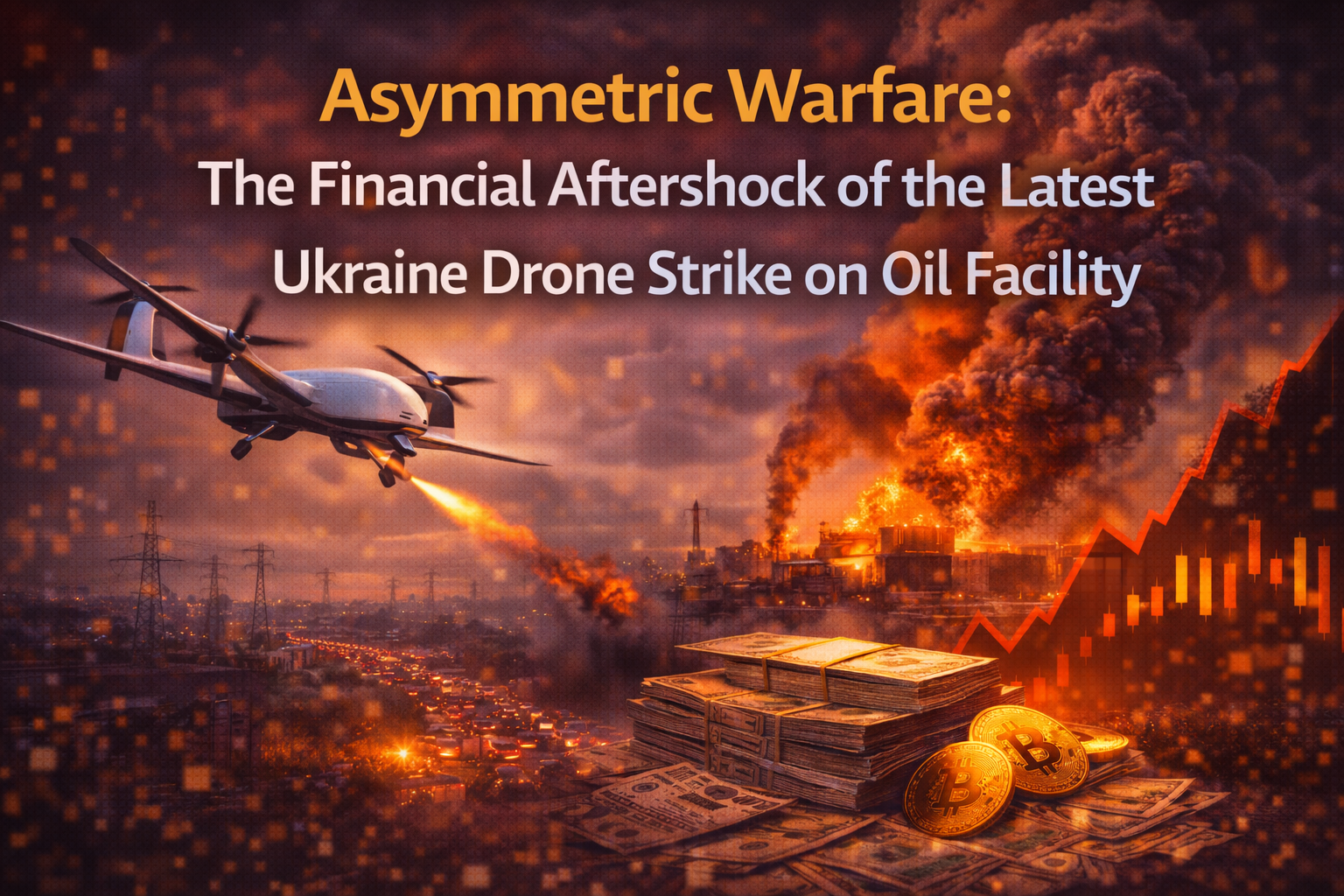
The recent Ukraine drone strike on oil facility in Oryol creates new volatility in energy markets. We analyze the cost of drone warfare vs. hypersonic missiles and what it means for oil prices.
Table of Contents
I was staring at the commodities ticker this morning, watching Brent crude do that nervous little dance it does whenever geopolitical headlines hit the wire. Just when we thought the energy markets had priced in the conflict, the notification popped up: another massive escalation. Moscow launched a shiny new hypersonic missile—the “Oreshnik”—flaunting its high-tech capabilities. And how did Kyiv respond? Not with a grand military parade, but with a swarm of low-cost, high-impact drones.
The reports confirmed a successful Ukraine drone strike on oil facility in Russia’s Oryol region, setting a fuel and lubricants depot ablaze.
It’s a stark reminder of the new reality we are trading in. We aren’t just watching a military conflict; we are watching a war of economics. On one side, you have multimillion-dollar hypersonic missiles. On the other, you have relatively cheap drones dealing massive infrastructure damage. For investors, this Ukraine drone strike on oil facility isn’t just a war story; it’s a signal that the risk premium on energy is nowhere near gone. Let’s break down what this escalation means for the markets, the Russian war chest, and your portfolio.
The Economics of the “Cheap” Strike
Let’s talk about ROI (Return on Investment). I know, it sounds cold to apply financial metrics to war, but that is exactly what military strategists and defense analysts do.
Russia’s use of the Oreshnik hypersonic missile is a flex. It’s expensive, it’s terrifying, and it’s meant to send a message to the West. But financially? It’s a heavy lift. In contrast, the Ukraine drone strike on oil facility represents the ultimate asymmetric trade.
A long-range drone might cost $50,000 to $100,000. The damage it causes—burning through thousands of barrels of refined fuel, destroying storage tanks that take months to rebuild, and disrupting logistics—can run into the tens of millions.
- Cost Efficiency: Ukraine is effectively trading pennies for dollars.
- Infrastructure Stress: Russia has plenty of crude oil, but its refining and storage capacity is a bottleneck. Every time a Ukraine drone strike on oil facility connects, that bottleneck tightens.
- The Psychological Toll: It forces Russia to move expensive air defense systems away from the front lines to protect rear-guard energy assets.
Energy Markets: Why the Price Didn’t Explode (Yet)
You might be wondering, “If a Ukraine drone strike on oil facility is burning up Russian supply, why isn’t gas $5 a gallon again?”
The market is currently in a weird tug-of-war. On one hand, you have these supply disruptions. On the other, you have weak demand data coming out of China and rising production from the U.S. and Brazil. Traders are currently betting that the global supply cushion is thick enough to absorb a few burning depots.
However, complacency is dangerous. This wasn’t a one-off event. It’s part of a systematic campaign. As the Ukraine drone strike on oil facility strategy targets deeper and more critical infrastructure, we are inching closer to a tipping point. If they manage to hit a key export terminal (like Novorossiysk or Ust-Luga), that “cushion” disappears overnight.
The “Oreshnik” Escalation: A New Risk Premium?
The timing of this strike matters. It came hours after Putin confirmed the use of the new Oreshnik missile against Dnipro. This signals that neither side is looking for an off-ramp.
For the finance world, this “tit-for-tat” dynamic is the worst-case scenario. Markets hate uncertainty. If Russia escalates with hypersonics, and the response is a consistent Ukraine drone strike on oil facility campaign, the insurance costs for shipping in the Black Sea go up. The cost of doing business creates a “war tax” on everything from grain to diesel.
We are seeing this play out in the defense sector stocks. Companies that specialize in air defense and drone interceptors (like RTX or Rheinmetall) are seeing order books swell because every country is watching this and realizing: “We can’t stop a swarm of cheap drones with a $2 million Patriot missile.”
Russia’s Refining Problem
Here is a detail that doesn’t make the front page often enough. Russia is a gas station masquerading as a country. Its entire economy is built on digging stuff up and burning it or selling it.
When a Ukraine drone strike on oil facility happens, it doesn’t just burn fuel; it burns export revenue. Russia has had to ban gasoline exports intermittently to keep domestic prices stable. Why? Because their refineries keep getting hit.
- Sanctions Bite: Rebuilding these high-tech refineries is harder now. They rely on Western tech that is sanctioned. You can’t just order a replacement part from Siemens anymore.
- Revenue squeeze: If Russia can’t refine its own crude, it has to sell raw crude at a discount, hurting the federal budget that funds the war.
What This Means for Your Portfolio
So, what do you do with this information?
First, don’t panic-buy oil futures. The market is efficient, and the “war premium” is often priced in quickly. However, the persistent threat of a Ukraine drone strike on oil facility suggests that energy volatility is here to stay.
- Energy Stocks: Integrated oil majors (like Exxon or Chevron) act as a hedge. If global supply drops and prices spike, their margins improve.
- Defense Tech: Look at the companies building the “counter-drone” tech. This is the fastest-growing segment in the military-industrial complex.
- Logistics: Shipping companies often charge higher rates during conflicts. Tanker stocks (like Frontline or Scorpio) can be volatile but profitable plays when supply chains get disrupted.
According to analysis from the International Energy Agency (IEA), global refining capacity is already tight. Any sustained campaign that takes Russian capacity offline tightens the screws on diesel and jet fuel markets globally.
Furthermore, geopolitical analysis from The Atlantic Council suggests that this drone warfare strategy is likely to intensify as Ukraine seeks to level the playing field against Russia’s sheer mass.
Frequently Asked Questions (FAQ)
Will a Ukraine drone strike on oil facility cause US gas prices to rise?
It depends on the scale. A single depot fire in Oryol won’t change the price at your local pump. However, if the campaign expands to major export terminals or creates a systemic shortage of Russian diesel on the global market, it can reduce global supply, indirectly pushing up prices worldwide.
Why does Ukraine target oil facilities specifically?
Oil is the lifeblood of the Russian war machine. It fuels the tanks and jets, and the revenue from selling it funds the government. A Ukraine drone strike on oil facility hits both the military logistics and the economic wallet of Moscow simultaneously.
What was the Russian response to the drone strike?
The strike came amidst a broader exchange of fire. Russia claimed to have intercepted many drones, but confirmed the fire at the Oryol facility. This followed Russia’s launch of the new Oreshnik hypersonic missile, signaling a continued escalation from both sides.
Are Russian oil depots defended?
Yes, but Russia is vast. It is impossible to put a top-tier air defense system around every single fuel tank in the country. Ukraine exploits this by using long-range drones to hit “soft” targets deep inside Russian territory where defenses are thinner.
Is it safe to invest in oil stocks right now?
Energy stocks can be a good hedge against inflation and geopolitical risk. However, they are cyclical. Investing based solely on war headlines is risky. It is better to look at the fundamentals of the companies—cash flow, dividends, and reserves—rather than betting on the next Ukraine drone strike on oil facility.
Conclusion: The Fire Isn’t Going Out
The images of black smoke rising over Oryol are a graphic representation of where we are in 2026. The conventional war has stalled, but the economic war is accelerating. The Ukraine drone strike on oil facility strategy proves that in modern warfare, you don’t need a navy to enforce a blockade; you just need good engineering and good intelligence.
For the global economy, this means the “instability discount” is gone. We have to price in the reality that major energy infrastructure is fair game. As an investor, you can’t control the geopolitics, but you can acknowledge the reality: the era of cheap, secure energy flows from the East is over.