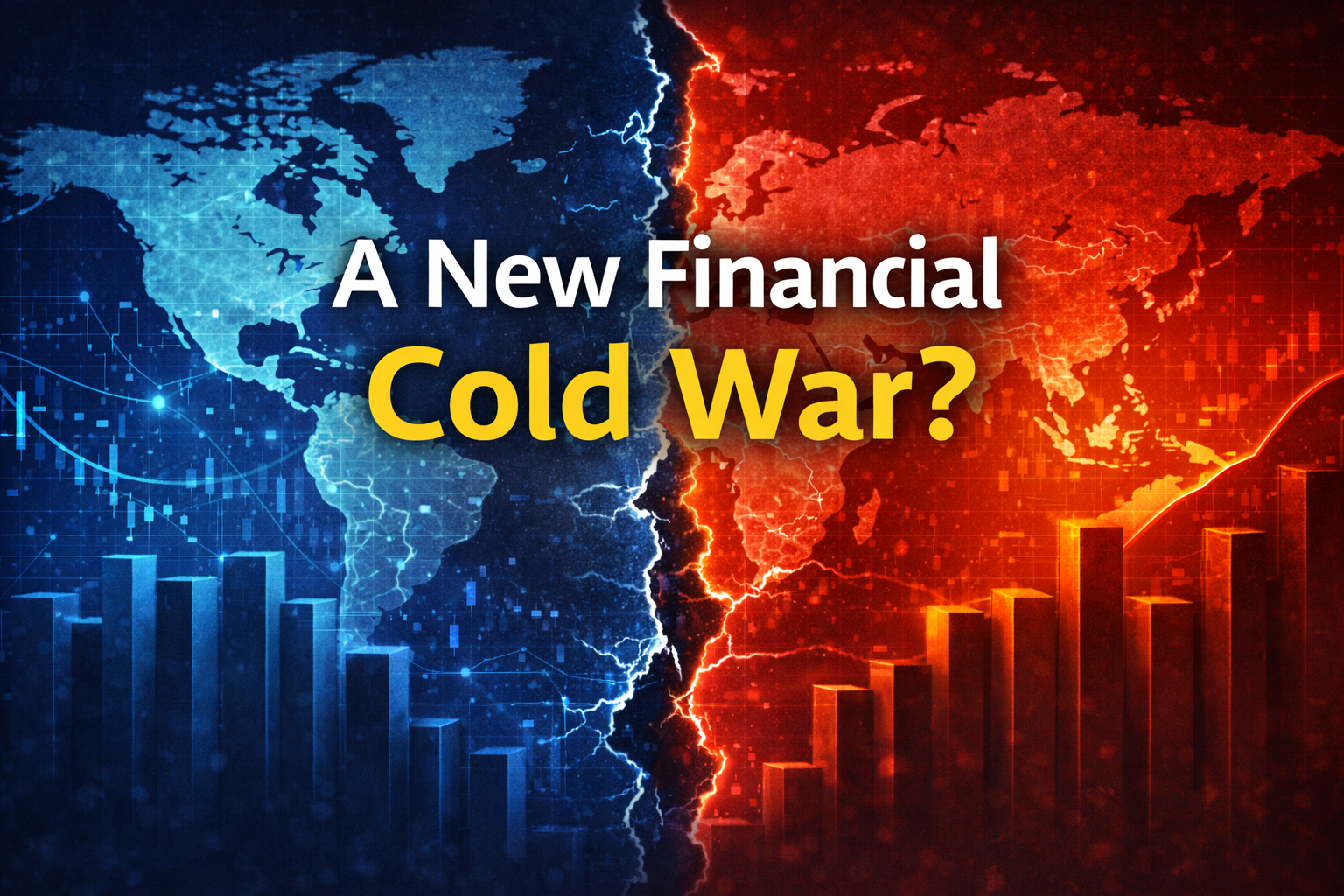
Is the world sliding into a Cold War–style global financial fragmentation? This in-depth analysis explores blocs, sanctions, currencies, trade, and the future of global finance.
Table of Contents
Introduction: A Familiar Pattern in a Digital Age
History rarely repeats itself exactly—but it often rhymes. In recent years, economists and policymakers have begun asking an uncomfortable question: are we witnessing the early stages of a Cold War–style global financial fragmentation?
Instead of tanks and missiles, today’s conflict lines are drawn through payment systems, supply chains, currencies, and technology standards. Nations are not cutting diplomatic ties outright, but they are quietly reducing financial interdependence with rivals.
What once looked like globalization without limits is now giving way to a world of guarded cooperation and strategic mistrust.
What Financial Fragmentation Really Means
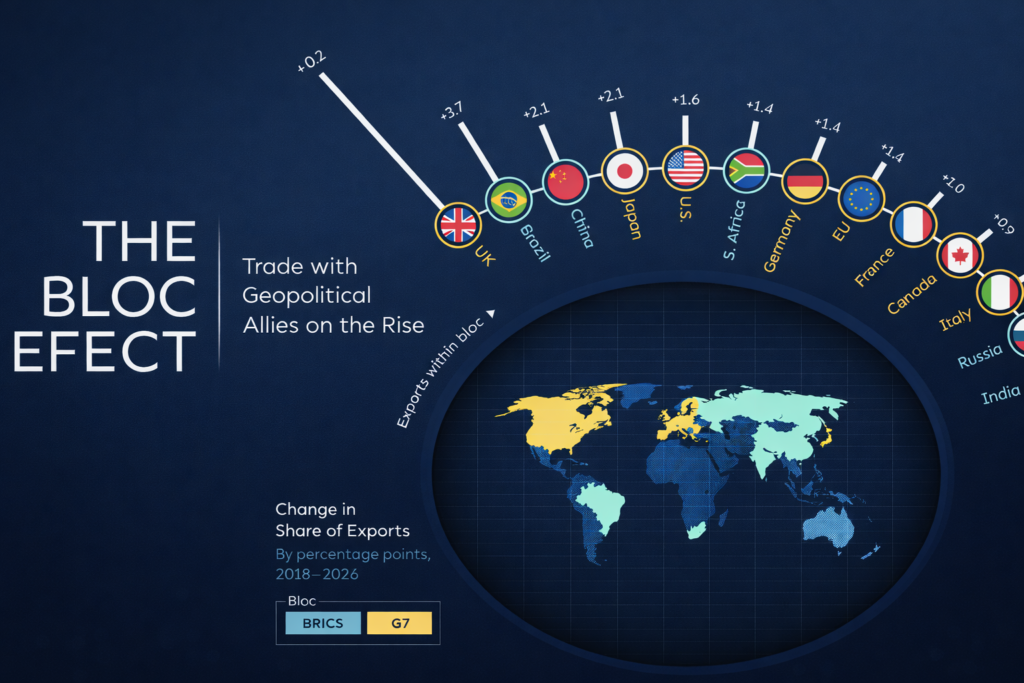
Global financial fragmentation refers to the splitting of the world economy into competing economic blocs, each with its own trade rules, payment systems, and financial infrastructure.
Unlike the original Cold War, today’s fragmentation is not purely ideological. It is driven by:
- Sanctions and counter-sanctions
- National security concerns
- Technological rivalry
- Currency and payment control
According to analysis from the International Monetary Fund, rising geoeconomic fragmentation could significantly reduce global GDP over the long term by weakening efficiency and trust
(https://www.imf.org).
How This New Cold War Differs From the Old One
The traditional Cold War divided the world into two relatively closed systems. Today’s version is more complex.
Modern Cold War–style fragmentation is:
- Partial, not absolute
- Economic, not primarily military
- Network-based rather than territory-based
Countries still trade with rivals, but selectively. Sensitive sectors—such as semiconductors, energy, finance, and data—are increasingly walled off.
This selective decoupling makes the system more fragile, not less.
Sanctions: The Financial Weapon of Choice
Sanctions have become one of the most powerful tools in modern geopolitics. Freezing reserves, blocking payment access, and restricting trade financing can cripple economies without firing a single shot.
However, the overuse of sanctions carries long-term consequences.
The World Bank has noted that repeated financial restrictions encourage affected countries to seek alternative systems, accelerating fragmentation
(https://www.worldbank.org).
In effect, sanctions may win short-term battles while losing long-term systemic cohesion.
The Rise of Competing Financial Blocs
As trust erodes, countries are reorganizing their financial relationships.
We now see:
- Alternative payment systems
- Regional trade agreements
- Local-currency settlement mechanisms
- Strategic commodity alliances
These moves are defensive—but collectively they resemble a Cold War–era bloc formation, adapted for a globalized world.
No single bloc is fully self-sufficient, which increases systemic risk rather than stability.
Currency Power and the Question of the Dollar
Currency dominance has always been central to geopolitical power. Today, discussions around reserve diversification and local-currency trade are growing louder.
Yet replacing a dominant currency is far harder than reducing dependence on it.
The Bank for International Settlements has repeatedly emphasized that trust, liquidity, and legal predictability—not politics alone—determine currency dominance
(https://www.bis.org).
Still, the push for alternatives reflects declining confidence in a unified system, a classic symptom of Cold War–style fragmentation.
Technology and Financial Sovereignty
Technology has become the new frontline.
Financial infrastructure now depends on:
- Cloud services
- Data standards
- Cybersecurity frameworks
- Digital identity systems
Control over these layers translates directly into financial power. Governments increasingly treat financial technology as strategic infrastructure rather than neutral tools.
This mirrors Cold War logic, where control over critical systems mattered more than open exchange.
Global Trade Is Slowing—and Splintering
Trade volumes have not collapsed, but trade patterns are changing.
Companies now prioritize:
- Resilience over efficiency
- Political alignment over cost
- Redundancy over optimization
The World Trade Organization has warned that fragmentation could reverse decades of trade integration, disproportionately harming developing economies
(https://www.wto.org).
This creates a paradox: nations seek security but may end up with slower growth and higher inflation.
Developing Economies Caught in the Middle
Perhaps the most vulnerable players in this emerging Cold War–like system are middle-income and developing countries.
They face difficult choices:
- Align with one bloc and risk retaliation
- Remain neutral and risk exclusion
- Attempt balancing acts with limited leverage
Financial fragmentation reduces access to capital, raises borrowing costs, and complicates development planning.
Is This Fragmentation Permanent?
History suggests fragmentation cycles are not permanent—but they are costly while they last.
Reintegration requires:
- Trust rebuilding
- Institutional reform
- Shared crisis response
Ironically, global shocks often force cooperation. Until then, the system remains stuck between interdependence and isolation.
The Psychological Shift: From Cooperation to Suspicion
Beyond economics, the most dangerous change may be psychological.
Financial decisions are increasingly framed in security terms. This mindset reinforces a Cold War logic where every dependency is seen as a vulnerability.
Once this perspective dominates policy thinking, fragmentation becomes self-reinforcing.
So, Are We Entering a New Cold War?
The answer is nuanced.
We are not reliving the Cold War of the 20th century—but we are entering a Cold War–style financial era, defined by:
- Competing systems
- Reduced trust
- Strategic economic planning
- Weaponized interdependence
The risk is not sudden collapse, but slow erosion of global efficiency and cooperation.
Conclusion: A World Less Connected, Not Less Dangerous
Global financial fragmentation does not eliminate risk—it redistributes it.
As systems split and redundancy replaces integration, costs rise and coordination weakens. The challenge for policymakers is to manage rivalry without destroying the foundations of global stability.
History shows that Cold War dynamics are easier to enter than to exit.
Is BRICS Expansion reshaping global finance? This deep-dive examines whether the growing BRICS bloc truly threatens Western financial institutions or remains more symbolic than structural.