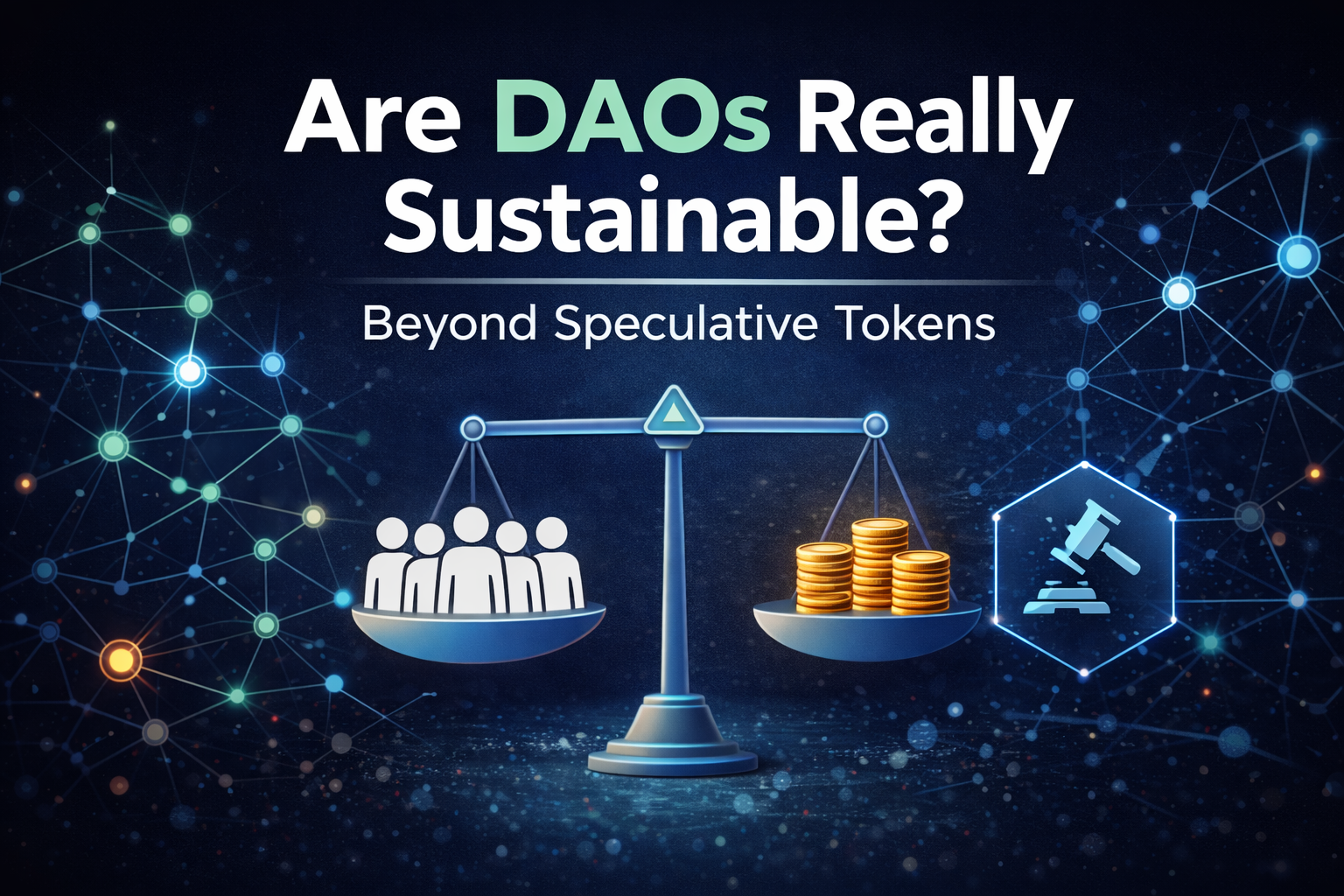
Are DAOs economically viable without speculative tokens? Explore real revenue models, governance challenges, and sustainable alternatives shaping the future of decentralized organizations.
Table of Contents
Introduction
Decentralized governance has become one of Web3’s most ambitious experiments. Over the past few years, thousands of communities have organized themselves as DAOs, managing treasuries worth billions and making collective decisions without traditional hierarchies.
Yet one uncomfortable question is gaining attention: are DAOs economically viable without speculative tokens?
Many decentralized organizations rely heavily on token price appreciation to fund operations, incentivize participation, and attract contributors. But speculation is volatile, short-lived, and often disconnected from real value creation. As markets mature, the pressure is rising to prove whether DAOs can survive—and thrive—without depending on speculative hype.
This article takes a grounded look at the economics behind decentralized organizations and whether long-term sustainability is possible beyond token speculation.
Understanding the Economic Foundation of DAOs
At their core, DAOs are internet-native organizations governed by smart contracts and collective decision-making. Instead of executives or shareholders, control is distributed among members who vote on proposals.
However, most DAOs today share a common trait:
they are token-centric.
Tokens typically serve three purposes:
- Governance rights
- Incentives for contributors
- Funding through token sales or emissions
This model worked well during bull markets, but it exposed a fragile dependency. When token prices fall, participation drops, treasuries shrink, and governance stalls—raising doubts about the long-term viability of DAOs.
The Problem With Speculative Token Dependence
Speculative tokens introduce short-term thinking into systems meant to be long-term.
Common issues include:
- Contributors chasing rewards rather than impact
- Governance manipulation by large token holders
- Treasury value tied to market sentiment, not productivity
Research and reporting from platforms like CoinDesk have repeatedly highlighted how governance participation often collapses when token incentives decline.
This dependency exposes a structural weakness: economic sustainability should not rely on price speculation alone.
Can DAOs Function Without Speculative Tokens?
The short answer: yes—but with trade-offs.
Token-less or low-speculation DAOs must rethink how value is created, captured, and distributed. Instead of focusing on token appreciation, they prioritize cash flow, services, and real economic output.
This shift moves DAOs closer to cooperative businesses rather than financial instruments.
Alternative Revenue Models for DAOs
To remain viable, DAOs must generate predictable income. Several models are already emerging.
1. Service-Based DAOs
Some DAOs operate like decentralized agencies, offering:
- Development services
- Design and marketing
- Research and analytics
Revenue comes from clients, not token emissions. Well-documented examples and DAO tooling insights can be found via DAOhaus.
2. Protocol Fee Sharing
Infrastructure DAOs can earn revenue through:
- Transaction fees
- Subscription access
- Usage-based pricing
This aligns incentives with actual adoption rather than speculation.
Governance Challenges Without Token Incentives
Removing speculative rewards doesn’t eliminate challenges—it reshapes them.
Without financial upside:
- Participation may decline
- Decision-making can slow
- Contributors need alternative motivation
Some DAOs address this through:
- Reputation-based governance
- Contribution tracking systems
- Non-transferable credentials
These systems reward long-term involvement rather than short-term trading.
The Role of Reputation and Social Capital
One promising alternative to token speculation is reputation economics.
Instead of tradable tokens, contributors earn:
- Voting power based on merit
- Recognition tied to impact
- Long-term influence within the DAO
This approach reduces governance capture and aligns incentives with organizational health. Analysts at Ethereum Foundation have explored such non-financial coordination mechanisms in depth.
Treasury Management Without Market Hype
Treasury sustainability is another key issue.
Speculative DAOs often hold volatile assets, exposing them to sudden downturns. More mature DAOs are now:
- Diversifying into stable assets
- Holding fiat or real-world instruments
- Funding operations through earned revenue
This conservative approach mirrors traditional financial management—ironically strengthening decentralized governance.
Are DAOs Competing With Traditional Companies?
In many ways, yes.
Without speculative tokens, DAOs start to resemble:
- Digital cooperatives
- Open partnerships
- Community-owned enterprises
The difference lies in transparency, global participation, and programmable governance. Regulatory discussions around such hybrid structures are increasingly analyzed by organizations like World Economic Forum.
The Psychological Shift Required
One overlooked challenge is mindset.
Speculative tokens attract:
- Traders
- Short-term participants
- Momentum-driven communities
Sustainable DAOs require:
- Builders
- Operators
- Long-term contributors
This transition is difficult but necessary. Economic viability without speculation depends more on culture than technology.
Case for Hybrid Models
The future may not be binary.
Many DAOs are experimenting with:
- Limited, non-inflationary tokens
- Revenue-backed governance rights
- Token utility without price promises
These hybrid approaches attempt to balance incentives while avoiding speculative excess.
So, Are DAOs Economically Viable Without Speculation?
Yes—but not effortlessly.
DAOs that survive without speculative tokens tend to share common traits:
- Clear revenue models
- Strong governance processes
- Value creation beyond financial incentives
- Transparent treasury management
Speculation can accelerate growth, but it cannot replace fundamentals.
Final Thoughts
The real question is not whether DAOs can exist without speculative tokens—but whether they are willing to evolve beyond them.
Long-term viability demands:
- Economic discipline
- Governance maturity
- Cultural alignment
As Web3 matures, the strongest DAOs will likely be those that treat tokens as tools—not crutches. Sustainable decentralized organizations will be built on participation, productivity, and purpose, not price charts.
Gala (GALA) Explained: How the Blockchain Gaming Ecosystem Works in the United States
Learn what Gala (GALA) is, how it works, its legal status in the United States, use cases, benefits, risks, taxes, and future outlook.