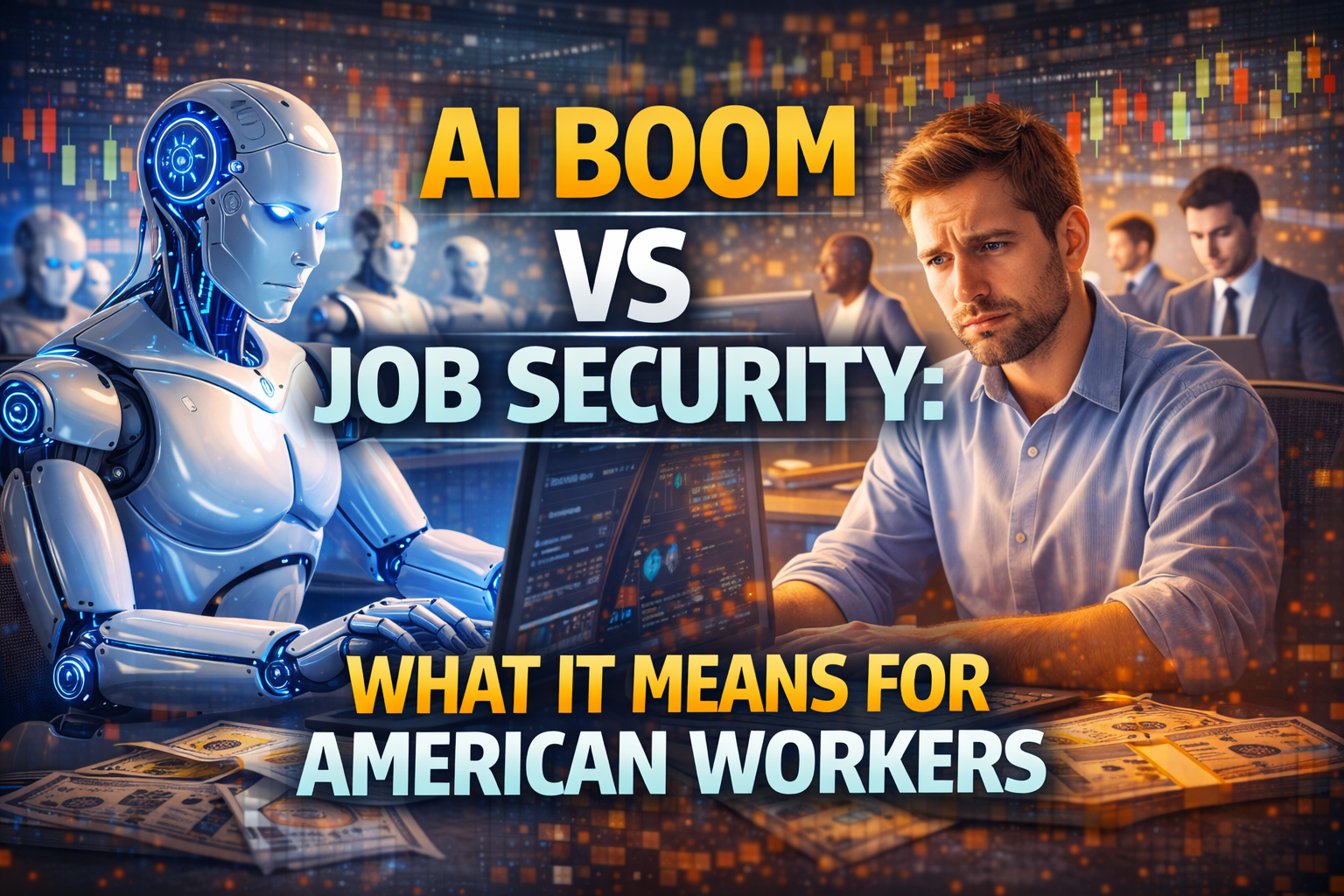
The AI Boom vs Job Security debate is reshaping America’s workforce. Explore how artificial intelligence affects jobs, wages, skills, and long-term security for U.S. workers.
Table of Contents
Introduction: Opportunity and Anxiety in the Same Moment
Artificial intelligence is no longer a futuristic promise. It is already embedded in offices, factories, hospitals, banks, and classrooms across the United States. From automated customer support to AI-assisted coding and data analysis, productivity gains are visible everywhere.
But so is fear.
For millions of Americans, the conversation around innovation has shifted from excitement to concern. As companies invest aggressively in automation, a difficult question hangs over the labor market: AI Boom vs Job Security—can both exist at the same time?
This blog explores how the AI surge is changing work in America, which jobs are most at risk, where new opportunities are emerging, and what this transformation truly means for workers in 2026 and beyond.
What the AI Boom Actually Looks Like in the U.S.
The current AI boom is not just about robots replacing factory workers. It is far broader and more subtle.
AI tools now handle:
- Data processing and analytics
- Customer service chat and voice support
- Content generation and marketing automation
- Software testing and code assistance
- Supply-chain optimization and forecasting
Unlike past waves of automation, this one directly affects white-collar and middle-skill jobs—roles once considered safe from technological disruption.
That shift is why the AI Boom vs Job Security debate feels more personal and urgent than previous technology cycles.
Why Companies Are Moving So Fast Toward AI
From a corporate perspective, the incentives are clear.
AI systems offer:
- Lower long-term labor costs
- 24/7 productivity without fatigue
- Faster decision-making
- Consistent output at scale
In a high-interest-rate environment with pressure on margins, automation becomes a strategic necessity rather than a luxury. Companies that delay risk falling behind competitors who embrace efficiency early.
This rapid adoption leaves little time for gradual workforce adjustment, increasing worker anxiety.
Which American Jobs Face the Most Pressure
Not all jobs are equally exposed. AI primarily threatens roles that are repetitive, rule-based, or data-heavy.
Higher-Risk Categories
- Administrative and clerical work
- Entry-level finance and accounting tasks
- Basic customer support roles
- Routine content production
- Some junior programming functions
These jobs are not disappearing overnight, but their demand is flattening or shrinking. Workers in these fields feel the tension at the core of AI Boom vs Job Security.
Jobs That Are More Resilient—for Now
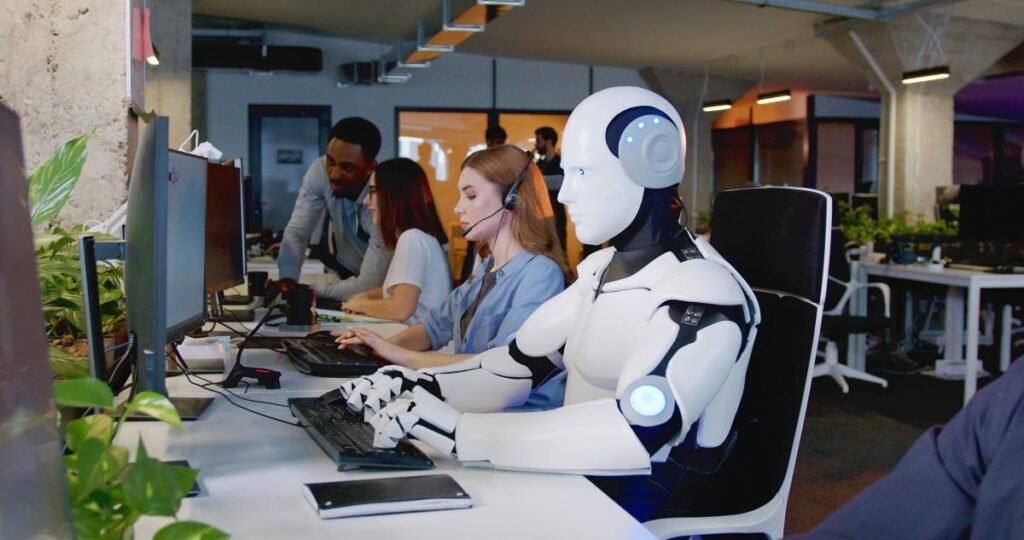
At the same time, many roles remain difficult to automate.
More Resilient Roles
- Skilled trades and maintenance
- Healthcare providers and caregivers
- Complex engineering and research
- Leadership, strategy, and management
- Creative work requiring deep human judgment
AI often augments these jobs rather than replacing them, increasing productivity instead of eliminating positions.
The challenge is that not all displaced workers can easily transition into these roles.
Wage Pressure and the Changing Value of Skills
Even when jobs remain, their value can change.
As AI boosts productivity, employers may need fewer workers to achieve the same output. This shifts bargaining power toward companies, putting downward pressure on wages in some sectors.
At the same time, workers who can use AI effectively—rather than compete against it—often command higher pay. The labor market is becoming increasingly polarized between AI-complementary skills and AI-replaceable tasks.
This dynamic deepens inequality and fuels concerns around AI Boom vs Job Security.
Why This AI Wave Feels Different From Past Automation
Technology has always disrupted jobs. So why does this moment feel more threatening?
Three reasons stand out:
- Speed – AI adoption is happening faster than previous technological shifts.
- Scope – It affects both blue-collar and white-collar work.
- Cognition – AI performs tasks once thought uniquely human, like writing, analysis, and pattern recognition.
These factors make the current transition more psychologically unsettling for workers.
The Mental and Emotional Impact on Workers
Job insecurity isn’t just an economic issue—it’s a mental health issue.
Workers increasingly report:
- Anxiety about long-term relevance
- Fear of sudden layoffs
- Pressure to constantly reskill
- Reduced confidence in career stability
Even those who keep their jobs may feel less secure, leading to cautious spending and lower risk-taking. This emotional dimension often goes unmeasured but plays a crucial role in how the economy responds to technological change.
How Policymakers Are Responding—And Where Gaps Remain
The U.S. policy response to AI-driven disruption is still evolving.
Current efforts focus on:
- Workforce retraining programs
- STEM and technical education
- AI governance and ethics guidelines
However, retraining alone cannot absorb all displaced workers quickly. Many programs lag behind industry needs, and access remains uneven across regions and income levels.
For insight into U.S. workforce adaptation:
https://www.bls.gov/emp/
Can Reskilling Really Solve the Problem?
Reskilling is essential—but not a complete solution.
Learning new skills requires time, money, and emotional energy. A mid-career worker with family obligations may struggle to pivot into a new field, even with training support.
Moreover, not everyone displaced by AI will find an equally paid role. This reality underscores why AI Boom vs Job Security is not just a training issue, but a structural economic challenge.
The Long-Term Economic Trade-Off
AI boosts productivity, which can increase overall economic growth. In theory, this creates new jobs and higher living standards.
In practice, the benefits are unevenly distributed.
Without deliberate policy and corporate responsibility:
- Gains may concentrate among capital owners
- Middle-class jobs may erode
- Social mobility may decline
The question is not whether AI will grow—it will—but whether its benefits will be shared broadly.
For broader economic analysis:
https://www.weforum.org/topics/artificial-intelligence/
What American Workers Can Do Today
While individuals cannot stop automation, they can adapt strategically.
Practical steps include:
- Learning to work with AI tools
- Developing skills that emphasize judgment, creativity, and leadership
- Staying flexible in career planning
- Building financial buffers against disruption
Adaptability, not job loyalty, is becoming the most valuable career asset.
Final Verdict: A Collision, Not a Choice
The framing of AI Boom vs Job Security suggests a binary choice—but reality is more complex.
AI is neither purely a threat nor purely a benefit. It is a force multiplier that rewards preparation and punishes complacency. For American workers, the coming years will be defined by how well individuals, companies, and policymakers manage this transition.
Final Thoughts
The AI boom is reshaping the meaning of work in America.
Some jobs will vanish. Others will evolve. New roles will emerge that do not yet exist. The outcome will not be decided by technology alone, but by choices made today—about education, fairness, and economic inclusion.
👉 In the age of AI, job security is no longer guaranteed—but relevance can be earned.
Is Dollar Dominance weakening or quietly strengthening? Explore how geopolitics, trade shifts, debt, and global crises are shaping the future of the U.S. dollar.