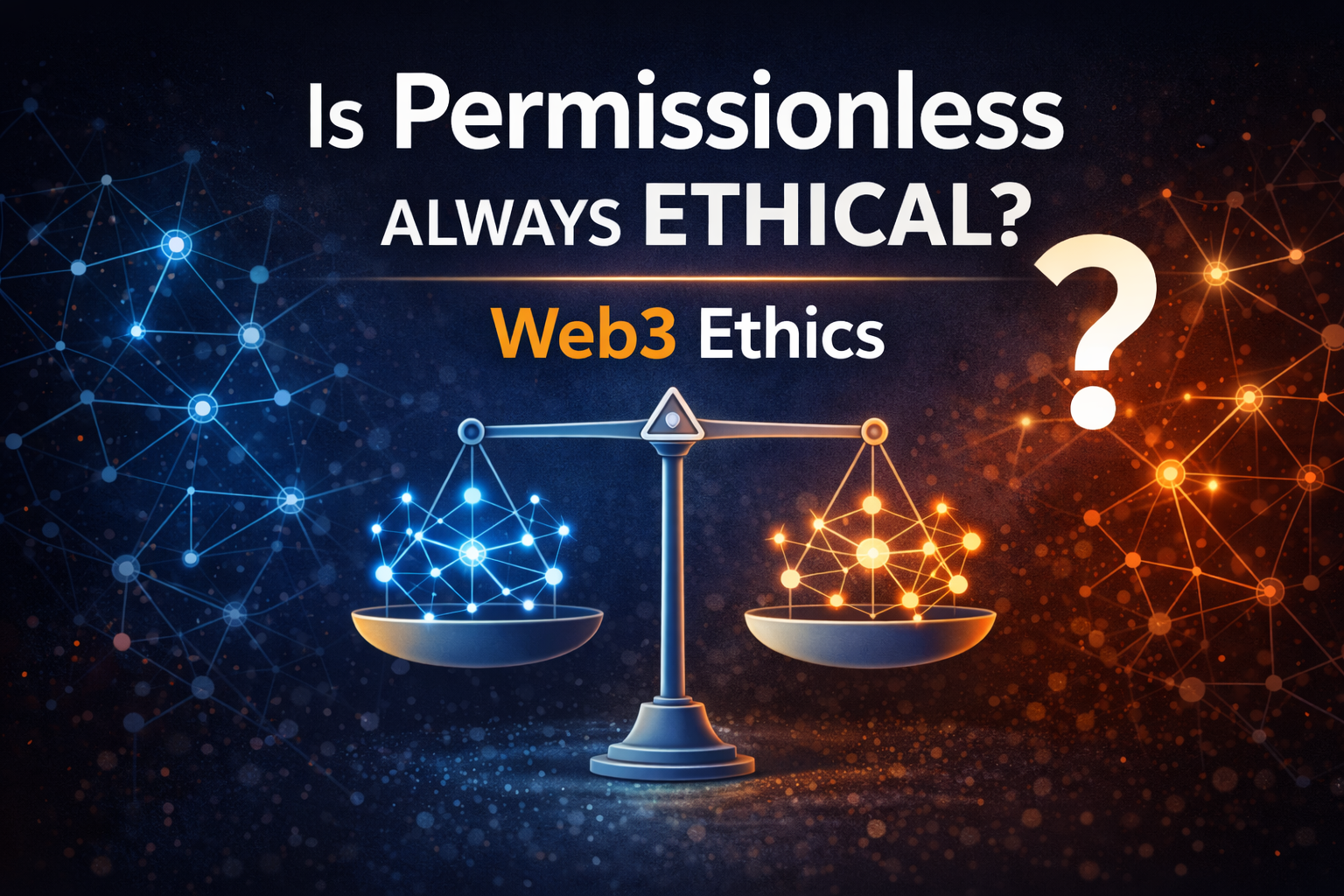
Explore Web3 Ethics and the moral debate around permissionless systems. Is decentralization truly neutral, or does responsibility still exist in Web3 design?
Table of Contents
Introduction
One of Web3’s most celebrated ideas is permissionless innovation. Anyone can build, transact, publish, or participate—no gatekeepers, no approvals, no centralized authority. To many, this feels inherently ethical. Freedom, after all, sounds like progress.
But a deeper question is quietly emerging: is “permissionless” always morally neutral?
As decentralized technologies scale globally, they don’t just empower creators and communities—they also enable scams, manipulation, financial exclusion, and harm without clear accountability. This tension sits at the heart of Web3 Ethics, a topic that deserves more than slogans and ideology.
This article explores whether permissionless systems are ethically neutral by default—or whether moral responsibility still exists in Web3 architecture, governance, and design.

What “Permissionless” Really Means in Web3
In Web3, permissionless systems allow anyone to:
- Deploy smart contracts
- Transact without identity checks
- Participate in governance
- Access financial tools globally
Technically, this is powerful. Socially, it is disruptive.
Permissionless design removes intermediaries—but it also removes filters. The assumption is that neutrality equals fairness. However, neutrality in code does not guarantee neutrality in outcomes, a central tension in Web3 Ethics.
The Myth of Moral Neutrality in Technology
A common defense in Web3 culture is:
“The technology is neutral. People choose how to use it.”
History suggests otherwise.
Technologies shape behavior by design. Defaults, incentives, and constraints influence outcomes. When systems are built without ethical foresight, harm is not accidental—it is predictable.
This idea is well explored in technology ethics research referenced by organizations like World Economic Forum, which has repeatedly highlighted how emerging technologies amplify both benefits and risks.
Permissionless ≠ Consequence-Free
One uncomfortable reality is that permissionless systems often shift responsibility, rather than remove it.
Examples include:
- DeFi protocols enabling financial exploitation
- DAOs approving harmful proposals through majority vote
- Anonymous actors launching scams with no legal trace
In traditional systems, accountability is enforced through regulation. In Web3, the absence of permission can become the absence of responsibility—an ethical gray zone central to Web3 Ethics debates.
Financial Inclusion vs. Financial Harm
Web3 often claims to bank the unbanked. In practice, permissionless finance can expose vulnerable users to:
- High volatility
- Irreversible transactions
- Complex financial instruments
Without education or safeguards, inclusion can turn into exploitation. Blockchain analysis firms frequently cited by Chainalysis have shown that retail users disproportionately bear losses in decentralized finance incidents.
Ethical design must consider who benefits and who absorbs the risk.
Governance Without Guardians
DAOs represent permissionless governance—but democracy without ethical frameworks can fail.
Key problems include:
- Voter apathy
- Whale dominance
- Majority decisions harming minorities
Just because a vote passes doesn’t mean it is ethically sound. In Web3 Ethics, legitimacy is not only about process—but about impact.
Research discussions hosted by the Ethereum Foundation often emphasize that governance systems require social norms, not just smart contracts.
Censorship Resistance vs. Social Responsibility
Censorship resistance is a core Web3 value. But absolute resistance raises moral questions.
Consider:
- Illegal content stored immutably
- Financial flows to harmful actors
- Disinformation amplified by token incentives
When nothing can be stopped, harm becomes permanent. Ethical neutrality breaks down when systems are incapable of responding to clear wrongdoing.
This is one of the most controversial areas in Web3 Ethics, because it challenges the belief that freedom must always outweigh harm prevention.
“Code Is Law” — But Whose Law?
The phrase “code is law” suggests that smart contracts replace legal systems. In reality:
- Code is written by humans
- Incentives reflect values
- Bugs create unintended outcomes
When a contract executes unfairly but “as written,” is that justice—or technical rigidity?
Many Web3 disputes end with the conclusion that users should have “known the risk.” Ethically, this shifts responsibility entirely onto individuals, ignoring power imbalances and information asymmetry.
Design Choices Are Ethical Choices
Every Web3 system makes choices:
- What defaults exist
- What risks are visible
- Who pays transaction costs
- How governance power is distributed
These are not neutral decisions. They embed values.
Ethical Web3 design does not require permission—but it does require intention. Ignoring ethics doesn’t make systems neutral; it makes them unaccountable.
Toward an Ethical Permissionless Future
Permissionless systems can coexist with ethics if builders embrace:
- Transparent risk disclosure
- Gradual decentralization
- Built-in safety mechanisms
- Community accountability norms
Some projects now experiment with:
- Time-locked governance
- Reputation-based voting
- Human-centered UX warnings
These approaches show that Web3 Ethics is not about restricting freedom—but about aligning freedom with responsibility.
Is Permissionless Always Morally Neutral?
No.
Permissionless systems are ethically incomplete by default. They remove gatekeepers—but they do not remove consequences. Pretending otherwise delays accountability and damages trust.
True decentralization maturity comes when builders ask not only “Can we build this?” but also “Should we?”
Final Thoughts
Web3 does not escape ethics—it amplifies them.
The question is no longer whether permissionless systems are powerful, but whether they are designed with moral awareness. As adoption grows, ignoring ethics becomes more dangerous than addressing them.
Web3 Ethics will define whether decentralized technologies remain tools of empowerment—or evolve into systems of unaccountable power.
Think charts drive the market? Think again. Global liquidity is the invisible force pushing Bitcoin up and down. Learn how central bank money dictates the crypto cycle in 2026.