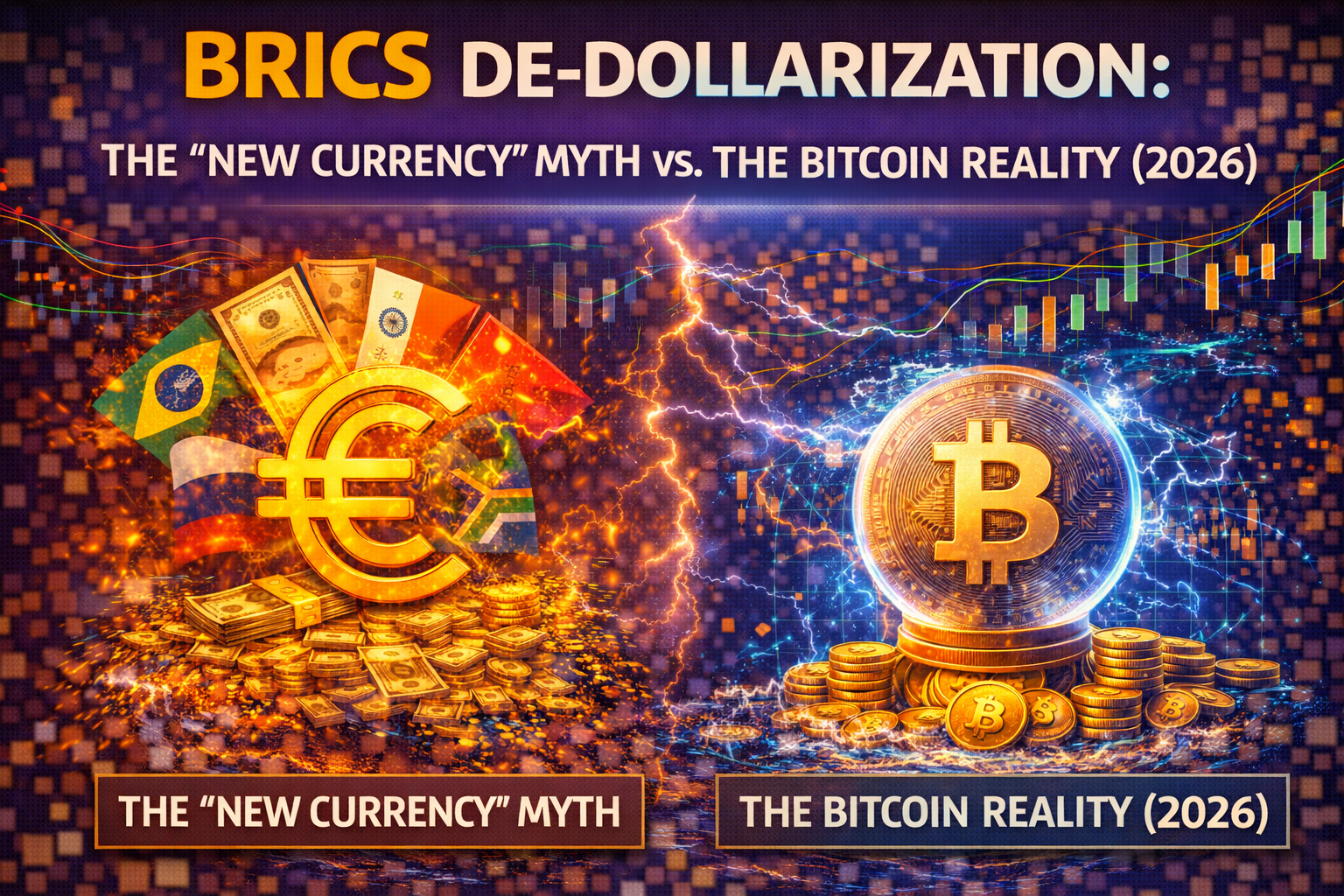
Is the BRICS currency dead? We expose the “De-Dollarization” myth in 2026, the rise of the BRICS Pay system, and why BRICS De-Dollarization might actually be the ultimate catalyst for Bitcoin.
Table of Contents
I remember the headlines back in 2024. “The Dollar is Dead!” everyone screamed. They claimed that Brazil, Russia, India, China, and South Africa were about to launch a gold-backed currency that would wipe the US Dollar off the map overnight.
Fast forward to 2026. President Trump is in the White House, threatening 100% tariffs on anyone who tries to replace the greenback. Suddenly, the loud speeches about a “BRICS Coin” have turned into whispers. Leaders like Lula and Putin are publicly backpedaling, assuring the world they have “no intention” of abandoning the dollar.
But if you look closely, something far more dangerous—and far more interesting—is happening beneath the surface.
While the myth of a single BRICS currency has been crushed by geopolitical threats, the reality of BRICS De-Dollarization is accelerating in the plumbing of the financial system. They aren’t trying to replace the dollar with a coin anymore; they are trying to replace the credit card network (SWIFT) entirely.
For crypto investors, this distinction changes everything. If you are betting on a “Petroyuan” to kill the dollar, you’re likely wrong. But if you are betting that this fragmentation creates the perfect storm for Bitcoin, you might be onto the trade of the decade.
Let’s separate the noise from the signal. Here is the truth about BRICS De-Dollarization in 2026 and what it actually means for your portfolio.
The Myth: The “BRICS Coin” Is Coming to Save Us
Let’s kill this narrative right now. There is no BRICS coin coming in 2026.
Why? Because economic unions are hard. The Euro works because European countries are somewhat similar. Imagine trying to create a shared currency for China (a manufacturing giant), India (a service tech giant), and Russia (a commodities exporter). Their economies are too different.
But the nail in the coffin was the “Trump Tariff” threat. When the US administration threatened to slap a 100% tariff on any nation attempting to bypass the dollar, the cost of rebellion became too high. India, now holding the BRICS presidency for 2026, has explicitly stated it wants “financial stability,” not a currency war with Washington.
So, if the shared currency is a myth, what is the BRICS De-Dollarization agenda actually doing?
The Reality: It’s About the Plumbing (BRICS Pay)
Instead of printing a new coin, BRICS nations are building a new payment rail.
Think of SWIFT as the Gmail of banking. It’s a messaging system that tells banks where to move money. The US controls SWIFT, which allows them to “delete” countries (like they did to Russia) from the global economy.
In response, BRICS launched “BRICS Pay” (often called “The Bridge”).
- What it is: A blockchain-based messaging layer that connects national payment systems—like India’s UPI, Brazil’s Pix, and Russia’s SPFS.
- The Goal: It allows a Brazilian shoe manufacturer to accept payments in Real, while the Chinese buyer pays in Yuan. No US Dollars involved. No US banks involved.
This is the real face of BRICS De-Dollarization. It is invisible, decentralized, and much harder for the US to sanction because no single “new currency” is being created. They are just cutting out the middleman.
Why This Matters for Bitcoin (The Neutral Asset)
So, why should a Bitcoin holder care if India buys oil from the UAE in Rupees?
Because every trade settled in local currencies is a trade not settled in US Dollars. When demand for the dollar drops internationally, those dollars come home. This exacerbates domestic inflation in the US, forcing the Federal Reserve to print more money to finance the government’s massive debt.
This is where Bitcoin shines. Bitcoin is the only asset that is:
- Neutral: It is not controlled by the US (like the Dollar) or China (like the Yuan).
- Permissionless: You don’t need a SWIFT code to send it.
- Scarce: You can’t print more of it to pay for a tariff war.
As BRICS De-Dollarization fragments the global financial system into two blocks—the “Dollar Block” and the “BRICS Block”—Bitcoin emerges as the neutral bridge between them. It is the Switzerland of digital finance.
The “mBridge” Threat: Central Bank Digital Currencies (CBDCs)
We can’t talk about BRICS De-Dollarization without mentioning mBridge. This is a project backed by the Bank for International Settlements (BIS) involving China, UAE, and others.
It uses a specialized blockchain to allow Central Bank Digital Currencies (CBDCs) to be swapped instantly.
- The Risk: Governments love CBDCs because they offer total control. They will try to force BRICS De-Dollarization through these surveillance coins, not through Bitcoin.
- The Opportunity: The more governments push for authoritarian CBDCs, the more attractive Bitcoin becomes as “freedom money.” We are already seeing this in nations like Nigeria and Argentina, where people bypass the government’s digital currency to use stablecoins and Bitcoin instead.
The Sovereign Debt Spiral
Here is the ultimate bull case. The US Dollar derives its value from being the global reserve asset. If BRICS De-Dollarization succeeds even partially—say, reducing dollar trade by 20%—the demand for US Treasury bonds collapses.
To keep the US government funded, the Fed will have to become the “buyer of last resort.” This means Yield Curve Control (printing money to buy bonds). We saw this in 2020. We saw it in 2023. When the money printer turns on to save the bond market, scarce assets go parabolic.
- Gold is the analog winner.
- Bitcoin is the digital winner.
Conclusion: Don’t Buy the Hype, Buy the Insurance
The narrative of BRICS De-Dollarization is filled with propaganda on both sides. The West says the dollar is invincible; the East says the dollar is dead tomorrow.
The truth is in the middle. The dollar is slowly bleeding market share, not via a dramatic explosion, but through a thousand small cuts called “local currency settlements.”
For the astute investor, this is the signal to diversify. You don’t need to bet on the collapse of America to win. You just need to bet that in a fractured world, neutral, hard money will command a massive premium. BRICS De-Dollarization isn’t the death of the dollar, but it might just be the birth of Bitcoin’s golden age.
Do you think Bitcoin will be used for state-level trade settlement by 2030? Let me know your theory in the comments.
Atlantic Council: The Rise of BRICS Pay and mBridge Carnegie Endowment: Navigating the New Global Financial Order
Frequently Asked Questions (FAQ)
1. Is the BRICS currency launching in 2026? No. Plans for a unified “BRICS Coin” have been effectively shelved due to economic disparities between member nations and threats of tariffs from the US. The focus has shifted to the “BRICS Pay” system for settling trades in local currencies.
2. How does BRICS De-Dollarization affect the US economy? If demand for dollars decreases globally, it becomes more expensive for the US government to borrow money. This could lead to higher domestic interest rates and higher inflation, as fewer foreign nations are willing to buy US Treasury bonds.
3. Will Bitcoin replace the Dollar for BRICS trade? Unlikely in the short term. Governments prefer currencies they control. BRICS nations are prioritizing their own CBDCs (like the Digital Yuan). However, Bitcoin may serve as a neutral “reserve asset” for companies and individuals within those nations to bypass capital controls.
4. What is BRICS Pay? BRICS Pay is a decentralized payment messaging system—similar to a blockchain version of SWIFT. It allows member nations to settle trade in their own local currencies (e.g., Rupees and Rubles) without needing to convert to US Dollars first.
5. Can the US sanction the BRICS Pay system? It is difficult. Unlike SWIFT, which is centralized and subject to Western pressure, BRICS Pay is designed to be decentralized and run on distributed ledger technology. The US can sanction individual entities using it, but shutting down the entire network is technically nearly impossible.