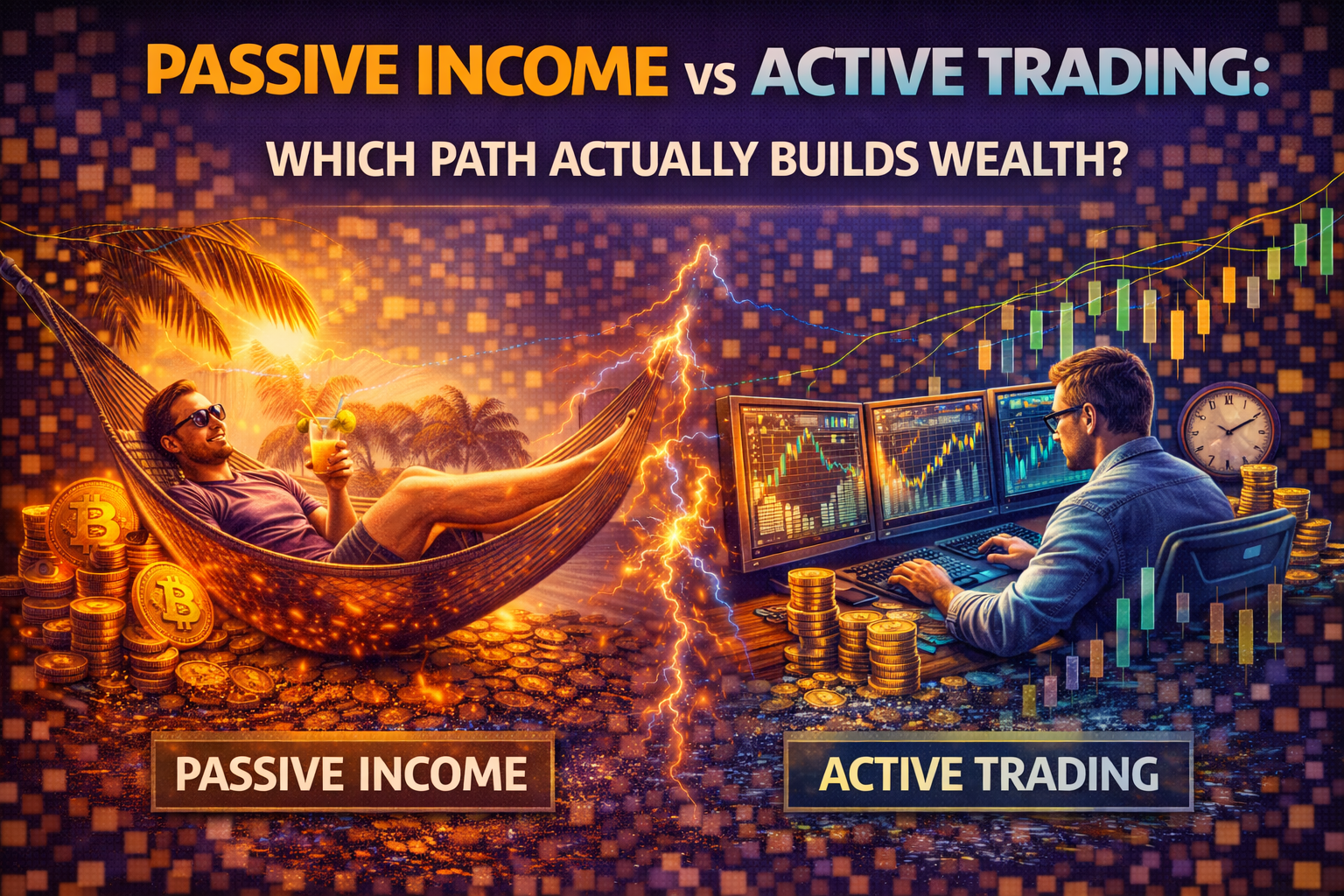
Stuck between the hustle and the yield? We break down passive income vs active trading to reveal which strategy scales your wealth and frees your time in 2026.
Table of Contents
I was sitting in a coffee shop last week, overhearing two guys debate their “financial freedom” plans. One was glued to his phone, sweating over 1-minute candle charts, bragging about a quick $500 scalp. The other was sipping his latte, talking about his dividend payouts and rental checks. It was the classic battle: the hustler vs. the investor.
It’s the question that haunts every aspiring millionaire: In the war of passive income vs active trading, which side should you pick?
If you check YouTube, you’ll see Ferraris driven by day traders claiming you can turn $1,000 into $1 million overnight. If you check Reddit, you’ll see the “FIRE” (Financial Independence, Retire Early) crowd preaching that slow, boring index funds are the only way. Both sides are partially right, and both are dangerously wrong.
The truth is, understanding the nuance of passive income vs active trading isn’t just about money; it’s about scalability. One path buys you a job; the other buys you freedom. But they often require each other to work.
In this deep dive, we are going to strip away the guru hype. We’ll look at the math, the time commitment, and the brutal reality of what actually scales when you pit passive income vs active trading against each other.
The Hustle Trap: The Reality of Active Trading
Let’s start with the sexy option. Active trading—whether it’s stocks, crypto, or forex—sells the dream of fast money. And yes, you can make a fortune. I know traders who clear six figures a month. But here is the dirty secret they don’t put on Instagram: It doesn’t scale.
When you analyze passive income vs active trading, you have to look at the “Input/Output” ratio. In trading, your input is you.
- The Time Sink: To be a profitable active trader, you are chained to the screen. You are reading charts, analyzing news, and managing risk 10 hours a day. If you stop working, the money stops.
- The Stress Cap: There is a psychological limit to how much capital you can actively manage. Trading a $10,000 account is fun. Trading a $10 million account is terrifying. The emotional toll prevents most people from scaling up.
So, when we compare passive income vs active trading, realize that active trading is essentially a high-paid, high-stress job. It is active income, not wealth building. You are the bottleneck.
The Yield Engine: The Power of Passive Income
Now, let’s look at the boring side. Passive income—dividends, staking rewards, rental income, royalties—is the slow burner.
The core difference in passive income vs active trading is that passive income divorces your time from your money.
- The Scalability: If you own 100 shares of a dividend stock, it takes zero effort. If you own 10,000 shares, it still takes zero effort. The income scales linearly (or exponentially) without requiring more of your life.
- The Compounding Effect: While the trader is stressing over the next 5% move, the passive investor is reinvesting their payouts. Over 10 years, this “snowball effect” often outperforms the erratic gains of the trader.
However, the “Passive Income” dream has a flaw: You need money to start. This is where the debate of passive income vs active trading gets interesting. You can’t generate meaningful passive income with $500. A 5% yield on $500 is $25 a year. That won’t buy you a coffee, let alone freedom.
The Hybrid Model: Why You Need Both
This is the epiphany that changed my life. You shouldn’t view it as a binary choice of passive income vs active trading. You should view them as steps in a sequence.
Step 1: Active Trading to Build Capital Use active trading (or a high-income skill) to generate “chunks” of cash. This is your growth engine. You use your time and skill to extract money from the market aggressively.
Step 2: Funnel into Passive Income Take the profits from your trading and immediately move them into passive vehicles. This solves the flaw of both systems.
- It solves the “capital problem” of passive investing.
- It solves the “burnout problem” of active trading.
When you structure your life this way, the battle of passive income vs active trading disappears. Active trading becomes your funding source, and passive income becomes your wealth storage.
Real Life Example: The “Bucket” Strategy
Let’s look at a real-world scenario of passive income vs active trading in action.
Meet Sarah. She has $10,000. Scenario A (Pure Trader): She day trades crypto. She turns $10k into $50k in a bull run. She feels rich. Then the bear market hits, she over-leverages, and drops back to $5k. She has nothing to show for 2 years of stress. Scenario B (The Hybrid): She trades the same way. But every time she makes $1,000 profit, she moves $500 into a boring S&P 500 ETF or a staking pool. Even if she blows up her trading account, she has built a permanent safety net. She used the volatility of active trading to fuel the stability of passive income.
This is why, when discussing passive income vs active trading, the smartest people use the “Barbell Strategy”: High risk on one side, zero risk on the other.
The Tax Implications: Uncle Sam’s Vote
You can’t talk about passive income vs active trading without talking about the IRS.
- Active Trading Taxes: Short-term capital gains are taxed as ordinary income. In the US, that can be 37%. You take all the risk, and the government takes a third of the reward.
- Passive Income Taxes: Long-term capital gains (assets held >1 year) and qualified dividends are taxed at 0%, 15%, or 20%.
From a tax efficiency standpoint, passive income wins the passive income vs active trading war hands down. It allows you to keep more of what you make.
Scalability: The Final Verdict
Let’s go back to our primary keyword: passive income vs active trading – what really scales?
Active trading does not scale indefinitely. Liquidity issues, slippage, and psychological limits act as a ceiling. You cannot day trade $1 billion the same way you day trade $100,000.
Passive income scales infinitely. Warren Buffett doesn’t sit at his computer day trading Apple. He collects dividends. He owns businesses. His wealth scales because it doesn’t rely on his daily labor. If your goal is to make $10,000 a month, active trading might get you there faster. But if your goal is to make $10 million a year, passive income (asset ownership) is the only mathematical way to get there.
Risk Profile: Can You Handle the Heat?
The choice between passive income vs active trading ultimately comes down to your personality type.
- The Adrenaline Junkie: If you need action, dopamine hits, and control, you will hate passive investing. You will tinker with it until you break it. You are built for active trading.
- The Strategist: If you prefer systems, patience, and long-term planning, active trading will destroy your nervous system. Stick to passive flows.
Most people fail because they try to force themselves into a box that doesn’t fit their wiring. They try active trading because they want “fast money,” not because they are good traders.
Conclusion: The Ultimate Wealth Hack
So, who wins the heavyweight bout of passive income vs active trading?
In the short term, active trading wins on speed. In the long term, passive income wins on freedom. But the ultimate winner is the person who masters the flow between the two. Use active trading to get rich; use passive income to stay rich.
Don’t let the internet convince you that you have to pick one side. The magic happens in the middle. Stop debating passive income vs active trading and start building a system that leverages both to buy back your time.
Are you currently an active trader, or are you focused on building your passive stack? Let me know your current split in the comments.
Frequently Asked Questions (FAQ)
1. Which is riskier: passive income or active trading? When comparing passive income vs active trading, active trading carries significantly higher risk. You can lose your principal investment rapidly due to market volatility and leverage. Passive income strategies generally focus on long-term growth and preservation, though they still carry market risk.
2. Can I start passive income investing with small amounts? Yes, but don’t expect to quit your job immediately. While passive income vs active trading debates often highlight the low barrier to entry for trading, you can start passive investing with as little as $5 using fractional shares or staking, but meaningful income requires substantial capital accumulation over time.
3. Is active trading considered a job or investing? Most financial experts classify active trading as a job. Unlike passive investing where money works for you, active trading requires your direct labor and time. This distinction is crucial when weighing passive income vs active trading for your lifestyle goals.
4. How much capital do I need to live off passive income? A common rule of thumb is the “4% Rule.” If you need $50,000 a year to live, you need roughly $1.25 million invested. This high capital requirement is why many people turn to active trading first—to build that nest egg faster than a 9-5 job allows.
5. Why do most active traders fail? Statistics show that 90% of active traders lose money. This is often due to emotional decision-making, lack of risk management, and over-leveraging. In the passive income vs active trading comparison, passive investing has a much higher success rate for the average person because it removes human error from the daily equation.