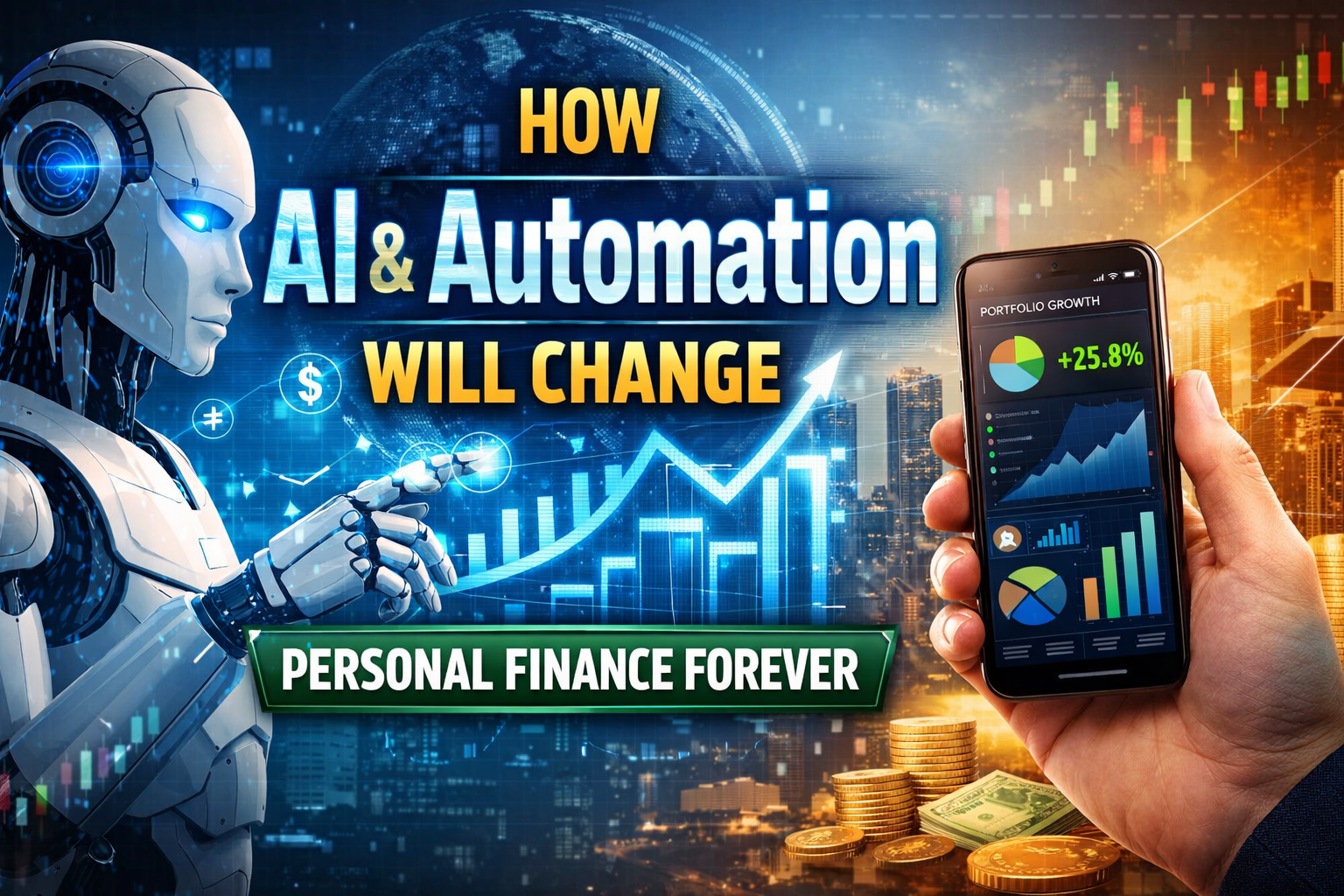
Discover how AI and Automation are transforming personal finance forever—from budgeting and investing to debt management and income growth. Learn what’s changing and how to adapt.
Table of Contents
Introduction: The Silent Financial Revolution
Personal finance is no longer just about saving money, budgeting monthly expenses, or picking the right investment. A quiet but powerful transformation is underway. AI and Automation are reshaping how people earn, save, invest, and manage money—across borders, income levels, and age groups.
Earlier, financial growth depended heavily on human judgment, manual tracking, and traditional advisors. Today, algorithms can analyze thousands of financial variables in seconds, automate complex decisions, and personalize money management like never before. This shift is not temporary. AI and Automation will change personal finance forever, and those who adapt early will benefit the most.
This article explores how this transformation is happening, what it means for individuals globally, and how you can stay financially relevant in an AI-driven world.
What Do AI and Automation Mean in Personal Finance?
AI (Artificial Intelligence) refers to systems that learn from data, identify patterns, and make decisions with minimal human input.
Automation refers to using technology to execute tasks automatically—without constant supervision.
In personal finance, AI and Automation work together to:
- Analyze spending behavior
- Predict future financial risks
- Optimize investments
- Automate savings and bill payments
- Detect fraud in real time
Instead of reacting to financial problems, people can now prevent them before they occur.
AI and Automation in Budgeting: From Manual to Intelligent
Traditional budgeting requires discipline, spreadsheets, and frequent updates. Most people fail—not because they lack income, but because tracking money manually is exhausting.
How AI Changes Budgeting
AI-powered tools:
- Automatically categorize expenses
- Detect overspending patterns
- Predict upcoming cash shortages
- Suggest personalized spending limits
Unlike static budgets, AI adapts in real time. If your income changes or expenses rise, the system adjusts instantly.
AI and Automation turn budgeting from a task into a background process—running silently while you focus on life.
👉 Example tools:

AI and Automation in Investing: Smarter Than Human Emotions
Human investors are emotional. Fear and greed drive poor decisions—panic selling, overtrading, or chasing trends.
Enter AI-Driven Investing
AI investing platforms:
- Analyze market data 24/7
- Remove emotional bias
- Automatically rebalance portfolios
- Match investments to risk tolerance
This makes investing more accessible to beginners and more efficient for experienced investors.
Robo-Advisors and Automation
Robo-advisors use AI and Automation to:
- Build diversified portfolios
- Adjust asset allocation over time
- Optimize tax efficiency
Popular platforms include:
AI does not guarantee profits—but it reduces human error significantly.
Debt Management and Credit Scoring Will Never Be the Same
Debt is one of the biggest personal finance challenges worldwide. Credit cards, student loans, and personal loans often spiral out of control.
AI-Powered Debt Optimization
AI systems can:
- Analyze interest structures
- Suggest optimal repayment strategies
- Automate EMI prioritization
- Predict default risk early
Some platforms even negotiate better terms using automated systems.
Smarter Credit Scoring
Traditional credit scores rely on limited data. AI and Automation use alternative data:
- Payment behavior
- Spending patterns
- Income stability
This improves financial inclusion—especially for people without traditional credit histories.
Learn more about modern credit models:
https://www.investopedia.com/terms/c/credit-score.asp
Fraud Detection and Financial Security in the AI Era
Financial fraud is increasing—but so is the technology fighting it.
How AI Protects Your Money
AI systems:
- Detect unusual transactions instantly
- Identify suspicious behavior patterns
- Block fraud before damage occurs
Unlike humans, AI never sleeps. It monitors accounts continuously.
Banks and fintech companies rely heavily on AI and Automation to secure user data and money, making digital finance safer than ever.
Personalized Financial Advice at Scale
Earlier, financial advisors were accessible only to the wealthy. Today, AI and Automation democratize financial guidance.
AI as a Personal Finance Coach
AI-driven platforms provide:
- Personalized savings advice
- Investment recommendations
- Retirement planning simulations
This advice evolves as your income, goals, and expenses change.
While AI cannot fully replace human advisors for complex planning, it covers 80–90% of everyday financial decisions—at a fraction of the cost.
How AI and Automation Will Change Income and Financial Planning
AI is not just changing money management—it’s changing income itself.
New Income Models
- Automated online businesses
- AI-powered freelancing
- Algorithm-based trading
- Content monetization using automation
At the same time, automation may replace some traditional jobs. This makes financial adaptability more important than ever.
Financial Planning in an Uncertain Future
AI tools can:
- Simulate future income scenarios
- Predict retirement shortfalls
- Adjust long-term plans dynamically
This turns financial planning into a living system—not a one-time calculation.
Risks and Limitations of AI and Automation in Personal Finance
Despite the benefits, blind trust in AI is dangerous.
Key Risks
- Over-reliance on algorithms
- Data privacy concerns
- Bias in AI models
- Lack of human judgment in rare events
AI works best when combined with human awareness. Understanding the basics of money remains essential.
Read more on ethical AI concerns:
https://www.weforum.org/topics/artificial-intelligence/
How Individuals Can Adapt to AI and Automation
To survive and thrive financially, adaptation is mandatory.
Practical Steps:
- Learn basic financial literacy
- Use AI tools—but understand their logic
- Diversify income sources
- Focus on skills AI can’t easily replace
- Stay updated with fintech trends
The goal is not to fight AI and Automation, but to collaborate with them.
The Future of Personal Finance: Human + AI
The future belongs to those who combine:
- Human intuition
- Ethical judgment
- AI-driven efficiency
AI and Automation will change personal finance forever, but they do not eliminate personal responsibility. Instead, they amplify smart decisions and expose careless ones faster.
Those who understand this shift early will build wealth more efficiently, protect their money better, and gain financial freedom in ways previous generations never could.
Final Thoughts
Personal finance is entering its most transformative phase in history. From budgeting and investing to income generation and security, AI and Automation are redefining how money works.
The real question is not whether this change will happen—but whether you are prepared for it.
If you embrace this evolution wisely, the future of personal finance can work in your favor—automatically.
Understanding the 1099-DA: Your 2026 Crypto Tax Survival Guide