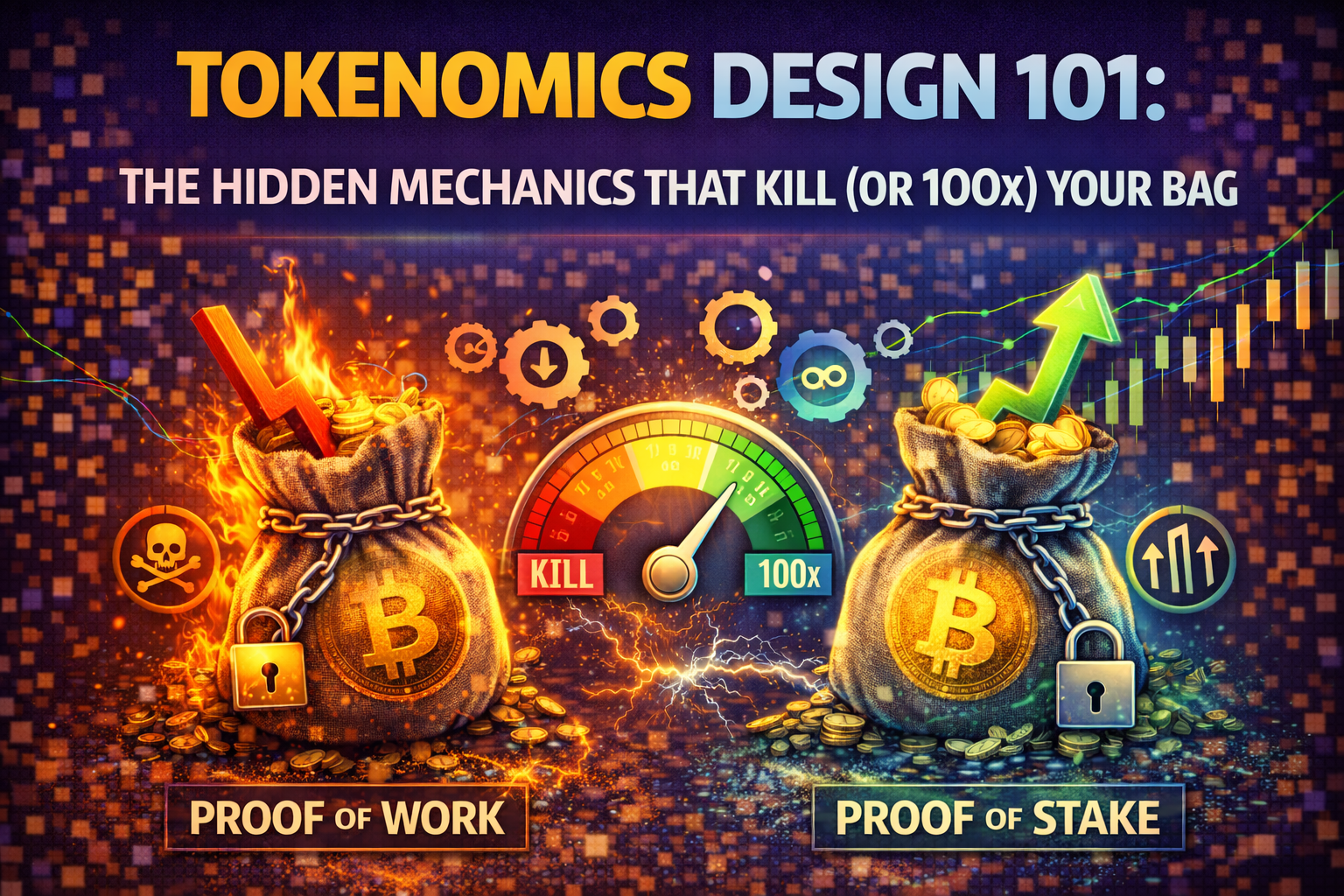
Is that 100x crypto gem a future giant or a slow-motion rug pull? Master Tokenomics Design—from emissions and vesting to inflation—to spot the difference before you invest.
Table of Contents
I still remember staring at my portfolio in late 2021, wondering why a specific DeFi token—let’s call it “FarmCoin”—was tanking 10% a day even though the project was growing. They had users. They had volume. They had hype.
But the price chart looked like a waterslide to zero.
The problem wasn’t the technology. The problem was the Tokenomics Design. The protocol was printing new tokens faster than the Federal Reserve during a crisis, diluting my holdings every single second. I wasn’t an investor; I was “exit liquidity” for the founders.
If you are serious about crypto, you have to stop looking at the price and start looking at the plumbing. Tokenomics design is the mathematical DNA of a cryptocurrency. It dictates who gets paid, when they get paid, and whether the token is designed to accrue value or slowly bleed to death.
In this guide, we are going to dissect the machinery. We’ll look at emissions, vesting cliffs, and the eternal battle between inflation and deflation. By the end, you’ll be able to look at a whitepaper and know instantly if you’re looking at a gem or a trap.
The Supply Schedule: Understanding Emissions
The first thing you need to check is the Emission Schedule. This refers to the rate at which new tokens are created and released into circulation.
Think of it like a company issuing new shares. If Apple suddenly doubled its total shares overnight, the value of your share would be cut in half. Crypto projects do this constantly, usually under the guise of “staking rewards” or “liquidity mining.”
The “Farm Token” Trap
In the last cycle, we saw the rise of high-emission tokens.
- The Pitch: “Stake your tokens and earn 5,000% APR!”
- The Reality: That APR is paid in newly printed tokens. The supply explodes, outpacing demand. The price crashes.
- The Lesson: If the emission rate is higher than the user growth rate, the price must go down. It’s simple math.
Sustainable tokenomics design usually involves a “halving” mechanism (like Bitcoin) or a decay curve, where emissions slow down over time as the network matures.
Vesting Schedules: The “VC Dump”
If emissions are the slow bleed, Vesting Schedules are the guillotine.
When a crypto project launches, the team and early investors (Venture Capitalists) get a massive chunk of the supply—often 20% to 40%. But they aren’t allowed to sell immediately. They have a “lock-up” period.
This is where you need to pay attention to two terms: Cliff and Linear Vesting.
The Cliff
The “Cliff” is the waiting period before any tokens are unlocked.
- Example: A 1-year cliff means VCs get zero tokens for the first 12 months.
- The Danger Zone: On Month 13, the cliff ends. Suddenly, millions of dollars worth of tokens are unlocked and hit the market. This is often called a “Unlock Event.” If you are holding the token on that day, you are likely to get crushed by sell pressure.
Linear Vesting
After the cliff, tokens usually unlock gradually—say, monthly over 3 years. This is Linear Vesting.
- Good Design: A long cliff (1+ year) followed by a long linear vest (2-4 years). This aligns the investors with the long-term success of the project.
- Bad Design: A short cliff (3 months) followed by a massive unlock. This is a sign the insiders want to cash out quickly.
Pro Tip: Always check sites like TokenUnlocks or CoinMarketCap to see the next major unlock date. Never buy right before a cliff ends.
Inflation vs. Deflation: The Supply Dynamics
Should a token supply go up or down? The debate over Inflation vs Deflation is central to modern tokenomics design.
The Inflationary Model (Dogecoin, Solana)
Most Layer 1 blockchains are inflationary. They print new tokens to pay validators (security budget).
- Pros: It incentivizes people to run nodes and secure the network forever.
- Cons: Your purchasing power is diluted over time unless you stake your tokens to earn the rewards.
The Deflationary Model (BNB, Ethereum)
This is the “Ultra Sound Money” narrative.
- Mechanics: The protocol takes a portion of the revenue (transaction fees) and “burns” it—removing it from existence forever.
- The Result: If demand stays the same but supply drops, price goes up.
The “Real Yield” Revolution
In 2026, the market has moved toward a hybrid model called Real Yield. Instead of printing new tokens to pay stakers (which is inflationary), protocols pay stakers using actual revenue (USDC or ETH) generated by the app. This is non-inflationary. It doesn’t dilute the supply. It’s the gold standard of modern tokenomics design.
Allocation: Who Owns the Network?
Before you buy, look at the pie chart. The Token Allocation tells you who really owns the project.
The Red Flags:
- Team + Insiders > 50%: This is effectively a centralized company. They have total control over governance and price.
- “Ecosystem Fund” with no rules: Often a slush fund for the team to sell tokens whenever they want.
The Green Flags:
- Community/Public Sale > 50%: This suggests a fair launch where the users own the network.
- Treasury controlled by DAO: Funds can only be spent if the community votes on it.
Token Utility: Why Does This Thing Exist?
Finally, ask the most important question: What does this token actually do?
In the ICO craze of 2017, most tokens were “Utility Tokens”—you needed them to use the software. Today, that model is largely dead because it adds friction. (Imagine needing “Facebook Coin” just to like a post).
In 2026, successful tokenomics design revolves around two things: Governance and Cash Flow.
- Governance: The token lets you vote on protocol changes. This has value for large entities (like exchanges) who want to influence the network.
- Cash Flow (Fee Switch): The token allows you to claim a share of the protocol’s revenue. This turns the token into a productive asset, similar to a dividend stock.
If a token has no governance power and no path to revenue share, it is a “Memecoin” in disguise. Trade it for fun, but don’t invest in it.
Frequently Asked Questions (FAQ)
What is a “good” inflation rate for a crypto token?
tokenomics design : There is no magic number, but generally, single-digit inflation (under 5-8%) is considered sustainable for established Layer 1 blockchains. For newer projects, higher inflation is acceptable initially to bootstrap growth, provided there is a clear plan to taper it down over time.
tokenomics design : How do I check the vesting schedule of a token?
You can find vesting details in the project’s “Whitepaper” or “Docs” section. Additionally, third-party analytics sites like TokenUnlocks and Messari provide visual charts showing upcoming unlock events and insider allocations.
Is token burning always good for the price?
Not always. Burning tokens is a marketing gimmick if the tokens being burned were never in circulation (e.g., the team burning their own “reserve” pile). For a burn to impact price, it must remove circulating supply or be tied to actual usage (like Ethereum burning gas fees).
What is the difference between “Circulating Supply” and “Fully Diluted Valuation” (FDV)?
Circulating Supply is the number of tokens currently in public hands. FDV is the market cap if all tokens (including locked team/investor tokens) were released today. A low market cap but high FDV is a warning sign of high future inflation.
Can tokenomics be changed after launch?
Yes, if the project has a governance mechanism. Token holders can vote to change emission rates, burn mechanisms, or staking rewards. However, changing the total supply or vesting schedules of early investors is usually hard-coded and immutable.
Conclusion: Don’t Be Exit Liquidity
The most dangerous words in crypto are “It’s going to the moon” followed by a chart that ignores Tokenomics Design.
tokenomics design : Price action is marketing. Tokenomics is gravity. You can fight gravity for a while with hype, but eventually, the supply dynamics win.
Before you put a single dollar into a new project, find the emission schedule. Check the vesting cliffs. Ask where the yield comes from. If you can’t find the answers, or if the answers are buried in complex jargon, walk away. In this game, clarity is the only true alpha.