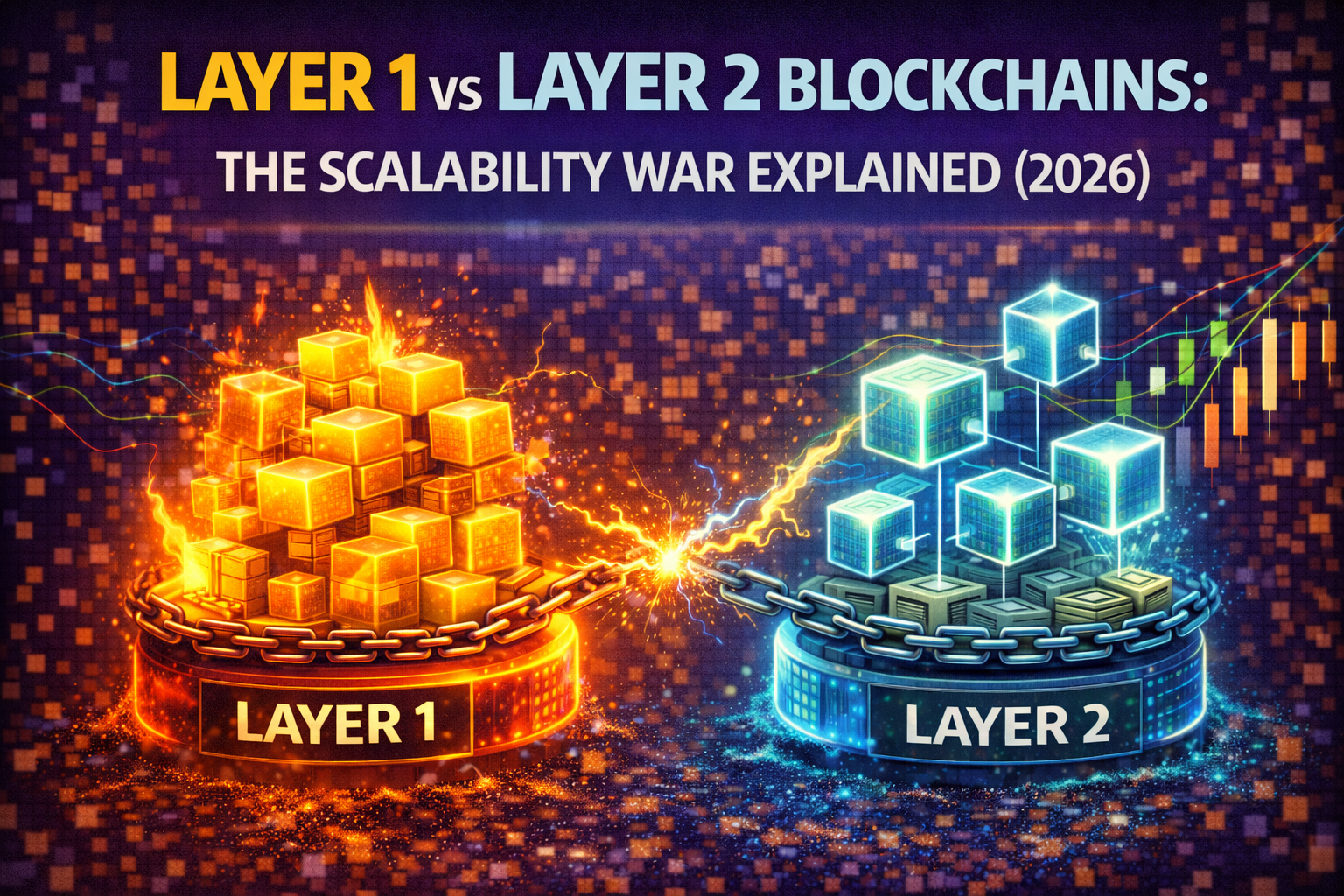
Confused by Layer 1 vs Layer 2 blockchains? We break down the scalability wars, gas fees, and why 2026 is the year of the “Superchain” adoption.
Table of Contents
I still have a screenshot on my phone from the 2021 bull run. It shows a transaction fee of $120 just to send $50 worth of Ethereum. It was ridiculous. It was unusable. It was the moment I realized that if crypto was ever going to be more than a casino for the rich, something had to change.
That change has arrived, and it’s the driving force behind the 2026 market structure. It’s the battle of Layer 1 vs Layer 2 blockchains.
If you are new to this, the terminology can feel like word salad. But understanding the difference between the “base layer” and the “execution layer” is critical for your portfolio. It explains why Ethereum is becoming the “settlement layer” for the internet, while new, lightning-fast networks are handling the actual traffic.
Today, we aren’t just talking tech specs. We are talking about economics. We are going to strip down the Layer 1 vs Layer 2 blockchains debate to see where the value is accruing, why fees have dropped to pennies, and which layer you should actually be betting on.
The Highway Analogy: Understanding the Bottleneck
To understand Layer 1 vs Layer 2 blockchains, stop thinking about computers and start thinking about traffic.
Layer 1 (L1) is the main highway. Think of Bitcoin or Ethereum.
- The Job: Security and Finality. It ensures nobody is cheating.
- The Problem: Everyone wants to use this highway at the same time. But it only has two lanes. When traffic spikes, everything jams up, and the “tolls” (gas fees) skyrocket. Only the highest bidders get through.
Layer 2 (L2) is a massive, double-decker express bus that drives on top of the highway.
- The Job: Speed and Capacity.
- The Solution: Instead of 1,000 cars trying to squeeze onto the highway, 1,000 people get on the bus. The bus drives down the highway as a single vehicle (one transaction). When it arrives, everyone gets off.
- The Result: The toll is split 1,000 ways. Everyone pays a fraction of a cent, but they still get the security of traveling on the main highway.
This “bus” system is how Layer 2 scaling solutions work. They bundle transactions off-chain and then settle the final bill on the L1.
Layer 1: The Foundation (Security at a Price)
The Layer 1 blockchain is the source of truth. Bitcoin, Ethereum, Solana, and Avalanche are all L1s. They are the bedrock.
When you transact directly on a Layer 1, you are paying for premium security. Every single node in the global network has to verify your coffee purchase. In 2026, we’ve realized this is inefficient. It’s like using an armored truck to deliver a pizza.
- The Trilemma: L1s suffer from the “Scalability Trilemma.” You can only pick two: Decentralization, Security, or Scalability. Ethereum picked the first two, which is why it’s slow. Solana tried to pick all three but has faced centralization concerns and outages.
- The Investment Thesis: Investing in an L1 is like investing in land. You want the real estate that everyone builds on top of. If the L2s (the buildings) are successful, the L1 (the land) becomes valuable because the L2s pay rent (security fees) to the L1.
Layer 2: The Execution (Speed for the Masses)
The conversation around Layer 1 vs Layer 2 blockchains shifted massively when “Rollups” became the standard.
L2s like Arbitrum, Optimism, and Base (Coinbase’s chain) take the heavy lifting off Ethereum. They process thousands of transactions per second and then just post a “proof” back to Ethereum saying, “Yep, all this happened.”
The Two Flavors of L2
- Optimistic Rollups: These assume all transactions are valid unless someone proves otherwise (innocent until proven guilty). They are cheaper and currently dominate the market.
- ZK (Zero-Knowledge) Rollups: These use complex math to prove transactions are valid instantly. They are the “holy grail” of scaling—faster and more secure, though harder to build.
In 2026, we are seeing the rise of the “Superchain”—where different Layer 2 blockchains talk to each other seamlessly. You might not even know you are on an L2 anymore; the apps just feel fast and cheap.
The Economics of Fees: Why L2 Wins
If you are a user, the winner of Layer 1 vs Layer 2 blockchains is already decided. It’s L2.
Let’s look at the numbers:
- Swap on Ethereum (L1): $5.00 – $15.00
- Swap on Arbitrum (L2): $0.01 – $0.05
- Swap on Solana (High-Performance L1): $0.001
This fee reduction unlocks entire industries.
- Gaming: You can’t put a game on a blockchain if every sword swing costs $5. On L2, it costs nothing.
- Social Media: “Decentralized Twitter” only works if “liking” a post is free. L2s make this possible.
This is why adoption metrics (Active Addresses) are exploding on L2s while staying flat on Ethereum L1. The users are migrating to the express lane.
Where Does the Value Go? The Investor’s Dilemma
Here is the tricky part for finance nerds like us. If everyone moves to L2, does the L1 die?
Not necessarily. In the Layer 1 vs Layer 2 blockchains economy, the relationship is symbiotic, but parasitic in nature.
- L2s need L1: Without Ethereum’s security, Arbitrum is just a centralized database. They must pay Ethereum ETH to settle data.
- L1 needs L2: Without L2s, Ethereum becomes a ghost town because nobody can afford to use it.
However, in 2026, we are seeing a “cannibalization” risk. L2 fees have become so cheap (thanks to the EIP-4844 upgrade) that they aren’t paying that much rent to Ethereum anymore. This has caused some concern for ETH holders—is the “Ultra Sound Money” narrative breaking because the L2s are too efficient?
Meanwhile, L2 tokens (like ARB or OP) have their own issues. They often act as “governance tokens” with no real revenue share. The users are there, but the value capture for the token holder is questionable.
The “Alt-L1” Survivor: Solana
We can’t talk about Layer 1 vs Layer 2 blockchains without mentioning the outlier: Solana.
Solana rejects the Layer 2 vision. It says, “Why build a bus on top of the highway? Let’s just build a highway with 10,000 lanes.” This is the Monolithic vs. Modular debate.
- Modular (Ethereum): Split the tasks. L1 does security; L2 does speed.
- Monolithic (Solana): Do it all on one layer.
In 2026, both models are thriving. Solana is capturing the retail/memecoin mania because it is simple (no bridging required). Ethereum + L2s are capturing the institutional/DeFi world because of superior security guarantees.
Adoption: The “Mullet” Strategy
The future of Layer 1 vs Layer 2 blockchains is that you won’t care.
We are moving toward the “Mullet” strategy of adoption: Web2 in the front, Web3 in the back.
- The Front: You open a finance app. You send money. It’s instant and free.
- The Back: The app is routing your transaction through Base (L2), which settles on Ethereum (L1).
You don’t need to know how TCP/IP works to send an email. You shouldn’t need to know what an “Optimistic Rollup” is to buy a stablecoin. The friction is vanishing.
Frequently Asked Questions (FAQ)
What is the main difference between Layer 1 and Layer 2?
Layer 1 is the base blockchain (like Ethereum) responsible for security and final settlement. Layer 2 is a scaling solution built on top of Layer 1 to process transactions faster and cheaper, inheriting the security of the L1.
Is Polygon a Layer 1 or Layer 2?
Polygon is unique. It started as a sidechain (acting like an L1) but has evolved into a true Layer 2 ecosystem with its zkEVM (Zero-Knowledge Ethereum Virtual Machine) rollups. In the modern context, it is widely categorized alongside Layer 2 blockchains.
Do I need to bridge my tokens to use Layer 2?
Yes. Assets natively live on Layer 1. To use an L2, you must “bridge” (move) your tokens from the L1 to the L2 network. However, in 2026, many exchanges and wallets do this automatically for you.
Are Layer 2s as safe as Layer 1s?
Generally, yes, but with a caveat. They derive their security from the L1, but the “Sequencer” (the computer ordering the transactions on the L2) can be centralized. If the sequencer goes down, the network might pause, though your funds usually remain safe on the L1.
Why are Layer 1 fees so high?
Layer 1 fees are high because block space is limited. When demand exceeds supply, users enter a “bidding war” (gas fees) to get their transaction processed. Layer 2s solve this by batching thousands of transactions into one, splitting the cost.
Conclusion: The Era of Cheap Scale
The war of Layer 1 vs Layer 2 blockchains isn’t really a war; it’s an evolution. We spent a decade building the engine (L1); now we are building the chassis and the wheels (L2).
For the investor, the signal is clear: Volume and activity are moving to L2s. The “Base Layer” assets (ETH, BTC, SOL) remain the pristine collateral—the digital gold and oil. But the “Execution Layer” is where the commerce happens.