As NATO members sharply increase military spending, national economies face rising debt, inflationary pressure, and social trade-offs. This in-depth analysis explains the hidden economic costs behind the defense boom.
Table of Contents
Introduction: When Security Starts Costing the Economy
In recent years, global politics has taken a decisive turn toward confrontation rather than cooperation. From Eastern Europe to the Indo-Pacific, governments are prioritizing security at levels unseen since the Cold War. At the center of this shift is NATO, whose members are rapidly increasing defense budgets in response to perceived threats.
While this surge is often justified as a necessary step to ensure national and collective security, it comes with significant economic consequences. Defense spending does not exist in a vacuum. Every additional dollar allocated to weapons, troops, and military infrastructure is a dollar not spent on healthcare, education, or productive economic investment.
This blog explores how the military spending boom is quietly distorting national economies, reshaping fiscal priorities, and creating long-term structural risks—especially for taxpayers and future generations.
NATO’s Defense Push: What Changed?
For decades after the Cold War, many alliance members treated defense as a secondary concern. Military budgets shrank, and the so-called “peace dividend” allowed governments to expand welfare programs and invest in infrastructure.
That approach has now reversed.
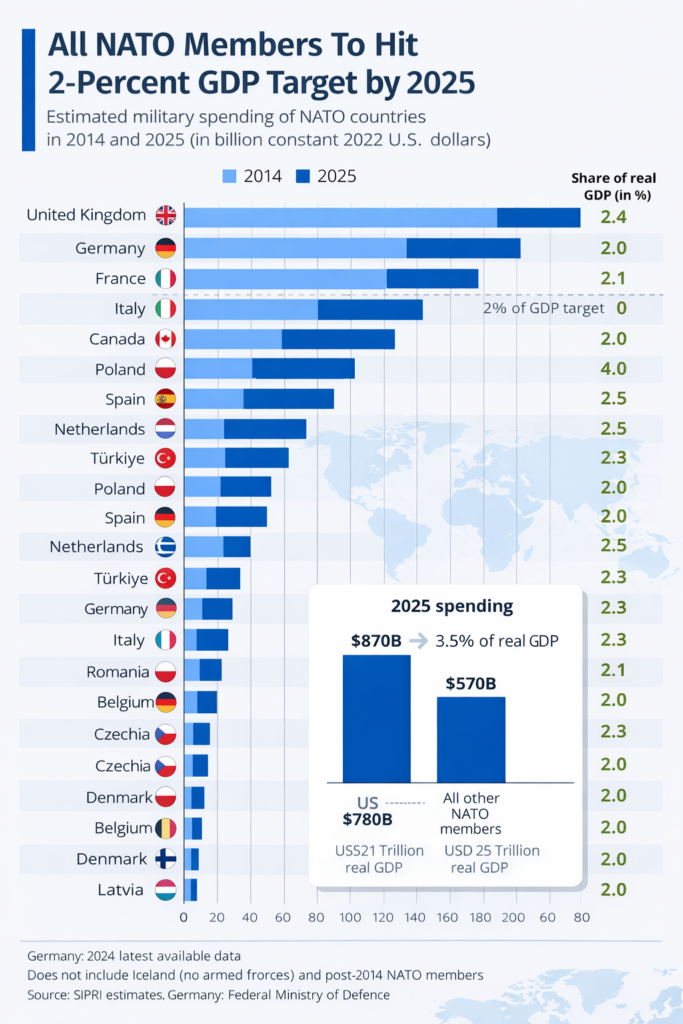
The alliance has pushed members to spend at least 2% of GDP on defense, a benchmark that once seemed symbolic but is now treated as a hard requirement. Countries that previously underspent are racing to catch up, while already high spenders are going even further.
This shift accelerated after the Ukraine conflict, rising tensions with Russia, and broader concerns about global instability. Defense is no longer just about deterrence—it has become a political signal of loyalty, strength, and seriousness on the world stage.
Defense Budgets vs Social Spending: A Zero-Sum Game
Guns or Growth?
National budgets are finite. When defense allocations rise sharply, other sectors inevitably feel the pressure. In many European economies, social welfare programs are facing cuts or slower growth to accommodate rising military bills.
Healthcare systems already strained by aging populations are receiving fewer resources. Education budgets are being frozen. Infrastructure projects are delayed. These trade-offs may not be immediately visible, but over time they weaken long-term economic productivity.
Unlike investments in education or technology, military spending often delivers limited multiplier effects. Tanks and missiles do not generate widespread consumer demand or lasting economic growth.
The Political Cost
Politically, this creates tension. Governments must justify why citizens should accept reduced public services while defense contractors report record profits. The result is growing public skepticism and, in some cases, protest movements questioning national priorities.
The Debt Problem: Borrowing for Security
Many alliance members are financing defense expansion not through higher taxes but through borrowing. This strategy avoids short-term political backlash but introduces long-term fiscal risk.
Rising public debt increases interest costs, especially in a high-rate environment. Central banks fighting inflation are less willing to support excessive government borrowing, which makes defense-driven deficits more expensive over time.
Smaller economies are particularly vulnerable. For them, a sudden increase in military expenditure can destabilize debt-to-GDP ratios and weaken investor confidence.
Inflation and the Military-Industrial Effect
Why Prices Rise
Large defense contracts inject massive sums into specific industries—steel, energy, electronics, and logistics. While this benefits suppliers, it also creates localized inflation. Skilled labor is pulled away from civilian industries, pushing up wages and costs across the economy.
Energy demand from military production further tightens already stressed markets. These pressures eventually filter down to consumers in the form of higher prices.
Who Benefits?
The biggest winners are defense manufacturers and related industries. Share prices of major arms companies have surged, while ordinary households struggle with cost-of-living increases. This imbalance contributes to widening inequality within member states.
NATO and Economic Distortion in Smaller Member States
For large economies like Germany or France, higher military spending is painful but manageable. For smaller or newer alliance members, the impact is far more severe.
These countries often redirect development funds into defense, slowing modernization and social progress. Instead of investing in digital infrastructure or industrial diversification, resources are tied up in imported weapons systems that offer little domestic economic return.
This dynamic risks locking smaller economies into a cycle of dependency—both militarily and financially.
The Opportunity Cost No One Talks About
Missed Civilian Innovation
History shows that major economic breakthroughs usually come from civilian research, not military procurement. By prioritizing defense, governments risk underfunding green energy, healthcare innovation, and digital transformation.
Ironically, these neglected sectors are often what make societies more resilient in the long run.
Long-Term Competitiveness
An economy overly focused on security spending may fall behind in global competitiveness. While rivals invest in artificial intelligence, manufacturing efficiency, and education, defense-heavy economies may struggle to keep pace.
Global Ripple Effects Beyond NATO Countries
The impact is not limited to alliance members. As Europe and North America absorb more global weapons supply, prices rise worldwide. Developing nations face higher costs for basic defense needs, worsening regional instability.
Additionally, increased military alignment deepens global economic fragmentation. Trade blocs harden, sanctions expand, and supply chains become more politicized—raising costs for everyone.please make an thumbnail in 1280x720px for this blog
Is This Level of Spending Sustainable?
The central question is not whether defense is necessary—it clearly is. The question is whether the current trajectory is economically sustainable.
If geopolitical tensions persist for years, governments may find themselves trapped between security commitments and economic reality. Voters will eventually demand better public services, lower inflation, and reduced debt.
Without careful balancing, today’s defense surge could become tomorrow’s economic crisis.
A Smarter Path Forward
There are alternatives. Greater coordination on procurement could reduce duplication and waste. More transparent budgeting would help citizens understand trade-offs. And integrating defense planning with broader economic strategy could soften long-term damage.
Security and prosperity do not have to be mutually exclusive—but achieving both requires restraint, strategy, and honest political debate.
Global power struggles are reshaping capital flows and growth prospects. Learn why Emerging Markets are facing financial shocks, currency pressure, and investor uncertainty in 2026.