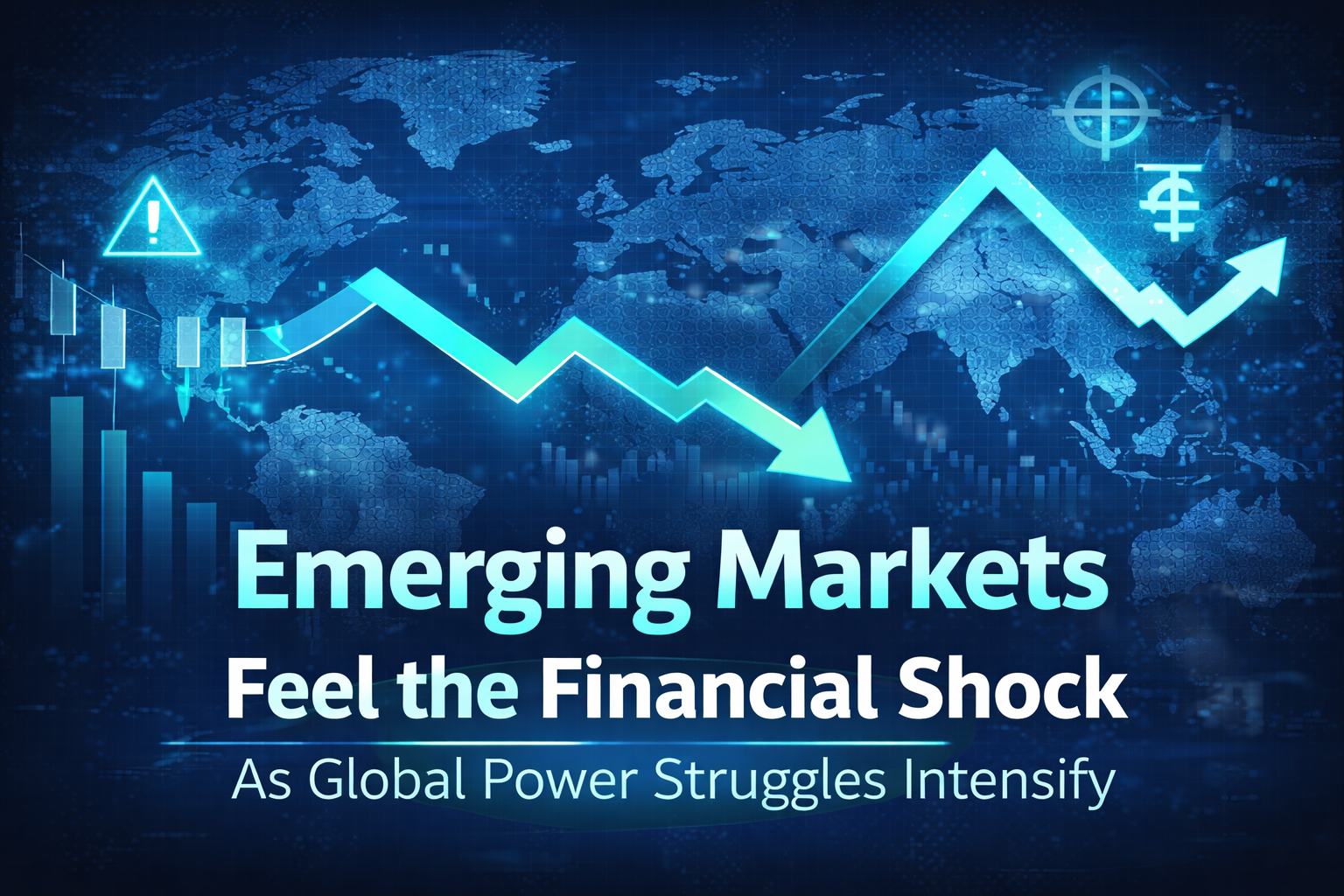
Global power struggles are reshaping capital flows and growth prospects. Learn why Emerging Markets are facing financial shocks, currency pressure, and investor uncertainty in 2026.
Table of Contents
Why Emerging Markets Are Feeling the Financial Shock of Global Power Struggles
In recent years, global politics and economics have become tightly intertwined. As rivalries between major powers intensify, financial markets around the world are reacting—and nowhere is this more visible than in Emerging Markets. Once viewed as engines of future growth, these economies are now grappling with volatility driven not just by domestic challenges, but by geopolitical forces far beyond their borders.
From capital flight and currency swings to trade realignments and rising borrowing costs, global power struggles are creating ripple effects that disproportionately affect developing economies. Understanding why this is happening requires a closer look at how international finance, politics, and investor psychology intersect.
🌍 The New Global Order and Economic Uncertainty
The post-globalization era has brought with it renewed geopolitical competition. Strategic rivalries, shifting alliances, and economic nationalism are changing how capital moves across borders. While advanced economies have stronger buffers, Emerging Markets often operate with thinner financial cushions, making them more exposed to sudden global shocks.
When tensions rise between major powers, investors tend to prioritize safety over returns. This shift usually benefits developed markets and reserve currencies, while riskier assets—often located in developing nations—experience sell-offs.💸 Capital Flows Are Becoming More Volatile
One of the most immediate effects of geopolitical stress is erratic capital movement. Foreign investment, which many developing countries rely on for growth and infrastructure, becomes unpredictable during periods of uncertainty.
Short-term portfolio investors are particularly sensitive to political signals. Even speculation about sanctions, trade barriers, or diplomatic breakdowns can trigger rapid outflows from Emerging Markets, weakening stock markets and pressuring currencies.
This volatility makes long-term planning difficult for governments and businesses alike.
💱 Currency Pressure and Inflation Risks
As global investors retreat to perceived safe havens, emerging-market currencies often depreciate. While weaker currencies can sometimes boost exports, sharp declines usually raise import costs, especially for energy and food.
This dynamic fuels inflation at a time when many governments are already under fiscal strain. Central banks are forced into tough decisions—raising interest rates to stabilize currencies or supporting growth at the risk of higher inflation.
🏦 Rising Borrowing Costs and Debt Stress
Global power struggles frequently lead to tighter financial conditions worldwide. Higher interest rates in advanced economies push up borrowing costs everywhere, but Emerging Markets feel the impact more severely due to higher risk premiums.
Many developing nations carry significant amounts of dollar-denominated debt. When global rates rise or currencies weaken, servicing this debt becomes more expensive, increasing the risk of fiscal stress or even default.
Institutions such as the International Monetary Fund (IMF) have warned that debt sustainability could become a major issue if geopolitical tensions persist.
🔗 https://www.imf.org
🔗 https://www.worldbank.org
🚢 Trade Disruptions and Supply Chain Shifts
Geopolitical competition is also reshaping global trade patterns. Strategic decoupling, export controls, and regional trade blocs are changing how goods move across borders.
For Emerging Markets, this presents a mixed picture. Some countries benefit from supply-chain diversification, while others suffer from reduced access to major markets or critical technologies.
Nations heavily dependent on a single export destination or commodity are especially vulnerable when political tensions disrupt established trade routes.
🧠 Investor Psychology: Risk Aversion Is Rising
Financial markets are not driven by numbers alone—sentiment plays a major role. During times of geopolitical stress, global investors often reassess their exposure to developing economies.
Even countries with strong fundamentals can be swept up in broader sell-offs simply because they are grouped under the emerging-market label. This perception gap makes it harder for policymakers to convince markets of stability.
🏗️ Domestic Challenges Amplify External Shocks
While global power struggles are a major factor, internal vulnerabilities can magnify their impact. Structural issues such as weak institutions, political instability, and limited policy flexibility make it harder for Emerging Markets to absorb external shocks.
Countries that rely heavily on foreign capital or commodity exports are particularly exposed when geopolitical tensions disrupt global demand or financing channels.
🔄 Strategic Adaptation and Policy Responses
Despite these challenges, many developing economies are adapting. Governments are diversifying trade partnerships, strengthening foreign-exchange reserves, and pursuing regional cooperation to reduce dependency on any single global power.
Some nations are also investing in domestic manufacturing and digital infrastructure to build resilience against external disruptions. These strategies may not eliminate risk, but they can help stabilize growth over the long term.
🔮 What Lies Ahead for Emerging Economies?
Looking forward, the financial outlook for Emerging Markets will depend largely on how global power struggles evolve. If tensions ease, capital could return quickly in search of higher returns. If rivalries deepen, volatility may become a permanent feature of the global financial system.
For investors and policymakers alike, the challenge is navigating a world where economics and geopolitics are increasingly inseparable.
As Political Risks Rise across the globe, investors are shifting toward defensive strategies. Learn why uncertainty is reshaping markets and how global capital is responding.