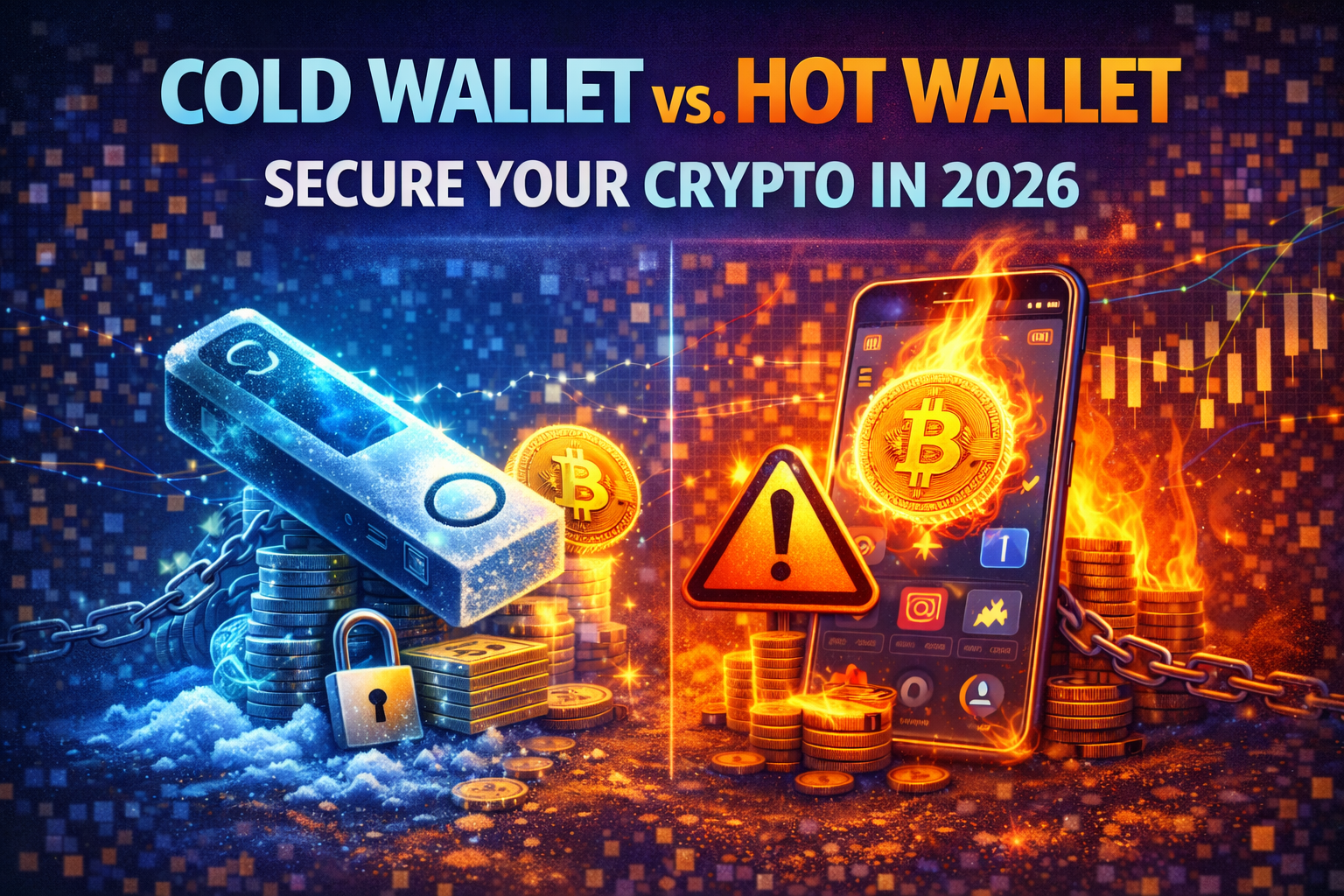
Hot wallets offer speed; cold wallets offer safety. But in 2026, new threats like “Wallet Drainers” and new tech like MPC have changed the game. Here is how to secure your assets.
Table of Contents
There are only two types of crypto investors: those who have been hacked, and those who haven’t been hacked yet.
It’s a grim saying, but in 2026, it’s truer than ever. As the value of digital assets skyrockets, the sophistication of attacks has evolved. We aren’t just worried about someone guessing our password “123456” anymore. We are dealing with sophisticated phishing contracts, SIM swaps, and clipboard malware.
The first line of defense—and the most important decision you will make—is where you store your keys. The debate between Cold Wallets and Hot Wallets is the difference between having a vault in a mountain and carrying cash in a bad neighborhood.
But the lines are blurring. With the rise of MPC (Multi-Party Computation) and “Smart Accounts,” the old rules are changing. Let’s break down the security architecture of 2026 and how to ensure your portfolio survives the next bear market—and the hackers.
The Hot Wallet: Speed Kills (and Thrills)
A Hot Wallet is any wallet connected to the internet.
- Examples: MetaMask, Phantom, Coinbase Wallet, Rabby.
- The Purpose: Convenience. You need a hot wallet to interact with DeFi, buy NFTs, or trade on decentralized exchanges (DEXs).
The Risk Profile: In 2026, the #1 threat to hot wallets is the “Wallet Drainer”. You click a link that looks like a legitimate minting site or airdrop claim. You connect your wallet. A pop-up asks you to “Approve” a transaction. You click yes. Instantly, every token in your wallet is transferred to a hacker.
- The Mistake: You didn’t lose your password; you signed a malicious permission slip. Hot wallets are vulnerable because they are “always on” and interacting with potentially malicious code.
Best Practice: Treat a hot wallet like the cash in your physical wallet. Carry $100 or $500 for daily spending. Never walk around with your life savings in your back pocket.
The Cold Wallet: The Digital Fort Knox
A Cold Wallet (or Hardware Wallet) is a device that keeps your private keys offline.
- Examples: Ledger Stax, Trezor Safe 3, Coldcard, Tangem.
- The Purpose: Storage. You use this for assets you don’t plan to touch for months or years.
How it Works: When you want to send a transaction, you create it on your computer. You send the unsigned data to the cold wallet (via USB or QR code). The device—which is not connected to the internet—signs the transaction with your private key and sends the signature back. Even if your computer has a virus, the hacker cannot see your private key because it never leaves the device.
The Risk Profile: The weakness of a cold wallet is You.
- Phishing: If you type your 24-word seed phrase into a computer to “verify” your device, you just compromised it.
- Physical Loss: If you lose the device and the paper backup of your seed phrase, the money is gone forever. There is no “Forgot Password” button.
The New Player: MPC and Smart Accounts
In 2026, a new technology is bridging the gap: MPC (Multi-Party Computation). Wallets like Zengo or Coinbase Smart Wallet don’t use a single private key or a seed phrase. Instead, the “key” is split into mathematical shares.
- Share 1 is on your phone.
- Share 2 is on the company’s server.
- Share 3 is in your iCloud/Google Drive.
To move money, you need 2 out of 3.
- The Benefit: If you lose your phone, you can recover the wallet using your email and face scan (Share 2 + Share 3). If the company gets hacked, they can’t steal your money because they only have one share.
- The Verdict: This is the future of “Hot Wallets.” It offers the convenience of an app with security closer to a cold wallet, removing the terrifying “single point of failure” of the seed phrase.
Air-Gapped vs. Connected: The Paranoia Spectrum
For the whales holding millions, even a USB connection is too risky. They use Air-Gapped cold wallets. These devices (like the Keystone or Ellipal) act like a QR code scanner. They never physically touch a computer or the internet. Data is transmitted solely via camera scanning. This protects against sophisticated supply-chain attacks or malware that could theoretically jump over a USB connection. Is it overkill for $500 of Bitcoin? Yes. Is it necessary for $5 million? Absolutely.
How Investors Lose Money (And How to Avoid It)
Here is the checklist to survive 2026:
- The “Pod” Strategy: Segregate your funds.
- The Vault (Cold): 80% of net worth. Bitcoin/ETH long-term holds. Never connect this to a website.
- The Trading Desk (Hot/MPC): 15% of net worth. Funds for active trading on exchanges.
- The Degen Wallet (Burner): 5% of net worth. A fresh hot wallet for minting NFTs or trying new shady protocols. If it gets drained, who cares?
- Read What You Sign: Use wallets like Rabby or extensions like Pocket Universe. They simulate the transaction before you sign it and warn you: “WARNING: This transaction will send all your USDT to a known scammer.”
- Never Type Your Seed Phrase: The only place you should ever type your 12 or 24 words is directly onto the physical buttons of a hardware wallet. If a website, email, or support agent asks for it, it is a scam. Period.
Frequently Asked Questions (FAQ)
1. Is it safe to buy a used hardware wallet? NEVER. Supply chain attacks are real. A hacker can modify the hardware of a used Ledger/Trezor to steal your funds the moment you deposit them. Always buy directly from the manufacturer’s official website, not Amazon or eBay.
2. What happens if my cold wallet breaks? Your money is not in the device; it is on the blockchain. The device just holds the keys. As long as you have your Seed Phrase (the 12-24 words you wrote down during setup), you can buy a new device, type in the words, and access your funds immediately.
3. Are exchange wallets (like Binance/Coinbase) considered hot wallets? Yes, but they are Custodial hot wallets. You don’t own the keys; the exchange does. They are convenient, but you carry “Platform Risk” (e.g., FTX collapsing). The saying “Not your keys, not your coins” applies here.
4. Can a cold wallet be hacked remotely? No. The private keys exist on a secure chip inside the device that is physically isolated from the internet. Unless someone physically steals the device and knows your PIN, or you give away your seed phrase, remote hacking is virtually impossible.
5. What is a “Dust Attack”? Hackers send tiny amounts of crypto (dust) to your wallet. If you try to spend it or move it, they can track the transaction on the blockchain to link your wallet to your real identity (doxing). In 2026, most wallet software automatically hides/ignores these dust amounts to protect you.
Conclusion: Security is a Habit, Not a Product
Buying a $100 Ledger doesn’t make you safe. Using it correctly makes you safe.
The battle between Cold and Hot wallets isn’t about which is “better”—it is about using the right tool for the job. You wouldn’t use a bank vault to buy a coffee, and you wouldn’t keep your life savings in your back pocket.
In 2026, the tech has improved, but the predators have too. Slow down. Verify every link. Segregate your funds. In the world of crypto, you are your own bank—and that means you are also your own security guard.