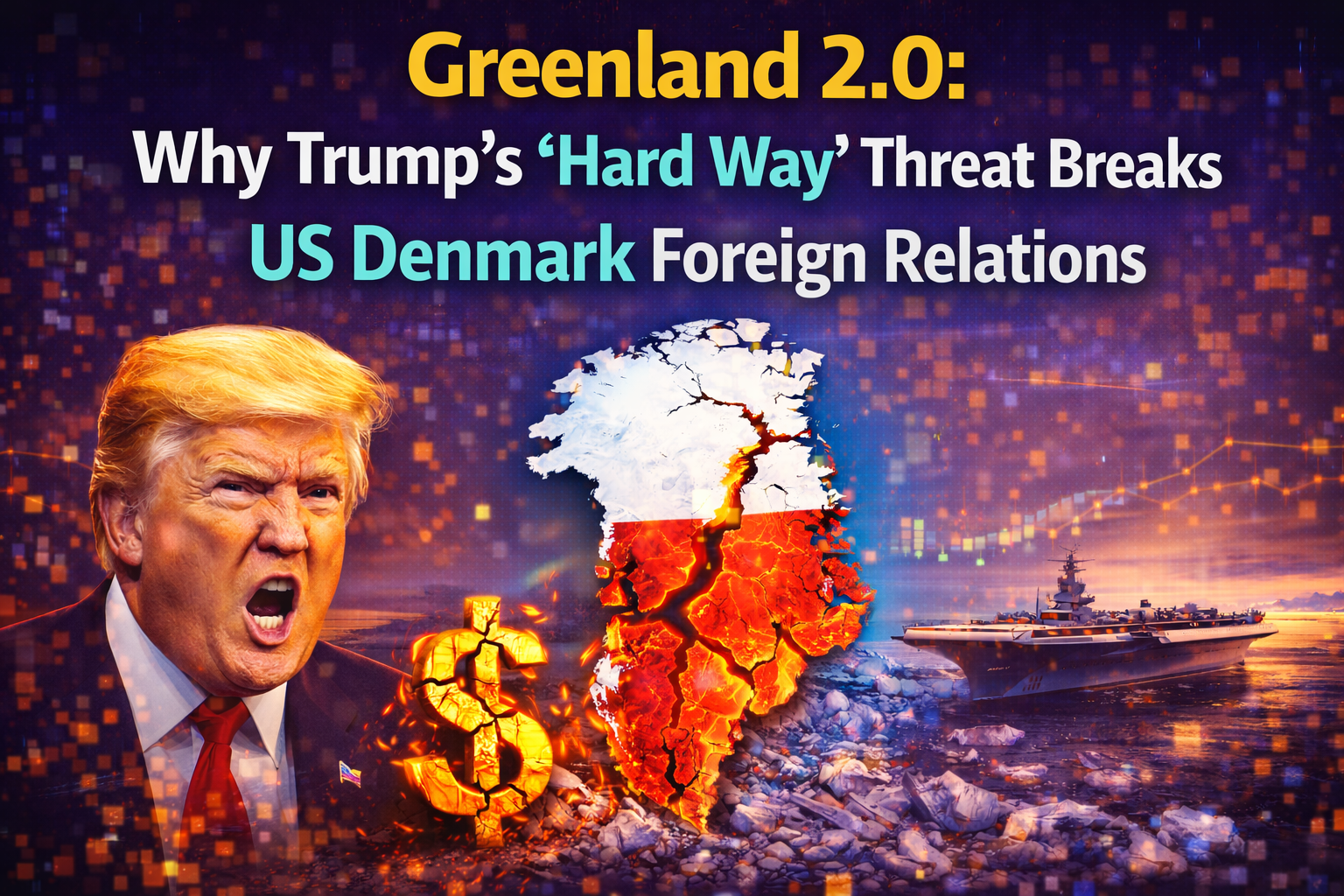
The US Denmark foreign relations crisis is heating up as Trump renews his bid for Greenland. We analyze the financial and geopolitical costs of the “hard way” approach.
Table of Contents
I’ll be honest: back in 2019, when the headlines first broke that the United States wanted to buy Greenland, most of us in the finance world chuckled. It sounded like a real estate mogul trying to flip a continent. We made memes, checked the price of Danish Krone futures, and moved on.
But here we are in January 2026, and nobody is laughing.
The reports coming out of Washington this week are not about a friendly business deal. With President Trump reportedly telling aides that he is willing to acquire the island “the hard way” if Denmark refuses to sell, we have moved from an eccentric M&A proposal to a full-blown diplomatic standoff. The current state of US Denmark foreign relations is arguably at its most fragile point since World War II.
For investors, this isn’t just political theater. It’s a signal that the Arctic is about to become the most contested asset class on the planet. Whether it’s rare earth minerals or strategic dominance over the North Atlantic, the price tag for Greenland—both financial and diplomatic—is skyrocketing.
Let’s strip away the sensationalism and look at the cold, hard economics of why this island is suddenly worth risking a NATO alliance over.
The Asset Valuation: Why Buy an Ice Sheet?
US Denmark foreign relations : To understand the ferocity of this move, you have to look at the balance sheet. Why does the U.S. want Greenland so badly that it’s willing to alienate a key European ally?
It comes down to two words: Resource Security.
Greenland isn’t just ice; it’s a geological vault. As the ice sheet recedes (a grim reality of climate change), it exposes massive deposits of rare earth elements—neodymium, praseodymium, dysprosium. These are the vitamins of the modern economy. You can’t build an F-35 fighter jet, an EV battery, or a wind turbine without them.
Currently, China controls roughly 90% of the processing for these minerals. By acquiring Greenland, the U.S. wouldn’t just be buying land; it would be buying a “kill switch” for China’s supply chain dominance.
- The Valuation: Estimates vary wildly, from $500 million to over $1 trillion depending on the recoverable mineral reserves.
- The Cost of “No”: If the U.S. doesn’t control these resources, and China’s “Polar Silk Road” initiative gains a foothold in Nuuk, American tech and defense sectors face an existential supply squeeze.
“The Hard Way”: A Diplomatic Default?
The phrase “the hard way” is what has spooked the markets and European capitals. In diplomatic speak, this is as close as you get to a threat of hostile takeover without declaring war.
This rhetoric has sent US Denmark foreign relations into a tailspin. Danish Prime Minister Mette Frederiksen has dismissed the idea as “absurd,” and Greenland’s leadership has stated plainly: “We are not for sale.”
From a geopolitical risk perspective, this is a massive liability. Denmark is a founding member of NATO. It controls the straits that allow the Russian Baltic fleet to exit into the Atlantic. Alienating Copenhagen forces the U.S. into a precarious position:
- NATO Fracture: If the U.S. bullies a small ally, trust within the alliance erodes. European defense stocks (like Rheinmetall or BAE Systems) are climbing partly because Europe realizes it might need to defend its own sovereignty, even from its friends.
- The Thule Factor: The U.S. already operates Pituffik Space Base (formerly Thule) in northern Greenland. It is the eyes and ears of America’s missile warning system. Pushing Denmark too hard puts this lease at risk, potentially blinding U.S. strategic defense.
The Investment Play: Arctic Sovereignty
So, how do you trade a diplomatic crisis in the Arctic?
The smart money is looking at Arctic infrastructure and defense logistics. If the U.S. is serious about projecting power in Greenland—whether through purchase or pressure—it needs icebreakers, ports, and satellite coverage.
- Shipbuilders: Companies that build ice-capable vessels are in a bull market. The U.S. Coast Guard is woefully under-equipped compared to Russia in the Arctic. Expect massive government contracts to bridge this gap.
- Mining Juniors: Keep an eye on the small-cap mining companies that currently hold exploration licenses in Greenland. Their stock prices are volatile lottery tickets. If the U.S. forces a deal, these licenses could be bought out at a premium. If the deal collapses and Greenland bans mining to spite the U.S., they go to zero.
The Currency Question: DKK vs. USD
We also need to talk about the Danish Krone (DKK). It’s pegged to the Euro, so it’s relatively stable, but a rupture in US Denmark foreign relations introduces a new risk premium.
If the U.S. were to impose tariffs or sanctions on Denmark to force a sale (a tactic not unheard of in recent trade wars), the Danish economy—which relies heavily on shipping (Maersk) and pharma (Novo Nordisk)—could take a hit.
- The Maersk Indicator: Watch the stock price of A.P. Moller-Maersk. As a bellwether for global trade and a Danish national champion, any dip there suggests the market fears real economic retaliation.
Conclusion: The Real Estate Deal of the Century?
US Denmark foreign relations : The renewed push for Greenland proves that we have entered a new era of “transactional geopolitics.” The old rules of sovereign respect are being weighed against the new rules of resource scarcity.
For Denmark, this is an insult. For the U.S. administration, it’s a necessary acquisition for national survival. For you, the investor, it’s a warning: The map is changing. The stable alliances of the last 50 years are now liquid assets, capable of being sold to the highest bidder—or taken by the strongest arm.
Keep your eyes on the Arctic. The ice is melting, and the sharks are circling.
Frequently Asked Questions (FAQ)
Can the US actually buy Greenland?
US Denmark foreign relations : Technically, no. Greenland is a semi-autonomous territory within the Kingdom of Denmark. It has its own government (Naalakkersuisut) which handles domestic affairs. Any decision to leave Denmark or join the US would require the consent of the Greenlandic people and the Danish government, both of which have firmly said “No.”
Why are US Denmark foreign relations strained now?
US Denmark foreign relations : Relations are strained because the US President has reportedly threatened to acquire Greenland “the hard way” if a sale isn’t negotiated. This implies potential coercion or military pressure against a NATO ally, which Denmark views as a violation of its sovereignty and the alliance’s principles.
Does the US have a military base in Greenland?
Yes. The US operates Pituffik Space Base (formerly Thule Air Base) in northern Greenland. It is the US military’s northernmost installation and is critical for missile warning and space surveillance. This base exists under a defense treaty with Denmark.
What resources does Greenland have?
Greenland holds significant deposits of rare earth elements, uranium, zinc, and potentially oil and gas off its coast. As the ice sheet melts due to climate change, these resources are becoming more accessible, sparking interest from the US, China, and Russia