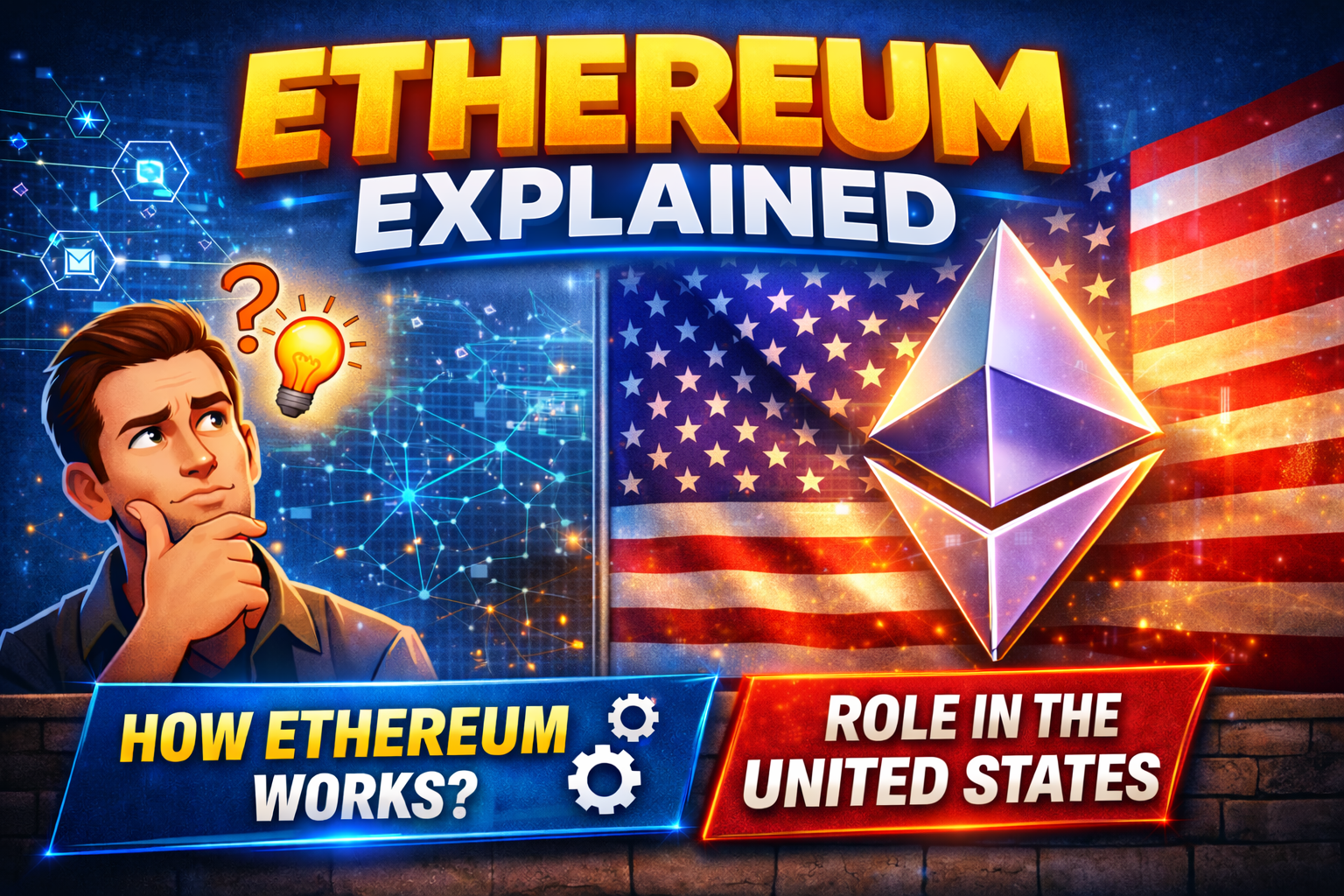
Ethereum Explained: How Ethereum Works and Its Role in the United States for the future of crypto in America.
Table of Contents
Introduction oF Ethereum Explained: How Ethereum Works and Its Role in the United States
Ethereum is the second-largest cryptocurrency in the world and the most important blockchain platform for decentralized applications. While Bitcoin is often called digital gold, Ethereum is considered the backbone of the crypto economy, especially in the United States.
From Wall Street institutions to Silicon Valley startups, Ethereum plays a critical role in shaping the future of finance, technology, and the internet in the US. This guide explains what Ethereum is, how it works, its legal status in the US, and why it matters—in clear and simple language.
What Is Ethereum Ethereum Explained: How Ethereum Works and Its Role in the United States
Ethereum is a decentralized blockchain platform that allows developers to build and run applications without relying on centralized servers or companies.
Ethereum’s native cryptocurrency is called Ether (ETH), which is used to:
- Pay transaction fees (gas fees)
- Secure the network
- Power smart contracts and decentralized apps (dApps)
Unlike Bitcoin, Ethereum was designed not just as money, but as a programmable blockchain.
Who Created Ethereum?
Ethereum was proposed in 2013 by Vitalik Buterin, a programmer and blockchain researcher. The Ethereum network officially launched in 2015.
Ethereum is now maintained by a global community of developers, researchers, and organizations, including many US-based companies and institutions.
How Ethereum Works
- Smart Contracts: Self-executing programs that run automatically
- Ethereum Virtual Machine (EVM): Executes smart contracts
- Nodes: Computers that maintain the network
- Validators: Secure the network through staking
- Gas Fees: Fees paid in ETH to process transactions
Ethereum’s Transition to Proof of Stake
In 2022, Ethereum moved from Proof of Work (PoW) to Proof of Stake (PoS), a major upgrade known as The Merge.
Benefits of Proof of Stake:
- Over 99% reduction in energy usage
- More environmentally friendly (important for US policy discussions)
- Stronger network security
- Enables future scalability upgrades
Why Ethereum Is Important in the United States
Ethereum plays a central role in the US crypto ecosystem.
Key Areas of Impact:
- DeFi (Decentralized Finance): Lending, borrowing, and trading without banks
- NFTs: Digital art, gaming assets, and collectibles
- Web3 Applications: Decentralized internet services
- Enterprise Blockchain: Used by US companies for real-world solutions
- Financial Innovation: Alternative to traditional finance systems
Ethereum and US Regulation
Is Ethereum Legal in the US?
- ETH is classified as a commodity, not a security (according to US regulators)
- Ethereum trading, holding, and usage are legal
- Crypto platforms must follow US compliance laws
Why Ethereum ETFs Matter:
- Allow investors to gain ETH exposure without owning crypto directly
- Increase institutional participation
- Improve market legitimacy
- Integrate Ethereum into traditional finance
Ethereum Gas Fees Explained
Gas Fees Depend On:
- Network congestion
- Transaction complexity
- Demand for block space
Ethereum Layer-2 Solutions Popular in the US
- Arbitrum
- Optimism
- Polygon
- Base (Coinbase-backed)
How Americans Use Ethereum
- Long-term investment
- DeFi platforms
- NFT marketplaces
- Web3 startups
- Cross-border payments
- Blockchain gaming
Ethereum Taxes in the US
Taxable Activities Include:
- Selling ETH
- Trading ETH for another crypto
- Earning ETH through staking
- NFT transactions
Advantages of Ethereum
- Largest smart contract platform
- Strong US developer adoption
- Backed by institutions and enterprises
- Secure and decentralized
- Supports thousands of applications
Risks and Challenges
- Network congestion during high demand
- Regulatory uncertainty
- Smart contract vulnerabilities
- Competition from other blockchains
Future of Ethereum in the United States
- Growing institutional investment
- Expansion of Web3 startups
- Ethereum ETFs
- Government interest in blockchain
- Integration with traditional finance
Should US Investors Consider Ethereum?
- Long-term investors
- Technology believers
- Developers and builders
- Diversified crypto portfolios
Conclusion
Ethereum is more than a cryptocurrency—it is a global computing platform that plays a vital role in the United States’ crypto and technology ecosystem. With strong institutional backing, regulatory clarity, and real-world use cases, Ethereum continues to shape the future of finance and the internet in America.