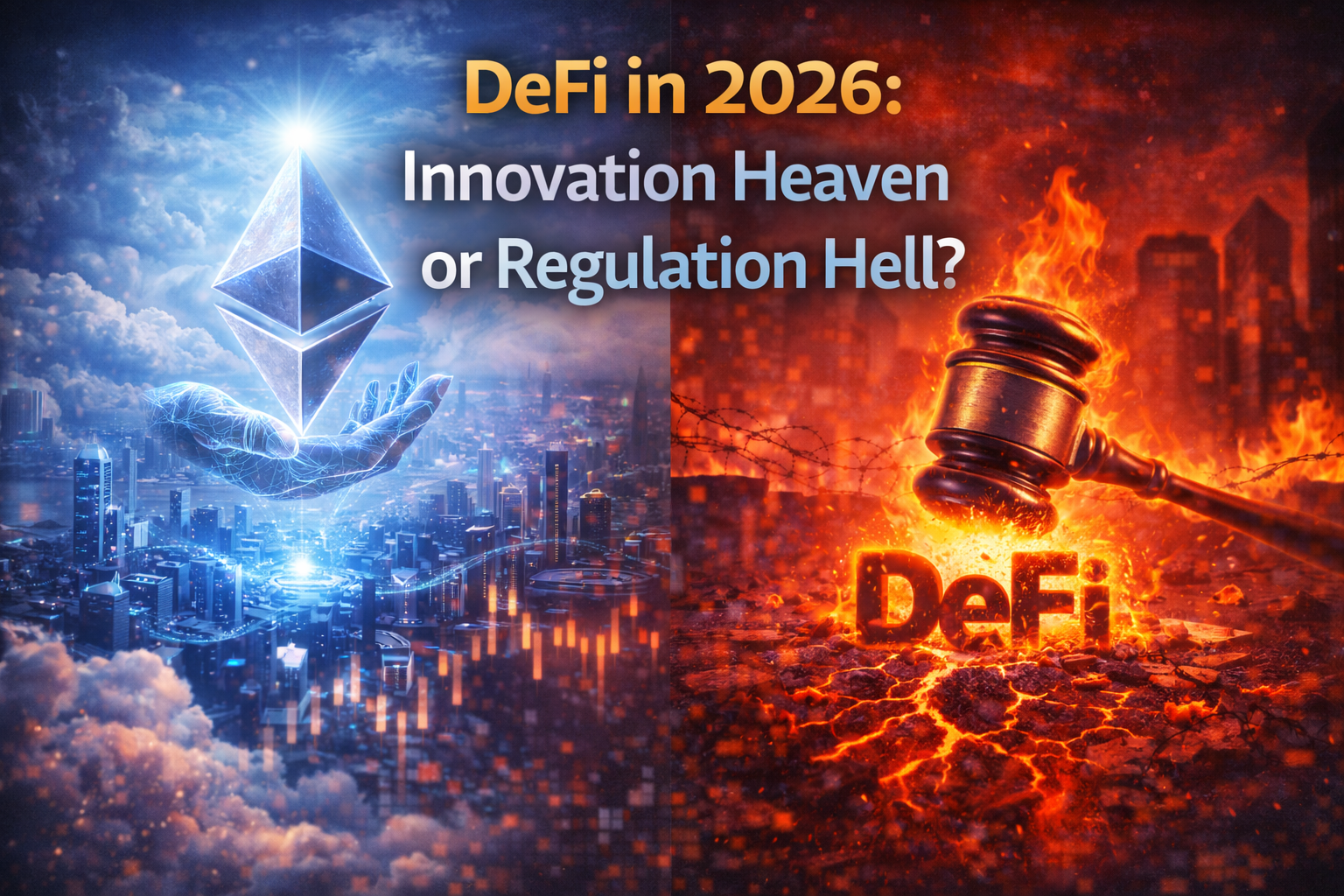
DeFi in 2026 is at a crossroads. From institutional “permissioned pools” to the explosion of Real World Assets (RWAs), we analyze if innovation can survive the new regulatory squeeze.
I remember the “DeFi Summer” of 2020 like it was yesterday. It was chaotic, unregulated, and frankly, a little bit insane. We were farming yields on food-themed coins with 10,000% APY, and nobody asked for your ID. It was the financial Wild West.
Fast forward to DeFi in 2026, and the landscape looks unrecognizable. The “degens” have been replaced (or at least joined) by guys in suits from BlackRock and Fidelity. The 10,000% yields are gone, replaced by “sustainable” returns on tokenized U.S. Treasuries. And perhaps most jarringly, your favorite decentralized exchange might now ask you to connect your digital ID before you can swap.
We are living through a pivotal moment. The technology is finally maturing, but the regulatory noose is tightening. As we navigate this new year, the big question isn’t “Will DeFi survive?” It’s “What will it look like?” Is DeFi in 2026 evolving into the future of finance, or is it becoming just another regulated banking lane with a blockchain backend?
Let’s tear apart the narrative and look at what is actually happening on-chain.
The “Suit” Invasion: Permissioned Pools and RWAs
If you want to understand DeFi in 2026, you have to stop looking at meme coins and start looking at Real World Assets (RWA). This is where the real money is flowing.
We are currently seeing a massive shift toward “permissioned liquidity pools.” Institutions love the technology of DeFi—instant settlement, 24/7 trading, programmable yield—but they hate the risk of trading against anonymous North Korean hackers.
The solution? Walled gardens.
- Tokenized Treasuries: By early 2026, billions of dollars in U.S. government debt have moved on-chain. Investors are using these stable, yield-bearing assets as collateral in DeFi lending protocols instead of volatile ETH or BTC.
- Institutional Vaults: Major custodians like Zodia and traditional banks are launching DeFi vaults that are “KYC-gated.” You can only enter if you are a verified entity. It’s boring, it’s safe, and it’s exploding in volume.
For the purist, this is a betrayal. But for the pragmatist, this is how DeFi in 2026 scales from a $100 billion niche to a multi-trillion dollar industry.
The Regulatory Squeeze: Is Privacy Dead?
Here is the uncomfortable truth: anonymity is becoming a luxury item.
Regulators globally, emboldened by frameworks like the EU’s Markets in Crypto-Assets (MiCA) and stricter SEC enforcement in the US, are cracking down on “non-compliant” code. The days of the “Tornado Cash” style privacy mixers are largely behind us, pushed to the dark corners of the web.
In DeFi in 2026, we are seeing the rise of Zero-Knowledge (ZK) Proofs for compliance. This is the innovation that might save us. Instead of handing over your passport to a decentralized exchange (DEX), you provide a cryptographic proof that says, “I am not a sanctioned individual, and I live in a jurisdiction where this trade is legal,” without revealing your actual name.
However, the pressure is real.
- The “Travel Rule”: It’s now fully enforced globally. If you move crypto from an exchange to a private wallet, the exchange needs to know who owns that wallet.
- Smart Contract Liability: Regulators are starting to argue that if a protocol has a “multisig” wallet controlling it (meaning humans can upgrade the code), those humans are liable for what the protocol does. This is pushing true DeFi in 2026 to either fully decentralize (burn the admin keys) or become a registered business.
The Security Reckoning: Post-2025 Trauma
We can’t talk about the current state of the market without mentioning the scars from last year. 2025 was a brutal year for hacks. We saw the massive Bybit breach ($1.4 billion lost) and the Cetus exploit ($223 million).
These events forced a change in psychology. In DeFi in 2026, security isn’t an afterthought; it’s the primary marketing feature.
- AI Auditors: We are seeing the deployment of autonomous AI agents that scan smart contracts in real-time, looking for vulnerabilities before a hacker can exploit them.
- Insurance Protocols: Decentralized insurance has finally found its product-market fit. Users are willing to pay a premium on their yields to insure their deposits against smart contract failure.
If a protocol hasn’t been audited by three top-tier firms and monitored by an AI sentinel, nobody touches it anymore. The “ape in first, research later” mentality is dead.

The Tech Pivot: Cross-Chain and AI Agents
It’s not all doom and gloom regulations. The tech is actually getting incredible.
For years, liquidity was fractured. If you had money on Ethereum, you couldn’t use it on Solana without a risky bridge. DeFi in 2026 is solving this with “Unified Liquidity Layers.” Technologies like Chainlink’s CCIP are making it seamless to move value across chains. You might use an app on your phone that trades on five different blockchains simultaneously, and you won’t even know it.
And then there are the AI Agents. Imagine a bot that manages your portfolio 24/7. It finds the best yields, auto-compounds your returns, and hedges your risk if the market drops—all entirely on-chain, non-custodial, and transparent. That is the new frontier.
Frequently Asked Questions (FAQ)
Is DeFi still profitable in 2026?
Yes, but the days of “passive” 10,000% APY are gone. DeFi in 2026 offers more “real yield” derived from actual economic activity (like trading fees or lending rates) rather than inflationary token emissions. Expect stable yields in the 5-15% range rather than moonshots.
Do I need to do KYC for DeFi now?
For many “institutional-grade” platforms, yes. However, true permissionless protocols (like Uniswap or Aave) still allow trading without KYC, though they are increasingly geoblocking users from strict jurisdictions like the US to avoid regulatory heat.
What are Real World Assets (RWAs) in DeFi?
RWAs are physical or traditional financial assets—like real estate, gold, or U.S. Treasury bonds—that are tokenized and brought onto the blockchain. They allow crypto investors to earn stable, off-chain yields while staying within the DeFi ecosystem.
Is my self-custody wallet safe from regulation?
Regulators cannot “freeze” a truly non-custodial wallet (like a Ledger). However, they can blacklist your address. If you interact with sanctioned entities, centralized exchanges (like Coinbase) may refuse to accept deposits from your wallet, effectively locking your funds in the digital realm.
What is the biggest risk for DeFi in 2026?
Regulatory fragmentation. If the US, EU, and Asia all adopt radically different rules for DeFi in 2026, it could fracture global liquidity, making the market less efficient and harder for developers to build universal apps.
Conclusion: The “Mullet” Thesis of Finance
So, where does this leave us? I like to call the state of DeFi in 2026 the “Mullet Thesis”: Business in the front, party in the back.
The “front” is the institutional layer—compliant, KYC’d, safe, and heavily regulated. This is where the trillions of dollars of pension funds will live. The “back” is the permissionless layer—the true DeFi where innovation still happens, code is law, and the risks (and rewards) are higher.