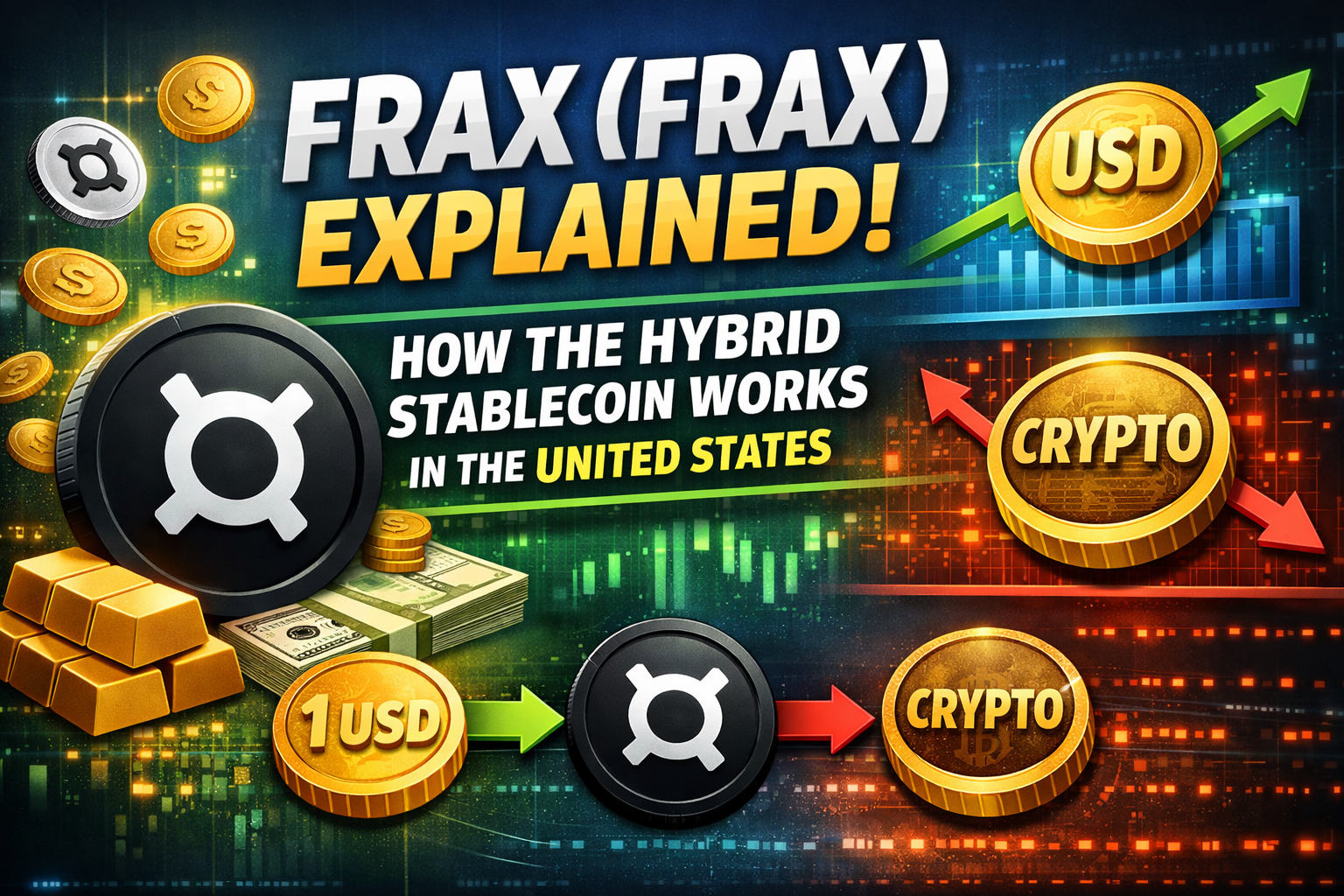
Frax (FRAX) Explained: How the Hybrid Stablecoin Works in the United States
Learn what Frax (FRAX) is, how it works, its legal status in the United States, use cases, benefits, risks, taxes, and future outlook.
Table of Contents
Introduction
Frax (FRAX) is a next-generation stablecoin that introduces a hybrid model combining collateral-backed stability with algorithmic mechanisms. Unlike traditional stablecoins that rely entirely on fiat reserves, Frax was designed to be more capital-efficient, decentralized, and adaptive.
In the United States, Frax has gained attention among DeFi users, developers, researchers, and crypto-native investors who are interested in innovative stablecoin designs beyond fully centralized models like USDC or USDT.
This article explains what Frax (FRAX) is, how it works, its legal status in the United States, use cases, advantages, risks, and future outlook in clear, human-friendly language.
What Is Frax (FRAX)?
Frax (FRAX) is a USD-pegged stablecoin designed to maintain a value close to 1 US dollar.
What makes Frax unique:
- It uses a fractional-algorithmic model
- It is partially backed by collateral
- It is partially stabilized by market mechanisms
- It is governed by a decentralized protocol
FRAX is issued on Ethereum and supported across multiple blockchains via bridges.
Who Created Frax?
Frax was founded by Sam Kazemian, an American software engineer and entrepreneur.
The Frax protocol is governed by Frax DAO, a decentralized community that manages:
- Collateral policies
- Protocol upgrades
- Risk parameters
- Ecosystem expansion
Frax has strong adoption among US-based DeFi communities and developers.
How Does Frax (FRAX) Work?
Frax uses a fractional-algorithmic stablecoin model.
Core Components:
1. Collateral Backing
FRAX is partially backed by:
- Stablecoins (such as USDC)
- Other approved on-chain assets
The collateral ratio can change based on market conditions.
2. Algorithmic Stabilization
When FRAX trades:
- Above $1: The system incentivizes minting
- Below $1: The system incentivizes burning
These mechanisms help push FRAX back toward its $1 peg.
3. FXS Token
FXS is the governance and value accrual token of the Frax ecosystem.
FXS holders:
- Vote on protocol decisions
- Absorb volatility in the system
- Benefit from protocol growth
Why Frax Is Important in the United States
Frax is important in the US crypto ecosystem because:
- It represents innovation in stablecoin design
- It blends decentralization with real collateral
- It is widely used in US-based DeFi platforms
- It contributes to research on scalable digital dollars
- It aligns with open-source and DAO governance values
Frax is often discussed in US policy and research circles as a stablecoin experiment.
Frax Use Cases in the United States
1. DeFi (Decentralized Finance)
Frax is used in DeFi for:
- Lending and borrowing
- Liquidity pools
- Stable collateral
- Yield strategies
FRAX is a core stablecoin in advanced DeFi strategies.
2. On-Chain Payments and Transfers
US users use FRAX for:
- Peer-to-peer transfers
- On-chain settlements
- Web3 payments
Its stability makes it suitable for blockchain-based payments.
3. DeFi Infrastructure and Research
Frax is often used as:
- A testing ground for new stablecoin mechanisms
- A base asset for DeFi protocol integrations
4. DAO Treasury Management
Some DAOs use FRAX for:
- Treasury diversification
- On-chain liquidity management
Is Frax (FRAX) Legal in the United States?
Yes. Frax (FRAX) is legal to own, hold, and use in the United States.
Key points:
- FRAX is available on US-accessible crypto platforms
- Ownership of FRAX is not illegal
- It operates as a decentralized protocol
- Users must comply with KYC/AML rules when using centralized exchanges
FRAX exists within the broader US crypto regulatory framework.
Frax and US Regulation
In the US, stablecoin oversight involves:
- SEC (Securities and Exchange Commission)
- CFTC (Commodity Futures Trading Commission)
- US Treasury and FinCEN
Frax differs from centralized stablecoins because:
- It has no single issuing company
- It is governed by a DAO
- It relies on smart contracts
This creates unique regulatory considerations in the US.
Frax (FRAX) vs DAI vs USDC (US Perspective)
| Feature | Frax (FRAX) | Dai (DAI) | USDC |
|---|---|---|---|
| Model | Fractional-algorithmic | Crypto-collateralized | Fiat-backed |
| Decentralization | Medium | High | Low |
| Issuer | DAO | DAO | US company |
| Transparency | On-chain | On-chain | Audited |
| US Compliance Image | Experimental | Neutral | Very strong |
Frax sits between decentralization and capital efficiency.
Advantages of Frax (FRAX)
- Innovative hybrid stablecoin design
- Capital-efficient compared to fully backed models
- Strong DeFi integration
- DAO governance model
- On-chain transparency
Risks and Challenges of Frax
- Complexity for beginners
- Dependence on collateral quality
- Algorithmic mechanism risks
- Smart contract vulnerabilities
- Regulatory uncertainty
Frax carries more risk than fully fiat-backed stablecoins.
Frax (FRAX) and Taxes in the United States
FRAX transactions may be subject to US tax laws.
Taxable events include:
- Trading FRAX for other cryptocurrencies
- Earning FRAX from DeFi protocols
- Using FRAX for payments
Because FRAX targets price stability, capital gains are usually small, but tax reporting is still required.
Future of Frax in the United States
Frax’s future in the US depends on:
- DeFi growth and innovation
- Regulatory clarity for decentralized stablecoins
- Adoption of hybrid financial models
- Continued protocol development
Frax is likely to remain an important experimental and research-driven stablecoin.
Is Frax Safe to Use in the US?
Frax is widely used in DeFi, but users should:
- Understand algorithmic and collateral risks
- Use secure wallets
- Avoid overexposure
- Monitor governance updates
Risk awareness is essential when using FRAX.
Conclusion
Frax (FRAX) represents a new generation of stablecoins that blend collateral backing with algorithmic design. In the United States, Frax stands out as an innovative DeFi-native stablecoin used by advanced users, developers, and DAOs.
While it carries more complexity and risk than traditional stablecoins, Frax plays an important role in pushing the boundaries of decentralized digital dollars and financial experimentation in the US crypto ecosystem.