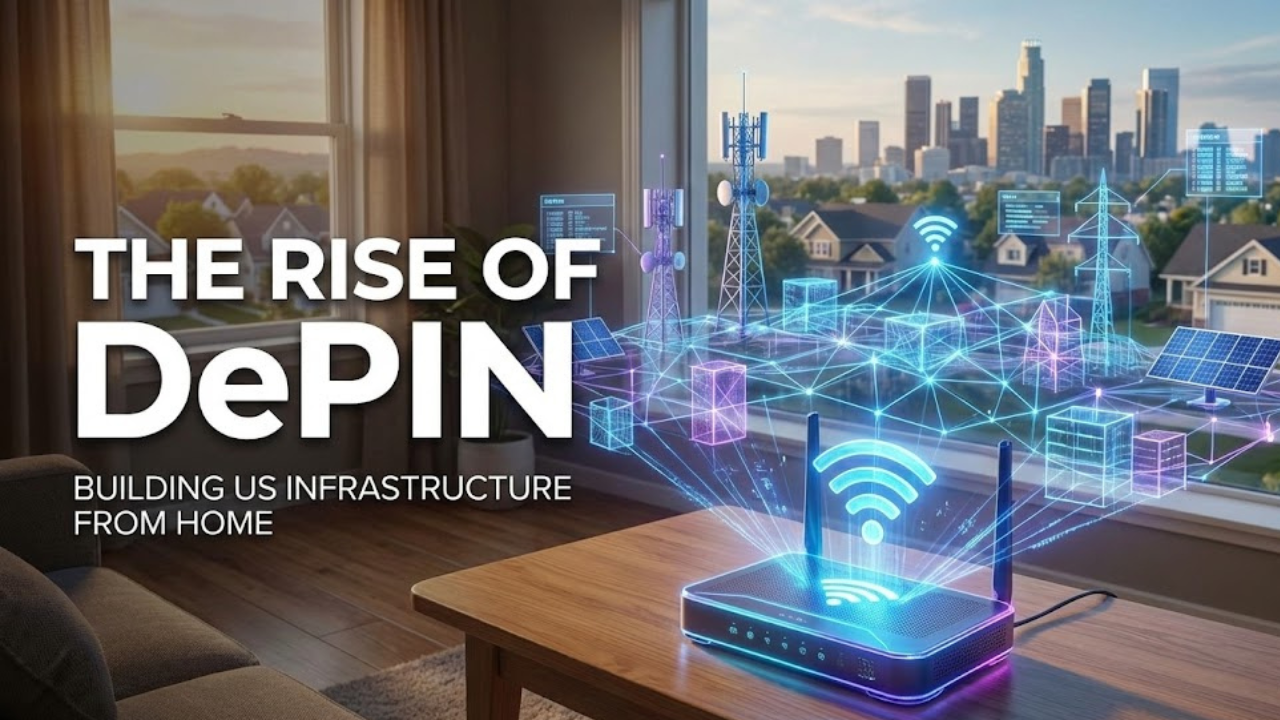
Discover The Rise of DePIN: How Your Home Wi-Fi is Rebuilding US Infrastructure. Learn how decentralized physical infrastructure networks are allowing everyday Americans to bypass monopolies, earn passive income, and power the future of 5G, energy, and AI from their own living rooms.
Table of Contents
For the last fifty years, the story of American infrastructure has been a story of centralized monopolies. If you wanted internet access, you likely had two choices—if you were lucky. If you needed electricity, you had one utility provider. Building out the critical networks that power our nation, from telecom towers to energy grids, was a high-stakes game reserved for government agencies and trillion-dollar corporations. The result? High prices, slow innovation, and a digital divide leaving millions behind.
But in 2026, a quiet revolution is taking place in garages, living rooms, and on rooftops across the United States. The old model of reliance on slow-moving giants is being upended by a powerful new economic concept: Decentralized Physical Infrastructure Networks.
We are witnessing The Rise of DePIN, and it is perhaps the most significant shift in the crypto space since the invention of Bitcoin. This isn’t about speculating on memecoins; this is a tangible, real-world movement where everyday citizens are using blockchain incentives to build, own, and operate the networks of the future—and getting paid to do it. Your home Wi-Fi router is no longer just a monthly expense; it is a potential revenue generator and a foundational brick in a new, community-owned digital America.
What is DePIN and Why is it Happening Now?
To understand The Rise of DePIN, you have to understand the flaw in the traditional model. Building physical infrastructure is incredibly capital-intensive. Telecom companies spend billions buying spectrum rights and erecting cell towers. They pass those costs onto you, and they only build where it is most profitable, often ignoring rural areas or underserved urban neighborhoods.
DePIN flips this model on its head. At its core, DePIN utilizes blockchain technology and crypto tokens to incentivize individuals to deploy hardware meant to provide a real-world service.
US Infrastructure : Instead of one company spending $10 billion to build a network, a DePIN protocol coordinates millions of individuals to spend $300 each on a small device—like a specialized Wi-Fi hotspot or a sensor. The protocol rewards these “citizen builders” with tokens for providing verified coverage or data.
So, why is The Rise of DePIN occurring in 2026, and not five years ago? We have reached a technological tipping point. Hardware costs for things like 5G radios and IoT sensors have plummeted. High-speed home broadband is nearly ubiquitous, providing the necessary backhaul. Most importantly, blockchain protocols (like Solana and various Layer 2s) are finally fast and cheap enough to handle millions of micro-transactions and verify physical “proof-of-work” in real-time. The infrastructure for the infrastructure is finally ready.
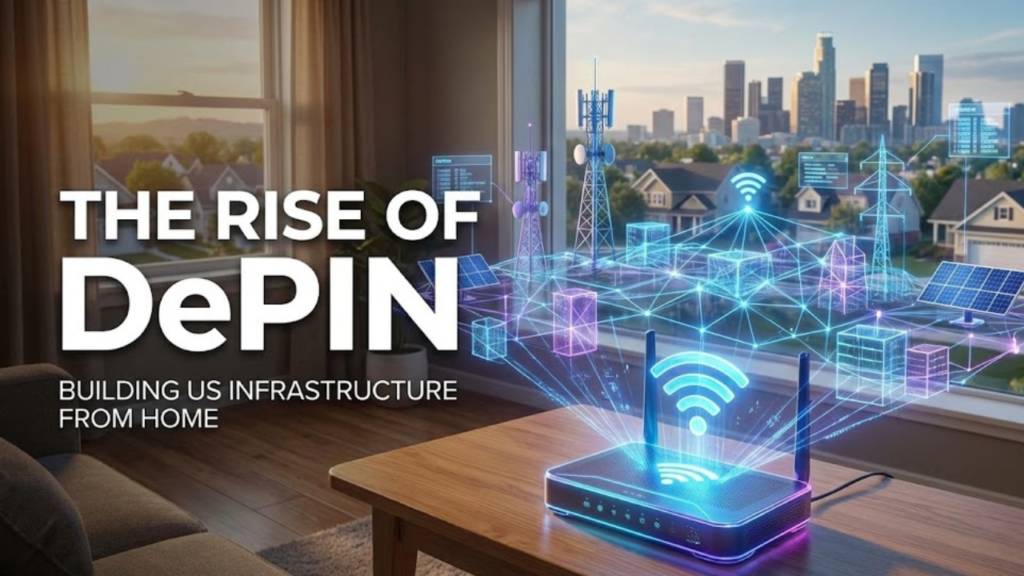
The Gateway: Turning Your Home Wi-Fi into a 5G Tower
The Rise of DePIN The most visible example of The Rise of DePIN: How Your Home Wi-Fi is Rebuilding US Infrastructure is happening right now in the connectivity space.
We all remember the early experiments with LoRaWAN IoT networks in the early 2020s. Those were the proof of concept. In 2026, DePIN has matured into full-blown, carrier-grade 5G cellular networks. The demand for mobile data is astronomical, driven by augmented reality applications and ubiquitous AI assistants. Traditional carriers cannot build cell towers fast enough to keep up with this density demand.
This is where you come in. By purchasing a specialized DePIN 5G small cell and placing it in your window, you are leveraging the internet connection you already pay for to create a coverage bubble for your neighborhood. When subscribers to that decentralized network walk by your house and their phone connects to your signal, your device earns tokens.
US Infrastructure : You are no longer just a passive consumer of data; you are an active network operator. This democratization of the telecom industry is a cornerstone of The Rise of DePIN. It allows the average American household to secure a piece of the passive income pie that was once reserved exclusively for shareholders of AT&T or Verizon. For many, this “infrastructure mining” covers their monthly internet bill entirely, turning a liability into an asset.
Beyond Connectivity: The Expanding DePIN Universe
While home Wi-Fi and 5G are the easiest entry points, The Rise of DePIN is a multi-trillion-dollar trend that is rapidly expanding into other critical sectors of the US economy. The model works anywhere centralized services are inefficient or overpriced.
The Decentralized Energy Grid
Perhaps the most critical frontier for DePIN is energy. The US power grid is aging, fragile, and struggling to cope with the twin demands of EV charging and extreme weather events. DePIN projects are creating “Virtual Power Plants” by connecting residential solar panels, home batteries (like Powerwalls), and smart thermostats.
Homeowners are rewarded with tokens for allowing the network to automatically draw on their stored battery power during peak usage times, preventing brownouts. This decentralizes energy resilience, making the entire national grid more robust against attacks or failures.
Mapping and Mobility
The Rise of DePIN is also changing how we navigate. Instead of relying on tech giants to send fleets of camera cars around the globe once a year, decentralized mapping protocols incentivize everyday drivers to install specialized dashcams. As you drive to work, you are collecting fresh, street-level imagery and map data. This data is crucial for autonomous vehicle training and smart city planning, and the value flows back to the drivers, not just a Silicon Valley boardroom.
The Compute-for-Hire Boom
The AI explosion of the mid-2020s created an insatiable, desperate demand for GPU computing power. DePIN networks stepped in to fill the void left by supply-constrained centralized cloud providers. Individuals with powerful gaming PCs or underutilized servers can now rent out their idle GPU power to AI researchers for training models or rendering graphics. It’s an “Airbnb for compute,” and it’s a vital part of the AI infrastructure stack in 2026.
Rebuilding America, One Node at a Time
The implications of The Rise of DePIN: How Your Home Wi-Fi is Rebuilding US Infrastructure go beyond individual passive income. This is a matter of national competitiveness and resilience.
A network built by millions of citizens is inherently harder to attack or censor than a network controlled by a single kill-switch. Furthermore, DePIN keeps economic value local. Instead of sending your monthly internet payments to a faceless conglomerate headquartered three states away, the value generated by a DePIN network circulates among the people in your community who are providing the coverage.
Of course, this transition is not seamless. We are still navigating complex regulatory frameworks here in the US, managing hardware supply chains, and dealing with the inevitable volatility of the token economies that power these networks.
But the trajectory is clear. The efficiency gains of crowdsourcing infrastructure are too massive to ignore. The Rise of DePIN is not a temporary crypto narrative; it is a fundamental re-architecture of how we build and maintain the physical systems that power our lives. In 2026, national infrastructure isn’t something that just happens to you; it’s something you help build from your own home. The only question left is how quickly you will plug in.
Messari: State of DePIN 2024 Report Messari is the gold standard for crypto research. Linking to their “State of DePIN” report (or their DePIN sector page) instantly signals to your readers that this isn’t just a hype cycle—it’s a measurable, institutional trend. This is perfect for the “investor” segment of your audience who wants to see the data backing the narrative.
Helium Mobile: Building the People-Powered Network Since your blog specifically highlights “Home Wi-Fi” and “5G,” linking directly to Helium (the largest active example of this technology) allows readers to see exactly what the hardware looks like and how the coverage map is growing in real-time. It transforms the abstract concept into a tangible product they can buy.
understanding the DA : click here